High School Object A is moving relative to O , what does it mean?

  • Thread starter Thread starter diazdaiz
  • Start date Start date
  • Tags Tags
    Mean Relative
Click For Summary
The discussion clarifies the concept of relative motion in special relativity, specifically how to determine the velocity of one object relative to another. It emphasizes that the relative speed of object A to observer O is defined by the change in A's position over time as measured in O's coordinate system, which can be quantified as 0.5c in this case. The velocity addition formula is mentioned, but the focus is on understanding that relative motion is invariant across inertial frames. It is crucial to differentiate between relative velocity and closing or separation velocity when using different frames of reference. Overall, the key takeaway is that relative motion is about how positions change over time in a specific observer's coordinate system.
diazdaiz
Messages
10
Reaction score
2
since i am new at learning special relativity, i still miss the concept about how thing move in special relativity. In high school, i am doing several problem about velocity addition, and that word always appear. for example:
A is moving with velocity vAO relative to O, and B is moving with velocity vBO relative to O, what is A velocity relative to B?
and then i am using formula
VAB=(VAO+VOB)/(1+VAO.VOB/c2)
and then you get the answer
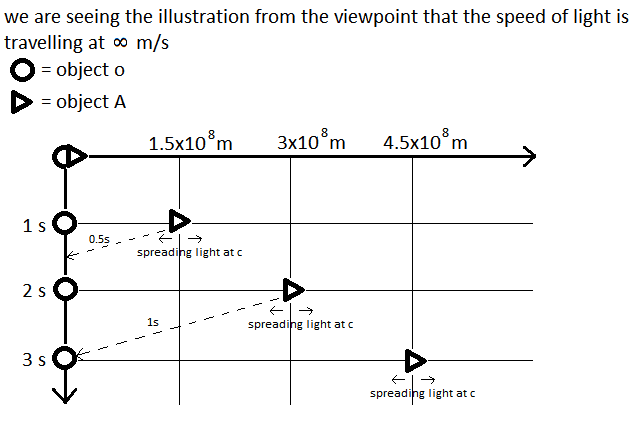
but i can't really understand it. So i try to draw it
(in this image, i just draw object O and A (without B), so i can understand what VAO really mean)
(let say that A is traveling 0.5c from our viewpoint)
dunno.png

so, VAO will be 1/3 c because O see A only travel 1.5x10⁸m after 1.5 second (or 3x10⁸m after 3 second), is this what we say A is moving relative to O?
 
Physics news on Phys.org
diazdaiz said:
is this what we say A is moving relative to O?
No, A moving relative to O means that the position of A as measured by O (in O's coordinate system) changes over time. The relative speed ##V_{OA}## is the change in A's position ##\Delta x## over the interval of time ##\Delta t## (as measured in O's coordinates), and in your diagram it's just 0.5c. Nothing to do with what O sees (i.e. light from A reaching O).
 
  • Like
Likes diazdaiz
Vitro said:
No, A moving relative to O means that the position of A as measured by O (in O's coordinate system) changes over time. The relative speed ##V_{OA}## is the change in A's position ##\Delta x## over the interval of time ##\Delta t## (as measured in O's coordinates), and in your diagram it's just 0.5c. Nothing to do with what O sees (i.e. light from A reaching O).
thank you very much, that's the keyword, its measured from O's coordinate
 
diazdaiz said:
thank you very much, that's the keyword, its measured from O's coordinate
The fact that A and O are moving relative to each other is invariant, you could use any inertial frame to make that determination. But if you want to measure their relative velocity then you need to use either A's or O's coordinates. Using a different frame of reference will give you what's called a closing or separation velocity which is not the same thing as their relative velocity.
 
In an inertial frame of reference (IFR), there are two fixed points, A and B, which share an entangled state $$ \frac{1}{\sqrt{2}}(|0>_A|1>_B+|1>_A|0>_B) $$ At point A, a measurement is made. The state then collapses to $$ |a>_A|b>_B, \{a,b\}=\{0,1\} $$ We assume that A has the state ##|a>_A## and B has ##|b>_B## simultaneously, i.e., when their synchronized clocks both read time T However, in other inertial frames, due to the relativity of simultaneity, the moment when B has ##|b>_B##...

Similar threads

  • · Replies 34 ·
2
Replies
34
Views
2K
  • · Replies 22 ·
Replies
22
Views
2K
Replies
6
Views
1K
  • · Replies 8 ·
Replies
8
Views
1K
Replies
16
Views
2K
  • · Replies 33 ·
2
Replies
33
Views
1K
  • · Replies 14 ·
Replies
14
Views
1K
  • · Replies 4 ·
Replies
4
Views
2K
  • · Replies 25 ·
Replies
25
Views
859
  • · Replies 29 ·
Replies
29
Views
3K