Oblique collision of two bodies undergoing projectile motion

Click For Summary
SUMMARY

The discussion centers on the oblique collision of two identical smooth balls projected at a 30-degree angle from points O and A, 100 meters apart. The coefficient of restitution is given as 0.7, and the goal is to determine the speed of projection for each ball. Key equations utilized include the projectile motion equation and momentum conservation principles, specifically along the tangential component during the collision. The final conclusion confirms that the vertical component of velocity remains unchanged during the collision due to the impulse approximation.

PREREQUISITES
  • Understanding of projectile motion equations
  • Familiarity with the concept of coefficient of restitution
  • Knowledge of momentum conservation principles
  • Basic grasp of impulse approximation in collisions
NEXT STEPS
  • Study the derivation of the projectile motion equation in detail
  • Explore advanced applications of the coefficient of restitution in collision problems
  • Learn about impulse approximation and its implications in physics
  • Investigate the effects of different angles of projection on collision outcomes
USEFUL FOR

Students and professionals in physics, particularly those focusing on mechanics, collision analysis, and projectile motion. This discussion is beneficial for anyone looking to deepen their understanding of collision dynamics and momentum conservation.

Sujith Sizon
Gold Member
Messages
7
Reaction score
0
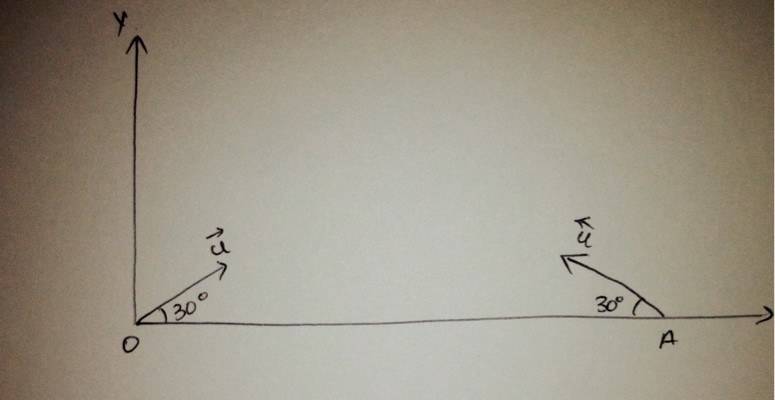
Q) two identical smooth balls are projected from points O and A on the horizontal ground with the same speed of projection the angle of projection in each case is 30 The distance between O and A is 100m . The balls collide in mid air And return to their respective points of projection if coefficient of restitution is 0.7 find the speed of projection of either ball (m/s) correct to nearest integer ?

Question figure
CyYWJ.jpg


My Attempt :

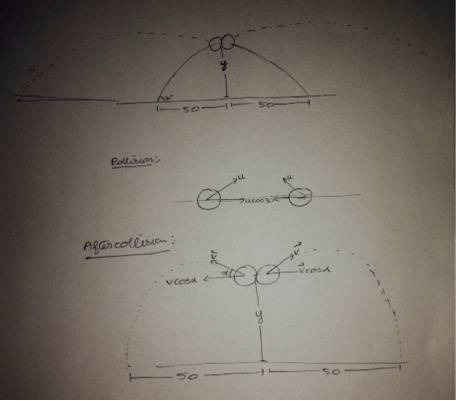
Taking ##y## as the height from the ground to the point where the masses collide and ##\alpha## as the angle made by the final velocity vector with the horizontal .

Using projectile equation ie : ##y=x\tan\theta\left[1-\frac{x}{R}\right]##

For the case when it is projected and reaches a height ##y##

##y=\frac{50}{\sqrt{3}}\left[1-\frac{50\times 20}{\sqrt{3}u^{2}}\right]##

For its return path considering a projectile motion from height ##y## with velocity vector making an angle ##\alpha## with the horizontal we get

##y=50\tan\alpha\left[1-\frac{50\times g}{v^{2}\sin2\alpha}\right]##

The from coefficient of restitution formula we get

##e\rightarrow0.7=\frac{2v\cos\alpha}{2u\cos30}##
SSySB.jpg


Now assuming that my procedure so far is appropriate i need one more equation so that i can find ##u## and ##v##

SOLVED (thanks to TSny)

Conserving momentum along tangential component we will have
##2mu\sin30 = 2mv\sin\alpha##
 
Last edited:
Physics news on Phys.org
Welcome to PF!

What happens to the vertical component of velocity of each smooth ball during the collision?
 
  • Like
Likes   Reactions: Sujith Sizon
TSny said:
Welcome to PF!

What happens to the vertical component of velocity of each smooth ball during the collision?
It changes but we can't conserve momentum along vertical because of gravitational force acting, right ?
 
You can forget about the effect of gravity during the very small time interval of the collision. The only important forces during the collision are the large contact forces between the two balls. (This is sometimes called the "impulse approximation" for collisions.)
 
  • Like
Likes   Reactions: Sujith Sizon
TSny said:
You can forget about the effect of gravity during the very small time interval of the collision. The only important forces during the collision are the large contact forces between the two balls. (This is sometimes called the "impulse approximation" for collisions.)
Which Impulse force ? the velocity changes only due to collision right ?
 
Yes. To a good approximation, the only force that causes a change in velocity of one of the balls during the collision is the impulsive contact force from the other ball.
 
  • Like
Likes   Reactions: Sujith Sizon
TSny said:
Yes. To a good approximation, the only force that causes a change in velocity of one of the balls during the collision is the impulsive contact force from the other ball.
Okay so this impulse contact force will be along horizontal right (along the surface of contact) , then we will have to find its value( of Impulse contact force) also , how will we find that ?

Im guessing J= Change in momentum along horizontal,
##J=mu\cos30 - mv\cos\alpha##
 
Last edited:
Yes, for smooth surfaces the contact force will be horizontal (perpendicular to the surfaces of the balls at the point of contact). You do not need to determine the contact force; the coefficient of restitution gives you everything you need to know about the effect of the contact force on the horizontal components of velocity of the balls. You have already taken care of this in your equations. But, you have not yet used important information that you can deduce about the vertical components of velocity.
 
  • Like
Likes   Reactions: Sujith Sizon
TSny said:
Yes, for smooth surfaces the contact force will be horizontal (perpendicular to the surfaces of the balls at the point of contact). You do not need to determine the contact force; the coefficient of restitution gives you everything you need to know about the effect of the contact force on the horizontal components of velocity of the balls. You have already taken care of this in your equations. But, you have not yet used important information that you can deduce about the vertical components of velocity.
So you are asking me to conserve momentum along vertical as
##2mu\sin30 = 2mv\sin\alpha##
But then it will mean that there is no change in its vertical component of velocity , but there should be right , only the would it be able to reach back to its initial position right ?
 
  • #10
Sujith Sizon said:
So you are asking me to conserve momentum along vertical as
##2mu\sin30 = 2mv\sin\alpha##
But then it will mean that there is no change in its vertical component of velocity , but there should be right , only the would it be able to reach back to its initial position
Is my third figure apt ?
 
  • #11
Sujith Sizon said:
So you are asking me to conserve momentum along vertical as
##2mu\sin30 = 2mv\sin\alpha##
But then it will mean that there is no change in its vertical component of velocity , ...
Yes, that's right. Without a vertical component of force, the balls do not change their vertical component of velocity during the collision.
...but there should be right , only the would it be able to reach back to its initial position right ?
I'm not sure why you believe this.
 
  • Like
Likes   Reactions: Sujith Sizon
  • #12
Your third figure looks good to me. :smile:
 
  • Like
Likes   Reactions: Sujith Sizon
  • #13
TSny said:
Yes, that's right. Without a vertical component of force, the balls do not change their vertical component of velocity during the collision.

oh okay because coefficient of restitution which is amount of change in speed only along impact axis so along tangential component it ought not to change and because of impulse approximations we are neglecting gravitational force , well then i will have my equation , thanks for your time .
 
  • #14
OK, sounds good.
 
  • Like
Likes   Reactions: Sujith Sizon

Similar threads

  • · Replies 6 ·
Replies
6
Views
2K
  • · Replies 21 ·
Replies
21
Views
1K
  • · Replies 11 ·
Replies
11
Views
2K
  • · Replies 14 ·
Replies
14
Views
2K
Replies
1
Views
1K
Replies
3
Views
1K
  • · Replies 1 ·
Replies
1
Views
2K
  • · Replies 53 ·
2
Replies
53
Views
5K
Replies
34
Views
2K
Replies
15
Views
3K