Ocean in the Sky: Exploring a Hypothetical Scenario

Click For Summary
SUMMARY

The forum discussion centers on a hypothetical scenario where Earth's oceans are suspended in the sky, exploring the implications of pressure dynamics in this unusual setting. Participants agree that the pressure at the "bottom" of this suspended ocean would be significantly lower than that at the seabed, particularly in deep trenches like the Mariana's Trench. The discussion highlights that if an observer were to enter this "sky ocean," they would not experience the same crushing pressure as they would at the ocean's depths, due to the altered gravitational and atmospheric conditions. The consensus is that while the pressure would be high, it would not equate to the extreme pressures found at the ocean floor.

PREREQUISITES
  • Understanding of hydrostatic pressure principles
  • Basic knowledge of atmospheric pressure dynamics
  • Familiarity with gravitational effects on fluid behavior
  • Concept of equilibrium in fluid systems
NEXT STEPS
  • Research hydrostatic pressure calculations in varying depths
  • Explore the effects of atmospheric pressure on fluid dynamics
  • Investigate gravitational influences on suspended fluids
  • Study equilibrium states in hypothetical fluid systems
USEFUL FOR

Science fiction writers, physicists, and anyone interested in theoretical physics and fluid dynamics will benefit from this discussion, particularly those exploring unconventional scenarios in storytelling or academic research.

Bruno Carbone
Messages
2
Reaction score
0
Hi all!

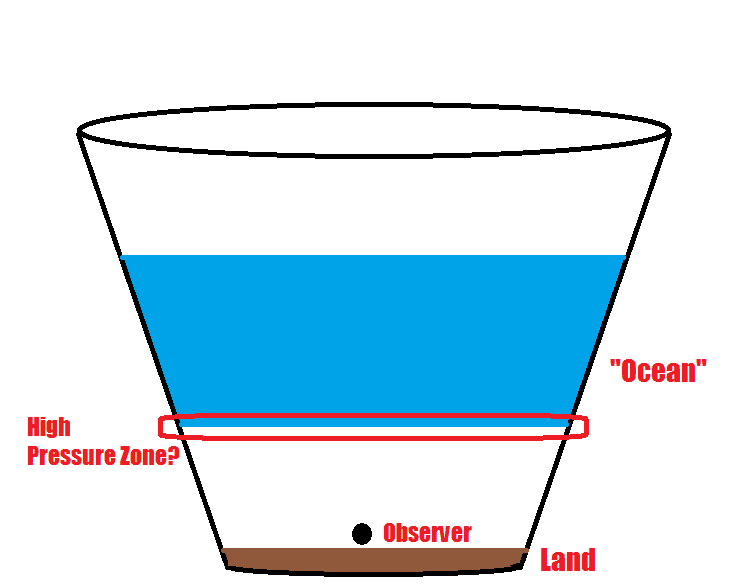
In the absurd hypothesis that we could take all water from Earth's oceans and distribute it equally through the sky ceiling (as shown below). We have the point of view of an observer in the land.
95G6eLi.png


Questions:

1. We know that the water pressure rises as we come closer to Earth's core, so the "flying ocean" would have less pressure at its "bottom", right?

2. If the previous is true, would the pressure difference be considerably lower than actual seabed one?

3. If observer in land would be launched in the air, entering the "sky ocean" from the "bottom", would he be crushed by the seabed pressure as if it were submerging into the Mariana's Trech, for example?

I know this is fairly nonsense but it's a scenario for a fiction.
And I really need answers!

:)

Thanks people!
 
Physics news on Phys.org
Bruno Carbone said:
would have less pressure at its "bottom"

Define "bottom". Is it up (far from the observer) or down (close to the observer)?
 
Bruno Carbone said:
1. We know that the water pressure rises as we come closer to Earth's core, so the "flying ocean" would have less pressure at its "bottom", right?
Less than what?

If you magically exchange the current oceans with a layer of air as indicated in the sketch, the system is far away from an equilibrium: the air below will start at its old pressure, but suddenly all the water above pushes down on it - the water would fall down and compress the air below it. Shortly before the water reaches the surface, air pressure will be so high it gives some resistance to further compression - but then you still have something like 3km of water that fell down some significant distance and still moves downwards. It will completely crush everything on the surface. Shortly afterwards all the land is covered by 3km of water with some highly compressed air bubbles (the pressure at the surface is the same as it is now 3km below the ocean surface) moving upwards. The water will then start to rush back into the oceans, the flow rates should be sufficient to level down everything the flood reaches.
 
Bruno Carbone said:
1. We know that the water pressure rises as we come closer to Earth's core, so the "flying ocean" would have less pressure at its "bottom", right?

2. If the previous is true, would the pressure difference be considerably lower than actual seabed one?

3. If observer in land would be launched in the air, entering the "sky ocean" from the "bottom", would he be crushed by the seabed pressure as if it were submerging into the Mariana's Trech, for example?

1. Compared to where the ocean bottom used to be? Maybe. It depends on the depth of the seafloor you're comparing the new one too. Very deep trenches in the current seafloor will have much higher pressures than the bottom of this floating ocean simply because the current ocean is much deeper at those locations than your new floating ocean would be.

2. Again, it depends on the depth of the seafloor that you're comparing the floating ocean too.

3. Probably, though the pressure wouldn't be nearly as much as the mariana's trench.
 
Are you writing a science fiction story?
 
mfb said:
Less than what?

If you magically exchange the current oceans with a layer of air as indicated in the sketch, the system is far away from an equilibrium: the air below will start at its old pressure, but suddenly all the water above pushes down on it - the water would fall down and compress the air below it. Shortly before the water reaches the surface, air pressure will be so high it gives some resistance to further compression - but then you still have something like 3km of water that fell down some significant distance and still moves downwards. It will completely crush everything on the surface. Shortly afterwards all the land is covered by 3km of water with some highly compressed air bubbles (the pressure at the surface is the same as it is now 3km below the ocean surface) moving upwards. The water will then start to rush back into the oceans, the flow rates should be sufficient to level down everything the flood reaches.

Hi MFB,

Wow, they said this forum was good. :)
Thanks for the prompt reply.

Yes, that's the case. And the outcome is what I've imagined. \o/
But my point is (and here I'll also answer jedishrfu: yes, it's a science fiction novel) that for some not important reason, the water will remain in the sky, causing the air pressure in the surface to increase. My doubt is that in this "suspended ocean" if it's bottom (that would be the highlighted red zone in the image as "High pressure zone", and from the observer point of view (as Borek said, down (close to the observer)) would have the same/equivalent pressure as the seabed since it moved away from the Earth's core.

The water would be distributed in the same depth on the sky ceiling, since we have enough space to allocate it and still have room for air down below.

Let's say someone tried to enter the "ocean" like a rocket coming from land and entering directly the ocean "bed", would it be crushed by water pressure as it was in a depth like, let's say, the Mariana's trench?

I hope I was clear this time... sorry if I confused you guys
:)
 
Last edited:
It is meaningless to ask "what would the laws of physics predict if the laws of physics do not apply".
 
  • Like
Likes   Reactions: jedishrfu
Bruno Carbone said:
My doubt is that in this "suspended ocean" if it's bottom (that would be the highlighted red zone in the image as "High pressure zone", and from the observer point of view (as Borek said, down (close to the observer)) would have the same/equivalent pressure as the seabed since it moved away from the Earth's core.

I believe I already answered this in post #4. The gravitational forces is practically the same, still well over 99% of what it is on the surface, so the pressure per depth wouldn't change much in that area. Along with that there would be a slight drop in pressure since the weight of the atmosphere is no longer pressing down on the ocean (since it is underneath).
 

Similar threads

  • · Replies 7 ·
Replies
7
Views
2K
Replies
22
Views
4K
  • · Replies 21 ·
Replies
21
Views
5K
  • · Replies 9 ·
Replies
9
Views
3K
  • · Replies 3 ·
Replies
3
Views
2K
  • · Replies 6 ·
Replies
6
Views
4K
Replies
3
Views
2K
  • · Replies 23 ·
Replies
23
Views
6K
  • · Replies 12 ·
Replies
12
Views
2K
  • · Replies 2 ·
Replies
2
Views
2K