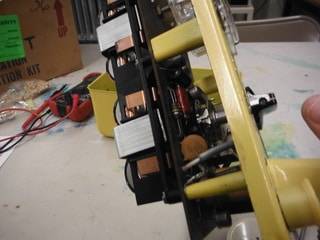
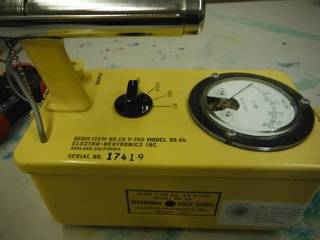
Old Geiger Counter needing repair....

Click For Summary

Discussion Overview

The discussion revolves around troubleshooting and repairing an old Geiger counter that has malfunctioned after being left powered on for several days. Participants share their observations, suggestions for testing components, and potential causes for the issues observed, focusing on electronic components and circuit behavior.

Discussion Character

  • Technical explanation
  • Exploratory
  • Debate/contested

Main Points Raised

  • One participant notes that the Geiger counter produces a steady tone and maximum readings on all scales after being left on, suggesting a malfunction.
  • Another participant suggests visually inspecting electronic parts for burned circuits and questions whether the meter works properly.
  • A participant proposes that the issue could be due to dielectric breakdown of capacitors, particularly electrolytic types, which may have dried out.
  • Concerns are raised about the circuit design, specifically the use of zener diodes for voltage regulation, which could lead to instability in high voltage output.
  • Participants discuss the possibility of a solder bridge causing a short circuit and the presence of a dark spot on the PCB that may indicate scorching.
  • One participant mentions the need for caution when measuring high voltages and suggests using a multimeter capable of high voltage readings.
  • Another participant outlines a series of troubleshooting steps, including measuring voltages across specific components to diagnose the issue.
  • After replacing a faulty capacitor, one participant reports a significant improvement in the Geiger counter's functionality, although they note the need for further calibration.

Areas of Agreement / Disagreement

Participants generally agree on the need to inspect and test various components, particularly capacitors, but there are multiple competing views on the exact cause of the malfunction and the best approach to repair it. The discussion remains unresolved in terms of a definitive diagnosis for the initial problem.

Contextual Notes

Some participants express uncertainty about the effects of prolonged high voltage exposure on capacitors and the implications for circuit behavior. There are also limitations in the ability to diagnose issues without further testing and measurements.

Who May Find This Useful

This discussion may be useful for electronics enthusiasts, educators, and hobbyists interested in troubleshooting vintage electronic devices, particularly Geiger counters and similar equipment.

mishima
Messages
576
Reaction score
43
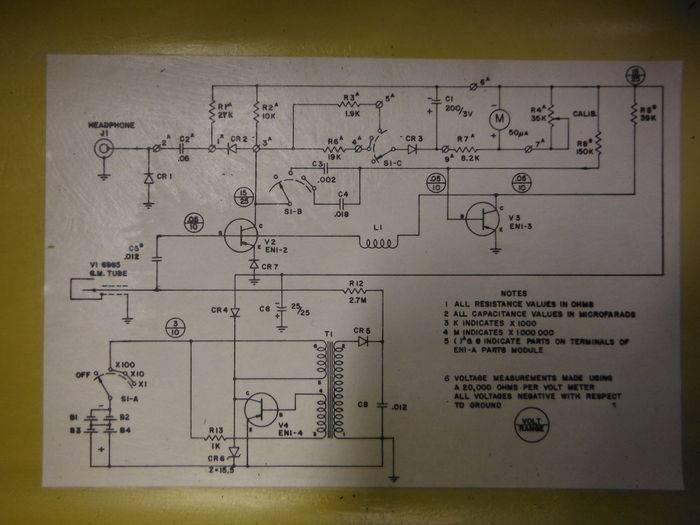
My class was recently donated an old but perfectly functioning Geiger counter. It was the type that came with a mono-speaker which made audible clicks when decay events were detected. It was left on in the cabinets for multiple days, and now there is a steady tone coming through the speaker and the reading on the meter is maximum on all 3 scales. I am wondering if there is any part I could check/test/replace to get this working again, I have little electronics knowledge in general. Schematic and other pictures below.

DSCF2932.jpg

DSCF2933.jpg

DSCF2934.jpg
 
Engineering news on Phys.org
Visually inspect the electronic parts for burned circuits.

Does the meter work properly?
 
The meter is at max when powered on, for all 3 scales. It is min when powered off.
 
Components do not visually look damaged, could it be the capacitors went through dielectric breakdown?
DSCF2938.jpg

DSCF2939.jpg
 

Attachments

  • DSCF2938.jpg
    DSCF2938.jpg
    49 KB · Views: 531
The two big black caps in the middle look like some kind of electrolytic type. They would be my first guess. The electrolyte dries out and the capacitance drops precipitously. C6 failing would also likely cause the symptoms you are describing.

Also in the top right corner the PCB trace is a different color. What is the situation there?

BoB
 
I got this quote from http://www.uraniumrocks.com/pages/cdv-700-model-information

The main problems with the circuit are transistor failure (likely due to inductive spikes) and the method they used to regulate the high voltage. Rather than using a voltage regulator tube like other models, they chose to use a couple of zener diodes to limit the voltage on the primary side of the transformer. Unfortunately, this means that a small change in the zener diode's voltage leads to a much larger change on the high voltage output.

Note: The recommended operating voltage for the 6993 tube is 890 vdc, so it could bite you.

image compliments of http://www.anythingradioactive.com/geigeraccess.htm

http://www.anythingradioactive.com/newprodpix/bitsanbobs/6993%20specs.jpg
 
Last edited by a moderator:
There seems to be a solder bridge connecting the emitter of V2 to something on V3. Perhaps it's shorting around L1?

But I'm probably mistaken if worked earlier.

There's a dark spot on the sub assembly. It's likely leftover flux, but it could be scorching. I can't tell from the photo.

Can you post a scope trace across the meter and the headphones?
 
dlgoff thanks for those great links. After browsing around a bit more it seems the cdv-700 models are fairly popular these days with modders and hobbyists.

rbelli I will have to check that top right corner tomorrow...could leaving the device on for days with hundreds of volts across the capacitors have dried them out?

Jeff I could rig up a soundcard scope but am a little concerned about voltages. I found https://www.orau.org/ptp/Library/cdv/eni700-6b.pdf this manual which gives a pulse voltage across the mic as 11 V. I would need to get that down to <0.7 for it to work with my computer, with a voltage divider. I think I could manage that.

But, I can't tell from the schematic what a working voltage across the meter would be, and with the nearby 930 V with possible failed components...I would feel more comfortable with a multimeter that could do a high voltage reading...perhaps mine can (I will check).
 
mishima said:
dlgoff thanks for those great links. After browsing around a bit more it seems the cdv-700 models are fairly popular these days with modders and hobbyists.

rbelli I will have to check that top right corner tomorrow...could leaving the device on for days with hundreds of volts across the capacitors have dried them out?

Jeff I could rig up a soundcard scope but am a little concerned about voltages. I found https://www.orau.org/ptp/Library/cdv/eni700-6b.pdf this manual which gives a pulse voltage across the mic as 11 V. I would need to get that down to <0.7 for it to work with my computer, with a voltage divider. I think I could manage that.

But, I can't tell from the schematic what a working voltage across the meter would be, and with the nearby 930 V with possible failed components...I would feel more comfortable with a multimeter that could do a high voltage reading...perhaps mine can (I will check).
It's not worth risking test equipment. Some technicians keep an isolation transformer near their scope, but I guess those days are fading as USB scopes become more popular.

This device is battery powered. Leaving it on for days would cause dead batteries. However, capacitors do age. You can check for short circuited caps easily enough. If they are open, it's a bit tougher.

With the batteries out, measure the resistance across the capacitors. Do it in both directions since some of them are in || with diodes/transistors. If they read near zero in both directions, then they are shorted. They are more likely to dry open, but that's harder to check. You can remove them and check them with a capacitance meter if you have one.
 
  • #10
My guess, as an old analog troubleshooter, is:
If it's not weak batteries,
you are hearing the power supply's oscillator.
It could be coming into the audio stage through either the high voltage circuit or the low voltage circuit. I think latter is most likely.

1. Check Low Voltage first... With device runing, place your DMM across C6 and write down what you get . You ought to read about 15.5VDC ..
2. Then switch meter to read AC volts, write down what you get. You ought to read less than 10% of the DC value.
If you read more AC than that , tack a capacitor of at least same value as C6 across C6 and repeat readings.
That will tell you whether C6 is open. And if your meter is "True RMS" it may report the DC content of voltage check the manual.

3. If steps 1 and 2 go okay,
check for noise on the the high voltage by temporarily connecting base and emitter of V2 together.
If that quiets things down, the noise is probably coming in through R12-C5 path. CR5 may be shorted or C8 may be open.

I think it's a long shot, but check R5 and R8. You can measure them in circuit with board de-powered. Read both directions...if you read more than the value of the resistor in one direction it's open. Other direction you'll read less because of parallel paths through the transistors.

Please post results of those three steps - there's lots of enthusiastic help here.

I like a Simpson 260 for troubleshooting...
simpson_260-5_01a.jpg


To check for AC in the power supply, step 2, move meter red lead from "+" jack to "Output" jack above polarity switch. That connects a capacitor in series to block DC, specifically for that type measurement. Very handy. It's only a 400 volt capacitor so don't try that on your HV supply.
 
Last edited:
  • #11
Measured C6 at 2.2 VDC, 13 VAC. Cut it out and replaced with 22 uF 25 V polar electrolytic, now getting 15.2 VDC and 0.03 VAC.

The meter is no longer a max constantly, but a min. Think I will go ahead and replace the other electrolytic, C1.

Edit: Forgot to mention, after cutting out the original C6 it was reading 0.22 nF on cap meter.
 
  • Like
Likes   Reactions: davenn
  • #12
Replaced C1 and I am detecting events again. Nearest I had on hand was a 330 uF for it (originally 200). Had to crank the calibration pot to the max but readings are falling within the acceptable range for the built-in check sample (roughly 1.5 mrem/hr). Will test some other samples in the stock room tomorrow.

Big thanks to all the help here. This website makes my classroom more awesome on a regular basis.
 
  • Like
Likes   Reactions: dlgoff, Jeff Rosenbury and davenn
  • #13
good success story :smile:

thanks for reporting back

Dave
 
  • Like
Likes   Reactions: dlgoff

Similar threads

  • · Replies 99 ·
4
Replies
99
Views
7K
  • · Replies 20 ·
Replies
20
Views
7K
  • · Replies 2 ·
Replies
2
Views
4K
  • · Replies 19 ·
Replies
19
Views
9K
  • · Replies 7 ·
Replies
7
Views
4K
  • · Replies 9 ·
Replies
9
Views
4K