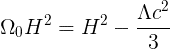
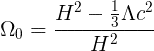
Omega being less than one in a flat Universe?

Click For Summary
SUMMARY

The discussion centers on the relationship between the density parameter Ω0 and the curvature of a flat Universe, specifically addressing whether Ω0 must be less than one. The Friedmann equation is utilized to derive that for a flat Universe (k = 0), the total density parameter Ωtotal, which includes contributions from both matter (Ωm) and dark energy (Ωde), must equal one. However, the calculations indicate that Ωm is approximately 0.27 and Ωde is about 0.73, leading to the conclusion that Ω0 is indeed equal to one when both components are considered. The misunderstanding arises from neglecting the contribution of dark energy in the initial calculations.

PREREQUISITES
  • Understanding of the Friedmann equation in cosmology
  • Familiarity with the concepts of critical density and density parameters
  • Knowledge of dark energy and its role in the Universe
  • Basic mathematical skills to manipulate equations
NEXT STEPS
  • Study the Friedmann equations in detail, focusing on their implications for cosmological models
  • Learn about the role of dark energy and the cosmological constant in the Universe
  • Explore the concept of curvature density parameters and their significance in cosmology
  • Investigate observational methods for measuring Ωm and Ωde in the Universe
USEFUL FOR

Astronomy students, cosmologists, and anyone interested in understanding the dynamics of the Universe and the implications of density parameters on its curvature.

TheTraceur
Messages
2
Reaction score
0
Hi everyone! I'm not very good at math as I'm in high school, and so probably did something wrong in this, but I did some calculations and am now wondering if a flat Universe requires Ω0 ≠ 1?

I started with the Friedmann equation,
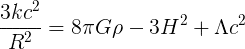
gif.gif


If you divide by 3 and take the inverse of both sides, you get,
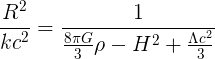
gif.gif


Since,

gif.gif


Where ρc is the critical density, we can re-write the equation in terms of Omega (I also multiplied both sides by c2),

gif.gif


Here it to me looks a bit odd, because here Omega being one does not correspond to a Universe with infinite radius of curvature, since you still have to cosmological constant, which is positive. Here it seems that if you want to assume that k = 0, and so have a flat Universe, you will need to have (since if R2/k, where k = 0, is 'infinite', then the other side must also be 'infinite'):


gif.gif


gif.gif


gif.gif


gif.gif


We then get:

gif.gif


And since the cosmological constant has been discovered to be positive, this would seem to mean that for a flat Universe (k = 0), Ω0 is not exactly equal to one, but in fact a tiny bit smaller. I'm pretty sure this is false, but I don't know where I've missed the fault in the derivation. May it be that the cosmological constant is assumed to be zero in the definition of critical density? Because if you don't assume a zero value for the cosmological constant in the definition of critical density, the cosmological constant dissapears in the denominator, and so Omega being one corresponds to a flat Universe.
 
Last edited:
Space news on Phys.org
Welcome to PF, TheTraceur!

TheTraceur said:
Hi everyone! I'm not very good at math as I'm in high school, and so probably did something wrong in this, but I did some calculations and am now wondering if a flat Universe requires Ω0 ≠ 1?

I started with the Friedmann equation,

gif.gif


If you divide by 3 and take the inverse of both sides, you get,

gif.gif


Since,

gif.gif


Where ρc is the critical density, we can re-write the equation in terms of Omega (I also multiplied both sides by c2),

gif.gif


Here it to me looks a bit odd, because here Omega being one does not correspond to a Universe with infinite radius of curvature, since you still have to cosmological constant, which is positive. Here it seems that if you want to assume that k = 0, and so have a flat Universe, you will need to have (since if R2/k, where k = 0, is 'infinite', then the other side must also be 'infinite'):
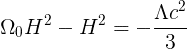
The thing you're missing here is that the ρ in your equation is the density of matter, ρm. So when you compute Ω0 = ρmcr, you're only computing Ωm, the density parameter for matter. This is less than 1: in the standard concordance model, we have Ωm = 0.27 and Ωde = 0.73, where Ωde (also called ##\Omega_\Lambda##) is the density parameter for dark energy. As you know, observations show that the total matter density is far less than the critical density, and it is the dark energy that makes up the difference, bringing the universe very close to, if not exactly, critical (flat).

So, how can your equation be reworked to include Ωde? Well, for the simplest type of dark energy, which is just represented by a cosmological constant term in the Friedmann equations, it turns out that the dark energy density ρde is constant with time, and is related to the cosmological constant by: ##\Lambda = 8\pi G \rho_{\textrm{de}}##

Substituting this into your equation above, we get (note, I'll just take c = 1 for convenience):$$H^2 = \frac{8\pi G}{3}\rho_m + \frac{8\pi G}{3}\rho_{\textrm{de}} - \frac{k}{R^2}$$Divide both sides of the equation by H2:$$1 = \frac{8 \pi G}{3H^2}\rho_m + \frac{8 \pi G}{3H^2}\rho_{\textrm{de}} - \frac{k}{R^2 H^2}$$Now, the important thing to understand in this equation is that a lot of these things are functions of time, i.e. their values change with cosmic time, t (the time since the Big Bang, according to observers who are co-moving with the expansion). The Hubble parameter, H(t) is a function of time. So is the matter density ρm(t). So is the scale factor R(t). I am assuming that you are using R to denote the scale factor. I usually use 'a', but that's okay. So, let's evaluate this equation NOW i.e. at t = t0, where t0 is the present age of the universe (some 13.7 billion years). It turns out that the present value of the Hubble parameter, H(t0), is just equal to the Hubble constant, H0. The present value of the scale factor, R(t0) = 1. I'll call the present value of the matter density ρm,0. So at t = t0 the equation becomes:$$1 = \frac{8 \pi G}{3H_0^2}\rho_{m,0} + \frac{8 \pi G}{3H_0^2}\rho_{\textrm{de}} - \frac{k}{H_0^2}$$ By now, you probably recognize that the factors in front of the ρ's are just equal to the reciprocal of the critical density: ##\rho_{\textrm{cr}} = 3H_0^2 / (8\pi G)##. So the equation becomes:$$1 =\frac{\rho_{m,0}}{\rho_{\textrm{cr}}} + \frac{\rho_{\textrm{de}}}{\rho_{\textrm{cr}}} - \frac{k}{H_0^2}$$By the definition of the Ω's, this is just equal to:$$1 = \Omega_m + \Omega_{\textrm{de}} - \frac{k}{H_0^2}$$OR$$\frac{k}{H_0^2} = (\Omega_m + \Omega_{\textrm{de}}) - 1 $$$$\frac{k}{H_0^2} = \Omega_{\textrm{total}} - 1$$So if Ωtotal (including contributions from both matter and dark energy) differs from 1, then the curvature k is non-zero. Some people even go so far as to define a "curvature" density parameter Ωk = -k/H02, so that 1 = Ωm + Ωde + Ωk.
 
Last edited:

Similar threads

  • · Replies 24 ·
Replies
24
Views
4K
  • · Replies 20 ·
Replies
20
Views
2K
  • · Replies 1 ·
Replies
1
Views
2K
  • · Replies 7 ·
Replies
7
Views
3K
  • · Replies 17 ·
Replies
17
Views
2K
  • · Replies 25 ·
Replies
25
Views
3K
  • · Replies 20 ·
Replies
20
Views
2K
  • · Replies 13 ·
Replies
13
Views
3K
  • · Replies 6 ·
Replies
6
Views
2K
  • · Replies 26 ·
Replies
26
Views
4K