Is Something Missing in the Expansion of Our Flat Universe?

Click For Summary

Discussion Overview

The discussion revolves around the implications of the Friedmann equations in the context of a flat universe and the critical density. Participants explore the mathematical relationships and physical interpretations of curvature (k) and density (ρ) in cosmological models, questioning whether certain assumptions lead to inconsistencies or undefined behaviors in the expansion of the universe.

Discussion Character

  • Technical explanation
  • Debate/contested
  • Mathematical reasoning

Main Points Raised

  • Some participants assert that for a flat universe with k=0 and critical density (ρ=ρc), certain derivatives become undefined, leading to questions about the model's consistency.
  • Others argue that k is not exactly 0 but very close, suggesting that the set of universes with k=0 is a null set, which may not be relevant to the original question posed.
  • There is a contention regarding the interpretation of the Friedmann equations and whether the simplifications made imply that k=±1 is not possible when ρ=ρc.
  • Some participants challenge the assertion that the probability of k being exactly 0 is zero, proposing that probability distributions can allow for non-zero probabilities at specific points.
  • Several replies emphasize the need for precise references and mathematical backing for claims made about the relationship between density and curvature.
  • There is a discussion about whether the scale factor can be defined under certain conditions, particularly when ρ=ρc, and how this relates to the curvature of the universe.

Areas of Agreement / Disagreement

Participants express differing views on the implications of k=0 and the relationship between curvature and density. There is no consensus on whether the original claims about undefined behaviors in the expansion of the universe are valid or how they should be interpreted.

Contextual Notes

Some limitations in the discussion include the dependence on definitions of curvature and density, as well as unresolved mathematical interpretations of the Friedmann equations. The discussion reflects ongoing debates in cosmology without reaching definitive conclusions.

Apashanka
Messages
427
Reaction score
15
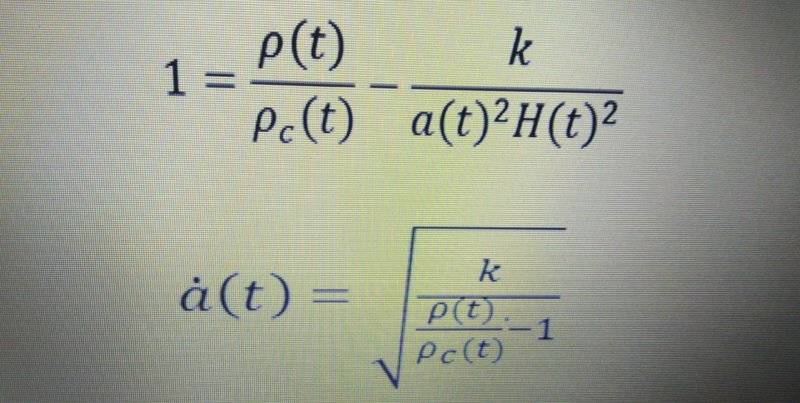
From friedmann equation
IMG_20190217_211811.jpg

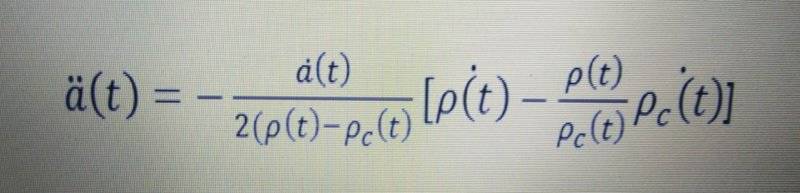
And
IMG_20190217_211847.jpg
For a flat universe with k=0 and ρ=ρc ,da/dt becomes undefined and d2a/dt2 becomes 0
But for the present time we know that our universe is flat and expanding with a acceleration (q -ve) ,
Therefore is it here something I am missing??
 

Attachments

  • IMG_20190217_211811.jpg
    IMG_20190217_211811.jpg
    46.5 KB · Views: 878
  • IMG_20190217_211847.jpg
    IMG_20190217_211847.jpg
    21.1 KB · Views: 807
Space news on Phys.org
Hi,

Precisely ## k ## refers to the spatial curvature of our Universe. Actually ## k \neq 0 ## but It is really close to ##0##.
$$
\begin{cases}
k > 0 \quad \text{closed "spherical" universe} \\
k = 0 \quad \text{flat universe} \\
k < 0 \quad \text{open "hyperbolic" universe}
\end{cases}
$$
The set of Universe with ## k = 0## is a ##\textbf{null set}##, then the probability of having such Universes is equal to zero. It is not experimentally meaningful to find ##k## precisely ##0##, there is always an error bar.

Usually in Friedman equation you can neglect the spatial curvature, but it does not mean that it is precisely ##0##
 
Apashanka said:
From friedmann equation

Where are you getting this from?
 
addaF said:
The set of Universe with k=0 k = 0 is a null set\textbf{null set}, then the probability of having such Universes is equal to zero.

This is true as a matter of actual measurements (we can never measure ##k## to be exactly 0), but irrelevant to the question the OP is asking, because he is claiming that a theoretical model with ##k = 0## is somehow inconsistent. That can be shown to be wrong without considering the measurement aspect at all.
 
addaF said:
is a null setnull set\textbf{null set}, then the probability of having such Universes is equal to zero
This is not necessarily true. It is only true if you assume that the probability distribution for k is everywhere finite. It is perfectly fine in probability theory to have probability distributions where the cdf is not continuous, ie, with particular points having a non-zero probability. The set k=0 is null in the standard measure on the real numbers, but that in itself means very little.
 
Orodruin said:
This is not necessarily true. It is only true if you assume that the probability distribution for k is everywhere finite. It is perfectly fine in probability theory to have probability distributions where the cdf is not continuous, ie, with particular points having a non-zero probability. The set k=0 is null in the standard measure on the real numbers, but that in itself means very little.
Sorry I am not in a position to text right now ,I am reposting my question
Screenshot_20190218-013029~2.png
 

Attachments

  • Screenshot_20190218-013029~2.png
    Screenshot_20190218-013029~2.png
    16.7 KB · Views: 628
Apashanka said:
I am reposting my question

My response is still the same: where are you getting this from?
 
PeterDonis said:
My response is still the same: where are you getting this from?
From the first Einstein field equation for FRW metric
3H2+3k/a2=8πGρ,little simplification gives the result posted in #6
Where ρc is 3H2/8πG(critical density)
(From R00-1/2Rg00)=8πGT00
 
Apashanka said:
From the first Einstein field equation for FRW metric
3H2+3k/a2=8πGρ,little simplification gives the result posted in #6

Have you considered the possibility that what your "little simplification" implies is not that ##\dot{a} = \infty## for ##\rho = \rho_c## and ##k = \pm 1##, but that ##k = \pm 1## is not possible if ##\rho = \rho_c##?
 
  • #10
PeterDonis said:
Have you considered the possibility that what your "little simplification" implies is not that ##\dot{a} = \infty## for ##\rho = \rho_c## and ##k = \pm 1##, but that ##k = \pm 1## is not possible if ##\rho = \rho_c##?
So why is the word 'HALT EXPANSION AFTER INFINITE TIME ' is associated with critical density ??
Is it something related to this
IMG_20190218_101508.jpg

The first one for expansion with acceleration and the second one with linear expansion .
Implies after the time at which ρ=ρc , a is not defined ,is it so??
(It is only for k=+-1,k=0 will allow expansion forever)
 

Attachments

  • IMG_20190218_101508.jpg
    IMG_20190218_101508.jpg
    15.8 KB · Views: 586
Last edited:
  • #11
Apashanka said:
So why is the word 'HALT EXPANSION AFTER INFINITE TIME ' is associated with critical density ??

Please give a specific reference where you are getting all this from. We can't comment on vague statements with no source.

Apashanka said:
Implies after the time at which ρ=ρc , a is not defined ,is it so??

I've already given you a strong hint in post #9. You need to go back and re-check the math. It doesn't mean what you think it means.
 
  • #13
Apashanka said:

This gives no math other than the definition of ##\rho_c##. Can you show me a source that says "just halt its expansion but only after an infinite time" and gives the math that supports that? "Source" means "textbook or peer-reviewed paper"; you need to be looking at those to get a proper understanding of this issue.

(Hint: if you find such a source, you will find that the math it gives only allows ##k = 0## if ##\rho = \rho_c##.)
 
  • #14
PeterDonis said:
This gives no math other than the definition of ##\rho_c##. Can you show me a source that says "just halt its expansion but only after an infinite time" and gives the math that supports that? "Source" means "textbook or peer-reviewed paper"; you need to be looking at those to get a proper understanding of this issue.

(Hint: if you find such a source, you will find that the math it gives only allows ##k = 0## if ##\rho = \rho_c##.)
Is it that for k=+-1 ,at the time of ρ=ρc ,a(t) at that time can't be defined ,that's why it is not allowed ??
But for k=0 ,it will allow expansion or contraction (linear or accelerated) forever...
 
  • #15
As you have been told repeatedly, you cannot have ##\rho = \rho_c## without having ##k= 0## or vice versa. The curvature is directly dependent on the energy content relative to the expansion rate.

There is no such thing as ”the time of ##\rho = \rho_c##”. It is either satisfied at all times or it is never satisfied.
 
  • #16
Orodruin said:
There is no such thing as ”the time of ρ=ρcρ=ρc\rho = \rho_c”. It is either satisfied at all times or it is never satisfied.
Ok if ρ=ρc is satisfied for all times , then for k=+-1 , the scale factor can't be defined...and no question of expansion or contraction or static.
Is it??
 
  • #17
Apashanka said:
Ok if ρ=ρc is satisfied for all times , then for k=+-1 , the scale factor can't be defined...and no question of expansion or contraction or static.
Is it??
Really? You are not reading. Reread the statement. You cannot have ##k = \pm 1## when ##\rho = \rho_c## because then ##k = 0## by definition.
 
  • #18
The OP question has been answered. Thread closed.
 

Similar threads

  • · Replies 54 ·
2
Replies
54
Views
6K
  • · Replies 1 ·
Replies
1
Views
3K
  • · Replies 7 ·
Replies
7
Views
3K
  • · Replies 20 ·
Replies
20
Views
2K
Replies
18
Views
2K
  • · Replies 18 ·
Replies
18
Views
3K
  • · Replies 1 ·
Replies
1
Views
2K
  • · Replies 13 ·
Replies
13
Views
3K
  • · Replies 3 ·
Replies
3
Views
2K
  • · Replies 9 ·
Replies
9
Views
3K