Undergrad What does adjacent indices mean in the context of matrix multiplication?

Click For Summary
In the context of matrix multiplication, "adjacent indices" refers to the indices involved in the summation process, where the summation index is eliminated from the final result. The term 'elimination' indicates that the summation index does not appear in the outcome, as illustrated by examples from summation equations. The use of the word 'adjacent' may be unnecessary and is not exclusive to matrices, as this principle applies to all summations. The discussion suggests that the term might relate to the summation convention, which is a broader mathematical concept. Understanding this concept is crucial for grasping matrix multiplication and related mathematical operations.
Oppie
Messages
7
Reaction score
1
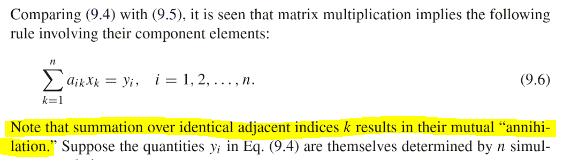
Hello, I was refreshing my Mathematics using S.M. Blinder's book "Guide to Essential Math" and on the section on Matrix Multiplication I got the following,
upload_2016-10-16_15-5-22.png


Can someone elaborate on the highlighted section? In particular, what does "adjacent indices" mean?

Thank you.
 
Physics news on Phys.org
'Elimination' just means that the result of the summation does not contain the index over which summation occurs. We see that from the fact that the RHS of the equation, which is just ##y_i##, has no ##k## in it.

The word 'adjacent' is unnecessary in the sentence. Nor is the observation relevant only to matrices. For any summation, the summation index is annihilated in the result. Consider for instance:
$$\sum_{k=0}^nx^k=\frac{1-x^{n+1}}{1-x}$$
There is no ##k## on the right-hand side.
 
  • Like
Likes Oppie
andrewkirk said:
'Elimination' just means that the result of the summation does not contain the index over which summation occurs. We see that from the fact that the RHS of the equation, which is just ##y_i##, has no ##k## in it.

The word 'adjacent' is unnecessary in the sentence. Nor is the observation relevant only to matrices. For any summation, the summation index is annihilated in the result. Consider for instance:
$$\sum_{k=0}^nx^k=\frac{1-x^{n+1}}{1-x}$$
There is no ##k## on the right-hand side.

Thank you. Maybe he mentions the word "adjacent" in consideration to the summation convention.
 
I am studying the mathematical formalism behind non-commutative geometry approach to quantum gravity. I was reading about Hopf algebras and their Drinfeld twist with a specific example of the Moyal-Weyl twist defined as F=exp(-iλ/2θ^(μν)∂_μ⊗∂_ν) where λ is a constant parametar and θ antisymmetric constant tensor. {∂_μ} is the basis of the tangent vector space over the underlying spacetime Now, from my understanding the enveloping algebra which appears in the definition of the Hopf algebra...

Similar threads

  • · Replies 1 ·
Replies
1
Views
2K
  • · Replies 19 ·
Replies
19
Views
4K
Replies
2
Views
2K
  • · Replies 8 ·
Replies
8
Views
2K
  • · Replies 13 ·
Replies
13
Views
5K
  • · Replies 2 ·
Replies
2
Views
2K
  • · Replies 2 ·
Replies
2
Views
2K
  • · Replies 12 ·
Replies
12
Views
3K
  • · Replies 5 ·
Replies
5
Views
3K
  • · Replies 7 ·
Replies
7
Views
5K