HansH
- 270
- 23
- TL;DR
- it seems to be generally accepted that lightspeed can only be measures as round trip speed, so not possible to measure lightspeed in 1 direction. So if that is true theoretically it could be possible that lightspeed is different in different directions. I think im can measure lightspeed in 1 direction however. So what goes wrong here?
Idea to measure 1 way lightspeed is to use 2 synchronized clocks and take into account the time dilation caused by moving the clock to the measuring position.
Suppose the speed of light in 1 direction is c1 and in the opposite direction it is c2.
I take 2 clocks that generate pulses. Both clocks are synchronized putting them beside eachother.
Next step is to move 1 clock to a position 1km away with a speed of 10m/s.
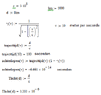
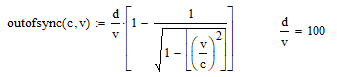
Based on that we kow the moving clock runs slower during the transport based on SRT can be easily calculated using the time dilation equation, see attachment. so based on 10meter per second time runs slower in the moving clock. so we can calculate the build up time difference between the 2 clocks as function of the actual speed of light in 1 direction.
Suppose one example where we have c in both directions. then for the 1 km distance where the clock moved with 10m/s we have a build up time difference between the 2 clocks of 6.661e=-14 s, while a light beam takes 3.33us to travel the 1km distance.
So based on that we can measure the 1 way lightspeed as 1000meters/(3.33us+6.661e-14s) assuming light travel at c. is light travels with a different speed in 1direction we measure the time and calculate back the 1 way speed of light using the time dilation formula plus the calculated time.
so if one states that measuring the speed of light in 1 direction is not possible, then what is wrong with my calculation?
Suppose the speed of light in 1 direction is c1 and in the opposite direction it is c2.
I take 2 clocks that generate pulses. Both clocks are synchronized putting them beside eachother.
Next step is to move 1 clock to a position 1km away with a speed of 10m/s.
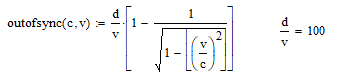
Based on that we kow the moving clock runs slower during the transport based on SRT can be easily calculated using the time dilation equation, see attachment. so based on 10meter per second time runs slower in the moving clock. so we can calculate the build up time difference between the 2 clocks as function of the actual speed of light in 1 direction.
Suppose one example where we have c in both directions. then for the 1 km distance where the clock moved with 10m/s we have a build up time difference between the 2 clocks of 6.661e=-14 s, while a light beam takes 3.33us to travel the 1km distance.
So based on that we can measure the 1 way lightspeed as 1000meters/(3.33us+6.661e-14s) assuming light travel at c. is light travels with a different speed in 1direction we measure the time and calculate back the 1 way speed of light using the time dilation formula plus the calculated time.
so if one states that measuring the speed of light in 1 direction is not possible, then what is wrong with my calculation?