Op amp circuit giving 0=0 at the end

10 replies · 3K views · last reply
Vishera
Messages
72
Reaction score
1

Homework Statement


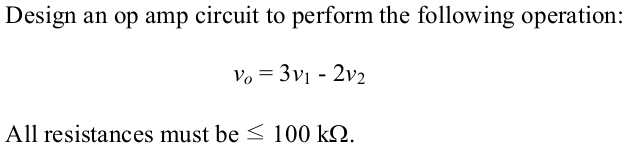
Printed problem statement: Design an op amp circuit to perform the operation v_o = 3v_1 - 2v_2, with all resistances less than or equal to 100 kΩ.


Homework Equations


The Attempt at a Solution


Here is my attempt: http://i.imgur.com/oKjwI8O.png

The problem is at the end, I get 0=0. What did I do wrong?
 
Vishera said:

Homework Statement


Text problem: Design an op amp circuit to perform the operation vo = 3v1 - 2v2, with all resistances at most 100 kΩ.


Homework Equations


The Attempt at a Solution


Here is my attempt: http://i.imgur.com/oKjwI8O.png

The problem is at the end, I get 0=0. What did I do wrong?

Can you post a drawing of your opamp circuit, with the resistor names labeled? Thanks. :smile:
 
berkeman said:
Can you post a drawing of your opamp circuit, with the resistor names labeled? Thanks. :smile:

Sure, here is the drawing of the general circuit that I am aiming to design:
Circuit schematic of a difference amplifier: an op amp with R1 and R2 feedback, R3 and R4 on the non-inverting input, voltage sources v1 and v2, output vo, Figure 5.24.


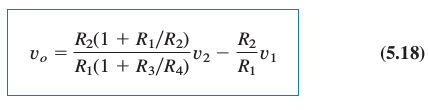
For that general circuit, the following equation applies:
Equation (5.18): v_o = [R2(1 + R1/R2)] / [R1(1 + R3/R4)] v2 - (R2/R1) v1, boxed in a rectangle.


Here is an example in the textbook:

Textbook page showing Example 5.7: design an op amp circuit with inputs v1 and v2 so that vo = -5v1 + 3v2, with solution vo = 3v2 - 5v1 and design 1 giving R2/R1 = 5, so R2 = 5R1.

Handwritten-style textbook math: 5(1 + R1/R2)/(1 + R3/R4) = 3 implies 6/5 over (1 + R3/R4) = 3/5, and 2 = 1 + R3/R4 implies R3 = R4 (equation 5.7.3). Choosing R1 = 10 kΩ, R3 = 20 kΩ gives R2 = 50 kΩ and R4 = 20 kΩ.
 
rude man said:
You sure it isn't Vo = 3V2 - 2V1?

I agree with rude man.

In all cases an input to the negative side of an single op-amp circuit will be inverted, while an input to the positive side will not be inverted.
 
rude man said:
You sure it isn't Vo = 3V2 - 2V1?

Is there any specific reason why you can't the following equation to:
Equation (5.18): vo = [R2(1 + R1/R2)] / [R1(1 + R3/R4)] × v2 − (R2/R1) × v1, displayed in a box with equation number on the right.


to:

vo=3v1-2v2?

I understand that I get 0=0 but why do I get 0=0? Algebraically speaking, why would it matter if it were vo = 3v2 - 2v1 or vo=3v1-2v2?
 
It might be helpful to write:

##3 v_1 - 2 v_2 = v_1 + 2(v_1 - v_2)##

Then a really simple circuit solution might come to mind.
 
Vishera said:
Is there any specific reason why you can't the following equation to:

Equation (5.18): vo = [R2(1 + R1/R2)] / [R1(1 + R3/R4)] × v2 − (R2/R1) × v1


to:

vo=3v1-2v2?

I understand that I get 0=0 but why do I get 0=0? Algebraically speaking, why would it matter if it were vo = 3v2 - 2v1 or vo=3v1-2v2?

combing your two equations the way you initially had them -R2/R1 would have to equal three.

that would imply that you have a negative resistance, which is impossible
 
I would solve this problem through an iterative method.

1. determine the relationship between R2 and R1 based on the V1 coefficient (hint R2/R1 = ?)
2. choose resistor values such that the relationship is true
4. determine R3 and R4 values based on the V2 coefficient and R1 and R2.
5. If needed go back to step 1
 
donpacino said:
combing your two equations the way you initially had them -R2/R1 would have to equal three.

that would imply that you have a negative resistance, which is impossible

I understand that negative resistance is impossible in the real world, but shouldn't I at least get an answer with negative resistances in the math? I didn't even get an answer in the algebra which is confusing me.
 
you got unlucky with the numbers. for that particular (wrong) arrangement of equations there is no solution. why don't you try it again with the correct number orientation. If you don't believe you got unlucky, change coefficients in the equation to some random combination and see what happens.

I do want to point out that the best way to solve these problems is an iterative process.
I recommend following the process I gave you above.