remettub
- 11
- 1
Hi all,
I'm designing a small 3-pronged clamping mechanism, and I'm having trouble figuring out the best way to keep the pressure even between the upper contact surfaces (pads). Here's a picture of my attempt from this afternoon:
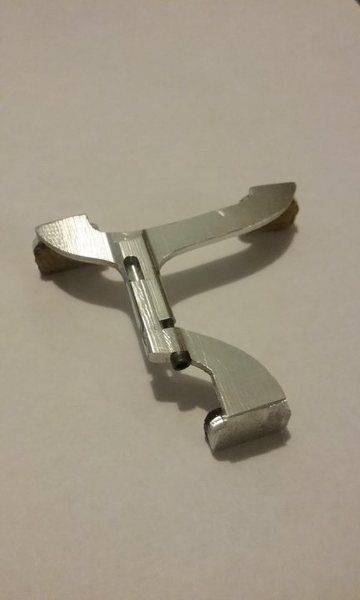
It's difficult to tell from the image, but the lower pad is directly under the halfway point between the top pads. I naively assumed that this would give me equal pressure under the top pads, even though the tightening screw is on the left, but of course in actuality the left pad applies considerably more pressure than the right (other design requirements make it impossible to put the tightening screw straight up through the center).
Since it took a good part of the day to design and make this guy, I'd like to have a clear understanding of how to predict the pressure distribution before I make the next version. I'm thinking it's either that there is a small amount of wiggle in the joint, or that the "C" path to the right pad is more flexible than the "\" path to the left.
If kept everything the same but shifted the lower pad to the right, would that balance the pressure more towards the top right? Is there a way to calculate how much to shift it? Or is it all about the relative flexibility on each side (I could give the left side an "S" shape to make it equally flexible). Or do I just need to tilt the bottom pad to compensate for the wiggle in the joint. Obviously my understanding is very limited at this point. Any enlightenment would be greatly appreciated!
Thanks,
-remettub
I'm designing a small 3-pronged clamping mechanism, and I'm having trouble figuring out the best way to keep the pressure even between the upper contact surfaces (pads). Here's a picture of my attempt from this afternoon:
It's difficult to tell from the image, but the lower pad is directly under the halfway point between the top pads. I naively assumed that this would give me equal pressure under the top pads, even though the tightening screw is on the left, but of course in actuality the left pad applies considerably more pressure than the right (other design requirements make it impossible to put the tightening screw straight up through the center).
Since it took a good part of the day to design and make this guy, I'd like to have a clear understanding of how to predict the pressure distribution before I make the next version. I'm thinking it's either that there is a small amount of wiggle in the joint, or that the "C" path to the right pad is more flexible than the "\" path to the left.
If kept everything the same but shifted the lower pad to the right, would that balance the pressure more towards the top right? Is there a way to calculate how much to shift it? Or is it all about the relative flexibility on each side (I could give the left side an "S" shape to make it equally flexible). Or do I just need to tilt the bottom pad to compensate for the wiggle in the joint. Obviously my understanding is very limited at this point. Any enlightenment would be greatly appreciated!
Thanks,
-remettub
