Imagin_e
- 58
- 0
Hi!
This is a textbook problem that I need help with (I want to practice as much as I can before the exams) and I hope that there is someone who can guide me. The question is:
You’re doing a first-order analysis on a new satellite in an elliptical (e = 0.2) orbit at 700 km altitude. Can you design the orbit so no maneuvers are necessary to maintain it? Hint: consider secular J2 perturbations only – can the effects of Ω counteract with ω? If it can’t be done at 700 km, is another altitude feasible?
See below
I used the following equations (for J2 perturbations) :
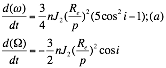
And for p and n:

I inserted n and p into the first two equations and got:

I assumed that they were all constant, so I ended up with:
 →
→

And this gave me of i1 = 90° and i2=63°. If we have these inclinations then there is no need for maneuvering. And now for the next question:
The next question to answer is can the effects of Ω counteract with ω? If it can’t be done at 700 km, is another altitude feasible? I have no idea how to answer this question.
As you can see I may be completely lost. I don't see my solution feasible since it doesn't actually answer the question about the no maneuvering bit. Anyone that can help me? Thanks!
This is a textbook problem that I need help with (I want to practice as much as I can before the exams) and I hope that there is someone who can guide me. The question is:
You’re doing a first-order analysis on a new satellite in an elliptical (e = 0.2) orbit at 700 km altitude. Can you design the orbit so no maneuvers are necessary to maintain it? Hint: consider secular J2 perturbations only – can the effects of Ω counteract with ω? If it can’t be done at 700 km, is another altitude feasible?
Homework Equations
See below
The Attempt at a Solution
I used the following equations (for J2 perturbations) :
And for p and n:
I inserted n and p into the first two equations and got:
I assumed that they were all constant, so I ended up with:
And this gave me of i1 = 90° and i2=63°. If we have these inclinations then there is no need for maneuvering. And now for the next question:
The next question to answer is can the effects of Ω counteract with ω? If it can’t be done at 700 km, is another altitude feasible? I have no idea how to answer this question.
As you can see I may be completely lost. I don't see my solution feasible since it doesn't actually answer the question about the no maneuvering bit. Anyone that can help me? Thanks!
Last edited by a moderator: