Undergrad Orientation of the Earth, Sun and Solar System in the Milky Way

Click For Summary
The discussion focuses on the motion of the solar system within the Milky Way and the relationships between celestial, ecliptic, and galactic coordinate systems. Diagrams illustrate the solar system's position, showing it approximately 50 light years above the galactic plane and detailing the angles between various celestial planes. Participants provide feedback on the diagrams, suggesting terminology corrections and clarifying the inclination of the Moon's orbit relative to the ecliptic. The conversation also addresses the solar system's clockwise motion around the Milky Way and the orientation of Earth's hemispheres in relation to this motion. Overall, the thread emphasizes the importance of accurate representation and understanding of astronomical coordinates and movements.
  • #91
Yes, we are on the same track :-) Thank you

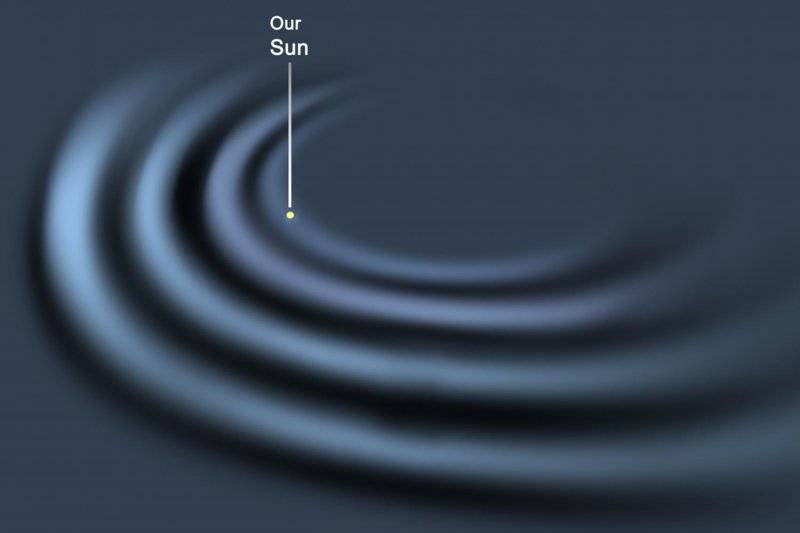
The blue lines are just to show that what I perceived after some hours with "depths-wavey-rods-related" attention. The blue bubbles are what I perceived that may form curved spiral arms/structures of some sort. I know I am in the same plane as the arms :-)

The idea is that... loooking at the Milky Way... after some time, my visual perception can sense the difference between the light of the stars and the diffuse light from the far away arms. I see the clouds, but I also.. feel the curvature. It is because of the experiences with DMT and also, http://www.consciousness-quotient.com/entheogenic-insights-some-methods-to-access-and-consciously-use-the-psychedelic-visions-without-exogenous-psychedelics/:-)

So, my experience is that I can perceive some curvature there, and my only working hypothesis is that... these bubbles-clouds of light seem to be curved following these ripples, as they are described below by some scientists. I cannot discern by analyzing light, but by feeling the curved energy-ripples.

This is how I do it - In order to activate this ultra-perception of depths, my energy enters in a hypersynchrony, and I get an amazing sensitivity. Our eyes are amazing, e.g. for some months I watched the sky only with one eye and trained my perception of "depths", to detect which objects are closer which are far, and in what order. So, maybe it is possible to do a some sort of triangulation even inside of one eye, by re-programming the perception. I heard about people who lose sight of one eye... the other eye compensate by naturally increase the sensitivity. But that's another discussion.

Maybe it looks impossible, but it is a matter of training and developing the sensitivity to light. And to be able to selectively use information only from some types of light receptors. Still, I need science to adjust my perception, it is not clear, because perhaps I use the rods-perception. So, the 3 dots I draw with blue is what I perceive. I thought they are arms, but after I discovered about the ripples and recently about density waves, I thought... this cannot be. I mean, whaaat? :-)
The arms are exactly in the position of the density waves, they say. And rods are very good at sensing densities, this is my current explanation of this perceptual vision.

So, the reason I am asking these things here is because I experience what you say it is impossible. :cool:
"There is no real way of separating material from one arm from another, just by eyeballing it, while sitting inside the galactic disc."
You know, maybe it is natural to the eye to do some sort of triangulation inside the retina. Maybe the distance is just some milimeters, but... the receptors can perceive a single photon, they say. I presume that in these high-energy-synchrony-experiences-DMT-like, my brain don't filter out these weak signals and they become conscious and I can play with them by ading them in a conscious way to the current perceptual vision. So, perhaps I use cones for close stars (and there is a very good perception of depths based on light differences), and for the "clouds" I use rods, and the "curvature" becomes available.

Thanks again
O.
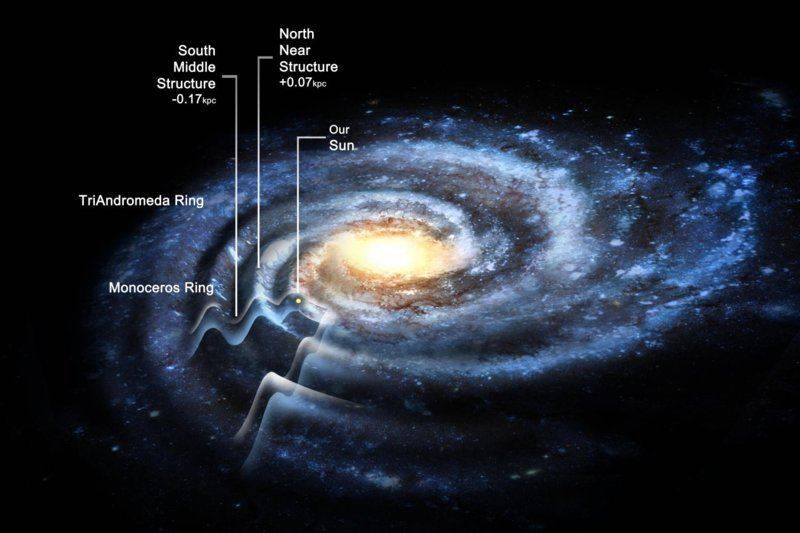
thecorrugate - ripples.jpg

thecorrugate - .jpg
 

Attachments

  • thecorrugate - .jpg
    thecorrugate - .jpg
    17.5 KB · Views: 1,070
  • thecorrugate - ripples.jpg
    thecorrugate - ripples.jpg
    46.6 KB · Views: 1,212
Last edited:
Astronomy news on Phys.org
  • #92
Bandersnatch, here is an exercise for depths-perception:

I cover one eye, and look at the full moon through the window There are 3 layers ar least. One is the moon, the other is the reflection of the moon in the windows, the third is the image on the retina. They are over-imposed, but I can detect that the reflection in the window is veeery close compared to the distance where the physical moon is. And the retina is closer.

Then, I select mainly the light from the physical moon and look at it and merge with it. And voila, I get a clear perception of the physical moon. The halo in the window is also there, but I don't care about it, I select only the light from the moon to configure my experience. It is a selective use of samyama (or full absorption, as described in Yoga Sutra).

The brain is smart at composing 3D images by using these depths-mechanisms, it is just a matter of consciously choosing what the "feed" is :-)

O.

 
  • #93
It's possible to measure light and apply computation to figure out what is there, without a need to invoke perception or consciousness.
 
  • #94
Love this thread! Does anyone know the Sun's orbit inclination relative to the galactic plane? If it "wobbles" then this will vary, but there must be an average inclination?
 
  • #95
Love this thread! Does anyone know the Sun's orbit inclination relative to the galactic plane? If it "wobbles" then this will vary, but there must be an average inclination?
If you look at the Milky Way, on a clear, dark night, you see it as a diagonal line from Northish to Southish and that’s the plane of the Galaxy. OTOH the Moon, Sun and planets follow a broad East West band. That’s the plane of the ecliptic and the Sun’s axis is near normal to that plane. So they are different.
 
  • #96
I had a problem with the above thread. It refused to treat the quote as a quote and then wouldn’t let me edit, either.
Weird.
 
  • #97
sophiecentaur said:
Love this thread! Does anyone know the Sun's orbit inclination relative to the galactic plane? If it "wobbles" then this will vary, but there must be an average inclination?
There isn't really an orbital plane that the Sun strictly follows. It bobs up and down across the galactic plane several times per galactic orbit like this.
ZS5jb20vaW1hZ2VzL2kvMDAwLzAwNy81ODIvb3JpZ2luYWwvc3VuLW1vdmVtZW50LW1pbGt5LXdheS0xMDEyMjItMDIuanBn.jpg

If you average this out, it follows the galactic plane.
The bobbing up and down is due to the same type of effect you would get if you drilled a hole from North to South pole and dropped an object into it. It would travel back and forth through the hole in a harmonic motion.

With the Sun, as it gets above the galactic plane, there is more disk matter "below" it, and it is pulled back towards the plane. It overshoots, and passes below the plane, and now more disk matter is above it, pulling it again back towards the plane, which it overshoots... rinse and repeat.
 

Attachments

  • ZS5jb20vaW1hZ2VzL2kvMDAwLzAwNy81ODIvb3JpZ2luYWwvc3VuLW1vdmVtZW50LW1pbGt5LXdheS0xMDEyMjItMDIuanBn.jpg
    ZS5jb20vaW1hZ2VzL2kvMDAwLzAwNy81ODIvb3JpZ2luYWwvc3VuLW1vdmVtZW50LW1pbGt5LXdheS0xMDEyMjItMDIuanBn.jpg
    33.6 KB · Views: 1,469
  • Like
Likes cbrtea2000, Borg and OmCheeto
  • #98
Janus said:
There isn't really an orbital plane that the Sun strictly follows. It bobs up and down across the galactic plane several times per galactic orbit like this.
View attachment 233686
If you average this out, it follows the galactic plane.
The bobbing up and down is due to the same type of effect you would get if you drilled a hole from North to South pole and dropped an object into it. It would travel back and forth through the hole in a harmonic motion.

With the Sun, as it gets above the galactic plane, there is more disk matter "below" it, and it is pulled back towards the plane. It overshoots, and passes below the plane, and now more disk matter is above it, pulling it again back towards the plane, which it overshoots... rinse and repeat.

Your description of the Sun's motion around the Milky Way is spot on, but the oft-used graphic (Medvedev 2007) used to illustrate it has a couple of errors. First, it shows the galaxy rotating clockwise (which is correct, with Galactic North as "up"), but the Sun is going in the wrong direction. It should be orbiting clockwise and not counterclockwise given the initial conditions of the diagram. The sinusoidal motion around the galaxy is also way out of scale. The Sun is about 26,000 light years from the center of the galaxy, and "bobs" above and below the galactic equator by a distance of about 250 light years in each direction. This means its northward and southward excursions above and below the galactic equator would only subtend and angle of about 0.55 degrees in each direction. It's hard to show these things to scale, but in my opinion, Medvedev got the direction of the sun's orbit backwards. Unfortunately, this diagram keeps being used, kind of like the erroneous "helical" model proposed by DJSadhu and now used and quoted by many. I've added a couple of diagrams of my own to try and make the Sun's orbit and motion easier to visualize.
Sun's Orbit around Milky Way (08Nov2018).jpg


Direction & Motion of Sun around Galaxy (08Nov2018).jpg


Motion of Sun around Milky Way Graph02 (08Nov2018).jpg
 

Attachments

  • Sun's Orbit around Milky Way (08Nov2018).jpg
    Sun's Orbit around Milky Way (08Nov2018).jpg
    37.9 KB · Views: 2,113
  • Motion of Sun around Milky Way Graph02 (08Nov2018).jpg
    Motion of Sun around Milky Way Graph02 (08Nov2018).jpg
    15.4 KB · Views: 1,060
  • Direction & Motion of Sun around Galaxy (08Nov2018).jpg
    Direction & Motion of Sun around Galaxy (08Nov2018).jpg
    81.6 KB · Views: 1,236
  • #99
I keep pointing out that the sun's motion around the Milky Way is not an "orbit" in the sense that we usually think of it. It is not even a closed curve. Orbits in a central potential like the solar system are closed curves, but orbits in a potential well like the Milky Way's are typically not. Even if the Milky Way's potential were static in time the orbit would not be a closed curve, and it is definitely not static in time. So it is best to think of the sun's motion as an approximate orbit, where each path around the Milky Way is a different curve.
 
  • #100
While the galaxy does have an overall angular momentum, which the solar system goes with,
This is not like a planet orbiting a star, whose motion is highly predictable.
The solar system is part of a local cluster of stars, and the clusters are components of yet larger clusters.
Those clusters constitute the macro scale structures of spiral arms and a central bulge.
The dynamics of this for an individual star is completely unpredictable,
even to the point that a star could get ejected from the galaxy in a case of very bad luck.
 
Last edited:
  • #101
phyzguy said:
I keep pointing out that the sun's motion around the Milky Way is not an "orbit" in the sense that we usually think of it. It is not even a closed curve. Orbits in a central potential like the solar system are closed curves, but orbits in a potential well like the Milky Way's are typically not. Even if the Milky Way's potential were static in time the orbit would not be a closed curve, and it is definitely not static in time. So it is best to think of the sun's motion as an approximate orbit, where each path around the Milky Way is a different curve.

No argument there - I agree that the sun won’t return to the same place in another 230 million years or so for the reasons you have noted. “Approximate orbit” is a more accurate term than just “orbit.” In a sense though, the Earth doesn’t return to the same spot either after one trip around the sun since it is moving through both space and time.

I have amended my diagram so that it doesn't show the sun’s orbit as a closed curve.

Sun's Approx. Orbit around Milky Way (08Nov2018).jpg


But the original intent in my previous post was to point out that the sun moves in unison with our rotating galaxy - not against it, and that its up and down motion is relatively very small.
 

Attachments

  • Sun's Approx. Orbit around Milky Way (08Nov2018).jpg
    Sun's Approx. Orbit around Milky Way (08Nov2018).jpg
    41.6 KB · Views: 12,292
Last edited:
  • #102
rootone said:
While the galaxy does have an overall angular momentum, which the solar system goes with,
This is not like a planet orbiting a star, whose motion is highly predictable.
Predictability is something that people tend to assume and we have had a very short fraction of a period in which to observe any motions outside the Solar System. We have been making 'fairly' accurate observations for less than a hundred years yet making predictions about many thousands of years in the future. They must be a bit speculative, surely.
Even motion within the Solar System is subject to Chaos so I have to wonder about the accuracy of predictions with the galactic many-body problem.
(Not that it really matters to us, of course.)
 
  • #103
fizixfan said:
I've been tinkering with a few diagrams in an attempt to illustrate the motion of the solar system in its journey around the Milky Way. I also wanted portray how the celestial, ecliptic and galactic coordinate systems are related to each other in a single picture. Note: in the Celestial, or Equatorial system, the Celestial North Pole (an extension of the Earth's axis of rotation), uses the default setting of North as "up." The Ecliptic and Galactic also use North as "up" with reference to the Celestial North Pole. Some people say that in space there is no such thing as "up" or "down," but in determining the position of a celestial object (e.g., declination and right ascension of a star or deep-sky object) is DOES matter.

Please have a look at these diagrams and feel free to comment on any errors, or make suggestions as to how I could make them better. I drew these images, but anyone is free to re-use them without restriction.

Figure 1 shows the motion of the Earth and Sun around the Milky Way. The solar system is actually well within the galactic disk, which is about 1,000 light years thick. The sun and the planets that circle it is roughly 50 light years above the galactic plane, and passed northward through it about 3 million years ago in its undulating path around the galactic center. Note: this diagram is not to scale. The northernmost excursion of the solar system takes it about 250 light years above the galactic plane. This means it would only subtend an angle of about 0.55° relative to the galactic center.

Figure 1. Motion of Earth and Sun around the Milky Way

View attachment 107278

Figures 2. and 3. show the orientation of the Earth, Sun & Solar System in the Milky Way - similar diagrams, just presented in different ways.

Figure 2. Orientation of Celestial, Ecliptic and Galactic Poles and Planes

View attachment 107279

Figure 3. Orientation of astronomical coordinates projected on the Celestial Sphere.

View attachment 107280The angle between Celestial Equator (an imaginary plane passing through the Earth's equator) and the Ecliptic Plane (an imaginary plane extended through the Sun's equator) is 23.4°. The angle between the North Celestial Pole (an imaginary line extending through Earth's axis of rotation) and the North Ecliptic Pole (an imaginary line extending through the Sun's axis of rotation) is the same - 23.4°. This is the familiar value for the "tilt" of the Earth in its path around the Sun.

The angle between the Ecliptic Plane and the Galactic Equator (an imaginary plane passing through, and parallel to, the disk of the Milky Way) is 60.2°. The angle between the North Ecliptic Pole and the North Galactic Pole (an imaginary line extending through the Milky Way's axis of rotation) is also 60.2°.

The angle between the Celestial Equator and the Galactic Equator is 62.9°, as is the angle between the North Celestial Pole and the North Galactic Pole.

These three angles = 23.4°, 60.2° and 62.9° cannot be shown or calculated in two dimensions, because they represent separate planes which do not intersect at a common point. If you look at Figure 3, you can see that this is so.

References:
https://en.wikipedia.org/wiki/Celestial_coordinate_system#Galactic_system
https://www.eso.org/public/news/eso0932/
http://www.engineeringanddesign.com/1/054.htm
I believe this is why we have shorter days in the winter but the moon is out longer at night and the opposite in the summer. Thoughts?
 

Attachments

  • Screenshot_20190804-043953.jpg
    Screenshot_20190804-043953.jpg
    96.2 KB · Views: 729
  • #104
The relative angles of the Earth’s tilt and the plane of the Moon’s orbit are only affected very slightly by our Galactic situation. The height of the Moon in the sky over the year doesn’t change a lot. In winter, the Moon is seen for more hours against a dark sky than in summer. Is that what you mean by “out”? A ‘pale’ moon can be seen in a light sky in summer for many hours.
 
  • Like
Likes Cataclysmo and davenn
  • #105
sophiecentaur said:
The relative angles of the Earth’s tilt and the plane of the Moon’s orbit are only affected very slightly by our Galactic situation. The height of the Moon in the sky over the year doesn’t change a lot. In winter, the Moon is seen for more hours against a dark sky than in summer. Is that what you mean by “out”? A ‘pale’ moon can be seen in a light sky in summer for many hours.
Thanks for your response. Yes the big picture of this thread is in regards to the position of the solar system relative to the mid plane of the Galaxy. I hope this discussion is still relevant and not deviating too far.

I'm focusing in on the celestial plain and lunar plain relative to earth. It seems the celestial plane and lunar plain are tilted in opposite directions leading to the trend of the Moon passing higher through the sky during winter nights and the sun passing lower in the sky during winter days. Yes, like you said longer hours of moonlight in the winter. I'm speaking from a northern hemisphere reference and also I'm curious if this is naturally also applicable for the southern hemisphere? Hope this isn't coming across as a homework question but actually as in sincere curiosity the heavenly bodies.
Kindest Regards
 
  • #106
Cataclysmo said:
Thanks for your response. Yes the big picture of this thread is in regards to the position of the solar system relative to the mid plane of the Galaxy. I hope this discussion is still relevant and not deviating too far.

I'm focusing in on the celestial plain and lunar plain relative to earth. It seems the celestial plane and lunar plain are tilted in opposite directions leading to the trend of the Moon passing higher through the sky during winter nights and the sun passing lower in the sky during winter days. Yes, like you said longer hours of moonlight in the winter. I'm speaking from a northern hemisphere reference and also I'm curious if this is naturally also applicable for the southern hemisphere? Hope this isn't coming across as a homework question but actually as in sincere curiosity the heavenly bodies.
Kindest Regards
If I may correct my terminology stating the lunar plane and Celestial plane are tilted in opposite directions is not very well worded. Basically I'm just saying the lunar plain is tilted higher than the celestial plain ( speaking from a northern hemisphere Viewpoint near winter solstice). I sure could use a better way to word that.
 
  • #107
Cataclysmo said:
I'm curious if this is naturally also applicable for the southern hemisphere?
The Moon's orbit has to around the CM of Earth / Moon so the plane must go through the middle. I think that implies that the effects are the same, top and bottom.
Edit: I think that comment needs to be modified to include the idea of 'average over time'.
 
Last edited:
  • #108
Cataclysmo said:
If I may correct my terminology stating the lunar plane and Celestial plane are tilted in opposite directions is not very well worded. Basically I'm just saying the lunar plain is tilted higher than the celestial plain ( speaking from a northern hemisphere Viewpoint near winter solstice). I sure could use a better way to word that.
"Tilted higher" is a bit of an arbitrary statement. The Moon's orbit is tilted at 5 degrees to the ecliptic (the Earth solar orbit plane). The Moon's orbit also has a nodal precession; It "wobbles". The period of this precession is 18.6 years. This, in turn means that the Lunar orbit varies from being 18.5 to 28.5 degrees in tilt with respect to the celestial equator over that 18.6 year period.

While in one year, at the winter solstice, the Lunar orbit will align so that the full moon can appear higher in the Southern sky (as seen from the Northern hemisphere) than the Sun does on the Summer solstice(The difference between maximum and minimum declination will be the greatest), 9.3 years later, the full moon will never get as high in the sky as the Sun does on the Summer solstice (the difference between declinations will be the least).
 
  • Informative
  • Like
Likes Cataclysmo and Klystron
  • #109
Janus said:
The Moon's orbit also has a nodal precession; It "wobbles". The period of this precession is 18.6 years. This, in turn means that the Lunar orbit varies from being 18.5 to 28.5 degrees in tilt with respect to the celestial equator over that 18.6 year period.

Whoa! That's a lot of wobble! I had no idea the Moon's orbit varied its tilt by 10 degrees.
Any idea where we are in the cycle now?
 
  • #110
Drakkith said:
Whoa! That's a lot of wobble! I had no idea the Moon's orbit varied its tilt by 10 degrees.
Any idea where we are in the cycle now?

The moon's orbit is always inclined by 5 degrees relative to the ecliptic plane. It's just that as it precesses, the inclination to the Earth's equatorial plane ranges from 23.5-5=18.5 to 23.5+5=28.5.
 
  • Like
  • Informative
Likes phinds, Cataclysmo and Drakkith
  • #111
Thank you for the feedback I enjoy being an ambassador of this knowledge to my friends and family. Two nights ago we were at the beach early in the morning and I was describing the beginning of the perseid meteor shower when we saw a red fiery meteor shoot overhead. It was about a spaghetti noodle wide with a tail about 20 degrees in arc length. I will study the main thread further.
Cheers.
If your plan is for one year plant rice. If your plan is for ten years plant trees. If your plan is for one hundred years educate children.
Confucius
 
  • Like
Likes sophiecentaur
  • #112
Janus said:
"Tilted higher" is a bit of an arbitrary statement. The Moon's orbit is tilted at 5 degrees to the ecliptic (the Earth solar orbit plane). The Moon's orbit also has a nodal precession; It "wobbles". The period of this precession is 18.6 years. This, in turn means that the Lunar orbit varies from being 18.5 to 28.5 degrees in tilt with respect to the celestial equator over that 18.6 year period.

While in one year, at the winter solstice, the Lunar orbit will align so that the full moon can appear higher in the Southern sky (as seen from the Northern hemisphere) than the Sun does on the Summer solstice(The difference between maximum and minimum declination will be the greatest), 9.3 years later, the full moon will never get as high in the sky as the Sun does on the Summer solstice (the difference between declinations will be the least).
The Elegance of this description will make teaching others more efficient thank you.
 
  • #113
fizixfan said:
I have always imagined that the Sun revolves around the galaxy in a counterclockwise direction assuming the convention of looking down on it from "North" (i.e. moving to the right in typical pictures).

I never made the connection to the fact that the spiral arms spin out clockwise (as seen from the North/top).

You learn something new every day.
 
  • #114
Oh, for a 3D video representation of the entire shebang. . . and (in my case) the 3D means to view it :woot:
 
  • #115
DaveC426913 said:
I never made the connection to the fact that the spiral arms spin out clockwise (as seen from the North/top).
It's worth while pointing out that the arms are not spinning like a Catherine Wheel Firework. They are just a density pattern or wave due to the interaction of each star with its 'close' neighbours. Density waves do not consist of the same stars all the time and do not travel at the same speed as their constituent stars so they can be looked upon as 'virtual'. Wiki gives a fair description of the effect.
 
  • Like
Likes anorlunda, Cataclysmo, diogenesNY and 3 others
  • #116
sophiecentaur said:
Wiki gives a fair description of the effect.
Excellent explanation and animations.
 
  • #117
That is neato-keen! Almost obvious (particularly the _winding effect_) if you stop to think about it, which I confess I have not until I read the wiki article.

diogenesNY
 
  • #118
This is Venus, high in the morning sky, amid the faint pillar of light called the Zodiacal Light. The glow is sunlight reflected off cometary dust in the inner solar system.
Above is the centre of the Galaxy area of Sagittarius. Alan Dyer
https://amazingsky.net/2014/04/06/venus-in-the-zodiacal-light/

Since the Zodiacal Light lies in the ecliptic plane, we can see from this image that the plane of the solar system intersects the galactic centre.

(PF doesn't want to insert the image today.)
 
  • #119
20191018_114101.jpg
 
  • Like
Likes DaveC426913
  • #120
This is my "map" of the solar system with the orbits to scale. I have included the orbits of eight planets plus that of Pluto and the parts of Eris' orbit that falls into the frame. I will add some labels and a wire coming out of the map to indicate the passage of the system around the centre of the Milky Way. I'll also post a shot of the inner planets orbits as they are rather small in this picture.
20191018_114821.jpg
 
  • Like
Likes Klystron and Drakkith

Similar threads

  • · Replies 8 ·
Replies
8
Views
2K
  • · Replies 13 ·
Replies
13
Views
2K
  • · Replies 8 ·
Replies
8
Views
2K
  • · Replies 19 ·
Replies
19
Views
7K
Replies
8
Views
10K
  • · Replies 2 ·
Replies
2
Views
3K
  • · Replies 52 ·
2
Replies
52
Views
6K
  • · Replies 19 ·
Replies
19
Views
3K
  • · Replies 4 ·
Replies
4
Views
3K
  • · Replies 4 ·
Replies
4
Views
7K