Origin of Centripetal force when the net force toward the center is 0?

Click For Summary
SUMMARY

The discussion centers on the origin of centripetal force for an object rolling down a vertical circular track. The user poses a question regarding the forces acting on a mass m released from the top of the track, specifically when the normal force (N) and gravitational force (Fg) along the y-axis counteract each other, resulting in a net force of zero. The key conclusion is that centripetal force is not a fundamental force but a net force that results from the combination of other forces, such as gravitational force components and normal force, acting on the object as it moves along a circular path.

PREREQUISITES
  • Understanding of Newton's laws of motion
  • Familiarity with centripetal acceleration and force concepts
  • Ability to draw and interpret free body diagrams (FBD)
  • Basic knowledge of circular motion dynamics
NEXT STEPS
  • Study the relationship between centripetal force and gravitational force in circular motion
  • Learn how to analyze free body diagrams for objects in circular motion
  • Explore the effects of varying speeds on centripetal force requirements
  • Investigate the role of normal force in different circular motion scenarios
USEFUL FOR

Physics students, educators, and anyone interested in understanding the dynamics of circular motion and the forces at play in such systems.

SireJeff
Messages
2
Reaction score
0
TL;DR
my question is about understanding origin of centripetal force when the net force towards the center is zero and I got this issue from a homework which I solved but quite have a problem understanding the concept ,for a body of mass with little to no rotation, if it starts moving on the surface of a circle like hill with radius R, what other forces beside Normal and gravitational are applied to it to count for centripetal Force when N and Fg counteract each other completely
to clarify , my purpose isn't to find a solution to my home work , I already did the home work and my thread is more a request of justification or at least a clarification of the forces at play. I need explanation on the general topic not the solution to my question, I am mentioning the question and trying to use it as a way to further develop and explain the context of my problem .

I have this question about centripetal force of an object rolling down a hill . so here's he question:
"A mass m is released from the top of a vertical circular track of radius r with a horizontal speed v0. Find angle θ where it leaves the contact with circular track.(object is dense and small, no rotation ,no friction no preliminary acceleration, the object starts moving slowly from the top)"

Now I know how to calculate for it but I don't get the presuppositions that we have for this object. The first idea that came into my head was that I should equate the sum of of N and Fg(force of gravity) forces along the y axis to the centripetal force(mV^2/R) and continue from there.

But I have this problem with the supposition , if the nromal force is the reaction of the surface to the force of gravity towards the mass of the object, then if Fg along the y axis is Fg=m.g.cos(theta) ,the normal force has to be the same as it ,then what force is acting as the centripetal force if the net force along the y axis equals zero?

Yet again I know since it's moving along a circle with Radius R, there has to be a force which is puling it inwards towards the center perpendicular to the velocity(direction of displacement) , I just can not understand what originates it, also I have to mention I'm modeling this in cartesian co-ordinates

[Thread edited some by the Mentors for readability]
 

Attachments
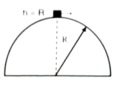
  • Capture.PNG
    Capture.PNG
    4.9 KB · Views: 128
Last edited by a moderator:
Physics news on Phys.org
SireJeff said:
if the nromal force is the reaction of the surface to the force of gravity
It's not. The normal force and gravity are not a Newton's 3rd Law force pair.
 
  • Like
Likes   Reactions: SammyS and PeroK
SireJeff said:
##\dots~## if the nromal force is the reaction of the surface to the force of gravity towards the mass of the object, then if Fg along the y axis is Fg=m.g.cos(theta) ,the normal force has to be the same as it ##\dots##
Why? Draw a free body diagram.

When the mass is going around the circle at some angle ##\theta## relative to the vertical, you know that the net force has a component directed towards the center. Now the normal force is perpendicular to and away from the surface. This means that it points away from the center. The weight is straight down and has component ##mg\cos\theta## towards that center. Assuming positive to be away from the center, the net force along the radius, is the sum of a positive normal force and a negative weight component. This net radial component is equal to mass times centripetal acceleration according to Newton's second law applied in the radial direction:$$F_{\text{net,r}}=N-mg\cos\theta=m\frac{v^2}{R}.$$ Note that there can be a combination of speed ##v## and angle ##\theta## such that the normal force becomes zero. What do you think that means?
 
  • Like
Likes   Reactions: SammyS
SireJeff said:
TL;DR Summary: my question is about understanding origin of centripetal force when the net force towards the center is zero and I got this issue from a homework which I solved but quite have a problem understanding the concept ,for a body of mass with little to no rotation, if it starts moving on the surface of a circle like hill with radius R, what other forces beside Normal and gravitational are applied to it to count for centripetal Force when N and Fg counteract each other completely

to clarify , my purpose isn't to find a solution to my home work , I already did the home work and my thread is more a request of justification or at least a clarification of the forces at play , I need explanation on the general topic not the solution to my question, I am mentioning the question and trying to use it as a way to further develop and explain the context of my problem .
I have this question about centripetal force of an object rolling down a hill . so here's he question:
"A mass m is released from the top of a vertical circular track of radius r with a horizontal speed v0. Find angle θ where it leaves the contact with circular track.(object is dense and small, no rotation ,no friction no preliminary acceleration, the object starts moving slowly from the top)"
now I know how to calculate for it but I don't get the presuppositions that we have for this object , the first idea that came into my head was that I should equate the sum of of N and Fg(force of gravity) forces along the y axis to the centripetal force(mV^2/R) and continue from there, but I have this problem with the supposition , if the nromal force is the reaction of the surface to the force of gravity towards the mass of the object, then if Fg along the y axis is Fg=m.g.cos(theta) ,the normal force has to be the same as it ,then what force is acting as the centripetal force if the net force along the y axis equals zero? yet again I know since it's moving along a circle with Radius R, there has to be a force which is puling it inwards towards the center perpendicular to the velocity(direction of displacement) , I just can not understand what originates it, also I have to mention I'm modeling this in cartesian co-ordinates
Let's imagine you are standing on the equator. The normal force between you and the Earth is not the true gravitational force, as obtained from Newton's law of gravitation. It's that force minus the centripetal force needed to keep you in a circular path. You can easily calculate how much more you would weigh at the equator if the Earth were not spinning. Likewise, if the Earth were spinning faster, you would weigh less - until eventually, if the Earth were spinning fast enough, gravity alone could not hold you to the surface.
 
Welcome, @SireJeff !

How did you solve the problem?
Wasn't the centripetal force (or the radial component of the object's weight) becoming smaller and smaller as the mass m was released and started moving slowly at first, then faster and faster, from the top of that vertical circular track?
 
Lnewqban said:
Welcome, @SireJeff !

How did you solve the problem?
Wasn't the centripetal force (or the radial component of the object's weight) becoming smaller and smaller as the mass m was released and started moving slowly at first, then faster and faster, from the top of that vertical circular track?
hello and thanks sire, actually yeah that's what I did in order to solve it ,but still when I draw the FBD, what I see is that the normal force is counter acted by the radial component of the objects weight and is canceled out. now I know it HAS to have one centripetal force in order for it to keep moving along the curved surface, what I don't get is: what is it that originates that Force? .and I quote this explanation:

""
It is important to understand that the centripetal force is not a fundamental force, but just a label given to the net force which causes an object to move in a circular path. The tension force in the string of a swinging tethered ball and the gravitational force keeping a satellite in orbit are both examples of centripetal forces. Multiple individual forces can even be involved as long as they add up (by vector addition) to give a net force towards the center of the circular path. ""
 
  • Skeptical
Likes   Reactions: weirdoguy
SireJeff said:
hello and thanks sire, actually yeah that's what I did in order to solve it ,but still when I draw the FBD, what I see is that the normal force is counter acted by the radial component of the objects weight and is canceled out. now I know it HAS to have one centripetal force in order for it to keep moving along the curved surface, what I don't get is: what is it that originates that Force? .
What don't you understand about the answers above? Why must two forces on a object always cancel out? Are you confused about Newton's third law? Note that a third law pair always acts on two different objects - not on the same object. In this case, there is no reason for gravity and the normal force to cancel.
 
  • Like
Likes   Reactions: vanhees71
SireJeff said:
the normal force is counter acted by the radial component of the objects weight and is canceled out.
What is your basis to claim that?
 
SireJeff said:
when I draw the FBD, what I see is that the normal force is counter acted by the radial component of the objects weight and is canceled out.
No, you're not seeing that if you drew the FBD correctly. The magnitude of the normal force is smaller than the radial component of the weight.
 

Similar threads

  • · Replies 4 ·
Replies
4
Views
1K
  • · Replies 10 ·
Replies
10
Views
2K
  • · Replies 15 ·
Replies
15
Views
4K
  • · Replies 16 ·
Replies
16
Views
2K
  • · Replies 5 ·
Replies
5
Views
4K
  • · Replies 37 ·
2
Replies
37
Views
5K
  • · Replies 6 ·
Replies
6
Views
2K
Replies
2
Views
2K
  • · Replies 2 ·
Replies
2
Views
3K
  • · Replies 24 ·
Replies
24
Views
4K