Orthogonality of 2 complex exponentials

  • Thread starter Thread starter Nana113
  • Start date Start date
  • Tags Tags
    Orthogonality
Click For Summary
SUMMARY

The discussion centers on the orthogonality of two complex functions, emphasizing that the inner product must include the complex conjugate of one function. The formula for the inner product is defined as $$\langle u, v \rangle = \int_a^b u(x)^*v(x) \ dx$$, which equates to zero for orthogonality. This definition generalizes the concept of orthogonality from 2D or 3D vectors to complex functions. Additionally, the inner product is characterized by linearity in one argument and anti-linearity in the other, ensuring positive definiteness.

PREREQUISITES
  • Understanding of complex functions
  • Familiarity with inner product definitions
  • Knowledge of linearity and anti-linearity concepts
  • Basic calculus for evaluating integrals
NEXT STEPS
  • Research the properties of Hermitian inner products in complex vector spaces
  • Study the implications of orthogonality in function spaces
  • Explore the differences between mathematicians' and physicists' conventions regarding inner products
  • Learn about weighted inner products and their applications
USEFUL FOR

Mathematicians, physicists, and students studying complex analysis or functional analysis, particularly those interested in the properties of inner products and orthogonality in complex vector spaces.

Nana113
Messages
4
Reaction score
0
Thread moved from the technical forums to the schoolwork forums
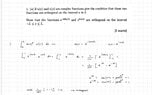
For 2 complex functions, to find the orthogonality, one of the function has to be in complex conjugate? Because in the lecture note, the first formula is without complex conjugate, so I’m a bit confused

IMG_5391.jpeg
 

Attachments

  • IMG_5392.jpeg
    IMG_5392.jpeg
    37.7 KB · Views: 127
Physics news on Phys.org
The inner product of two complex things always involves the complex conjugate of one of the things. In this case:$$\langle u, v \rangle = \int_a^b u(x)^*v(x) \ dx$$There are loads of hits on Goggle if you search for "complex inner product".
 
PeroK said:
The inner product of two complex things always involves the complex conjugate of one of the things. In this case:$$\langle u, v \rangle = \int_a^b u(x)^*v(x) \ dx$$There are loads of hits on Goggle if you search for "complex inner product".
so this condition always applies and the integral always equates to 0 when asking for orthogonality?
 
Nana113 said:
so this condition always applies and the integral always equates to 0 when asking for orthogonality?
That's the definition of orthogonality. It's a generalization of the concept of orthogonality for 2D or 3D vectors. Vectors (or functions) are orthogonal if $$\langle u, v \rangle = 0$$In this case that means that two functions are orthogonal if$$\int_a^b u(x)^*v(x) \ dx = 0$$
 
  • Like
Likes   Reactions: Nana113
Just to add a couple of things.

PeroK said:
The inner product of two complex things always involves the complex conjugate of one of the things. In this case:$$\langle u, v \rangle = \int_a^b u(x)^*v(x) \ dx$$There are loads of hits on Goggle if you search for "complex inner product".
The reason for this being that the inner product is supposed to satisfy ##\langle v,u\rangle = \langle u,v\rangle^*##, resulting in linearity in one argument and anti-linearity in the other.

PeroK said:
In this case that means that two functions are orthogonal if$$\int_a^b u(x)^*v(x) \ dx = 0$$
It should however be noted that an inner product on a function space will often come with an additional weight function. In this case it does not, but it is good to be aware.
 
Orodruin said:
Just to add a couple of things.The reason for this being that the inner product is supposed to satisfy ##\langle v,u\rangle = \langle u,v\rangle^*##, resulting in linearity in one argument and anti-linearity in the other.
It also, i'd say the main point, makes it positive definite. ##\langle u, u \rangle > 0## for non zero vectors.
 
PeroK said:
The inner product of two complex things always involves the complex conjugate of one of the things. In this case:$$\langle u, v \rangle = \int_a^b u(x)^*v(x) \ dx$$There are loads of hits on Goggle if you search for "complex inner product".

An inner product on a complex vector space is by definition linear in its first argument and Hermitian (see eg. here), so that \langle \alpha u, v \rangle = \alpha \langle u, v \rangle but \langle u, \alpha v \rangle = (\langle \alpha v, u \rangle)^{*} = \alpha^{*}\langle u, v \rangle. Hence we must have \langle u, v \rangle = \int_a^b u(x)v^{*}(x)\,dx.
 
pasmith said:
An inner product on a complex vector space is by definition linear in its first argument and Hermitian (see eg. here), so that \langle \alpha u, v \rangle = \alpha \langle u, v \rangle but \langle u, \alpha v \rangle = (\langle \alpha v, u \rangle)^{*} = \alpha^{*}\langle u, v \rangle. Hence we must have \langle u, v \rangle = \int_a^b u(x)v^{*}(x)\,dx.
Yeah, but that messes up Dirac notation!
 
pasmith said:
An inner product on a complex vector space is by definition linear in its first argument
Note: This is the typical definition among mathematicians. Among phycisists, the typical convention is that the linearity is in the second argument. One needs to be careful to ensure oneself which convention a particular source uses.
 
  • #10
PeroK said:
Yeah, but that messes up Dirac notation!
Because Dirac notation is typically used by physicists. See above.
 
  • #11
so my working out of the question attached is correct?
 
  • #12
Nana113 said:
so my working out of the question attached is correct?
Looks fine to me.
 

Similar threads

  • · Replies 5 ·
Replies
5
Views
2K
  • · Replies 17 ·
Replies
17
Views
3K
  • · Replies 16 ·
Replies
16
Views
3K
  • · Replies 2 ·
Replies
2
Views
1K
  • · Replies 8 ·
Replies
8
Views
1K
  • · Replies 5 ·
Replies
5
Views
2K
  • · Replies 18 ·
Replies
18
Views
4K
  • · Replies 1 ·
Replies
1
Views
2K
  • · Replies 4 ·
Replies
4
Views
2K
Replies
7
Views
2K