Oscillation with 2 springs attached to a mass

Click For Summary
SUMMARY

The discussion centers on the oscillation of a mass attached to two springs, focusing on the mathematical modeling of forces involved. Participants emphasize the importance of free body diagrams and coordinate systems to analyze the system effectively. The restoring force on the mass is derived as F = -(k₁ + k₂)Δx, indicating that the period of oscillation is independent of the extensions of the springs at equilibrium. Clarifications are made regarding the conditions under which the springs can be in tension or compression, and the necessity of understanding Hooke's law for accurate modeling.

PREREQUISITES
  • Understanding of Hooke's Law and spring constants (k₁, k₂)
  • Ability to create and interpret free body diagrams
  • Familiarity with basic principles of oscillatory motion
  • Knowledge of equilibrium conditions in mechanical systems
NEXT STEPS
  • Study the derivation of the equation of motion for coupled oscillators
  • Learn about the implications of spring constants on oscillation frequency
  • Explore the effects of damping on oscillatory systems
  • Investigate the behavior of systems with multiple springs in series and parallel
USEFUL FOR

Physics students, mechanical engineers, and anyone interested in understanding the dynamics of oscillatory systems involving multiple springs.

link223
Messages
70
Reaction score
12
Homework Statement
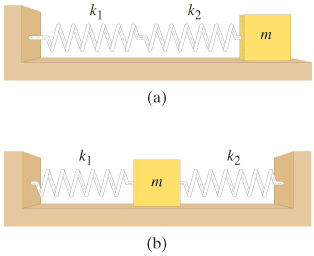
A mass m is connected to two springs, with spring constants k1 and k2 , in two different ways as shown in the figure.
Find the period for the configuration shown in the figure (a). Ignore friction.
Find the period for the configuration shown in the figure (b).
Express your answer in terms of the variables m, k1 , k2 and appropriate constants.
Relevant Equations
I don't know
How in the world I am supposed to start with this problem?
No clue, so can't provide HW solution by any means.
regards.
1659200800411.png
 
  • Like
Likes Delta2
Physics news on Phys.org
I'd start with free body diagrams, and a coordinate system.
 
  • Like
Likes berkeman
link223 said:
How in the world I am supposed to start with this problem?
Can you solve the simpler problem of a mass attached to a single spring?

(You really need to show something of your thinking here, so we have a clue where you are getting stuck.)
 
  • Like
Likes erobz
The general idea is to replace the two springs with one spring of constant ##k=f(k_1,k_2)## where f is a proper function different in each of the cases (a), (b).
Lets start to do this with case (b) which I consider simpler. Suppose mass m travels ##x## distance to the right. What is the total force on mass m at that point?
 
  • Like
Likes erobz
I don't know if there is a better way, but I put my coordinate system ## x = 0## at the leading edge of the block in scenario ##a## where it attaches to spring ##2##. Then I'd see if you can relate the displacement ##x## to the individual lengths of the springs ##x_1## and ##x_2##. That should get you started on ##a##.
 
  • Like
Likes Delta2
The question ought to state that in b) both springs are relaxed at the equilibrium position. Otherwise it cannot be solved.
 
haruspex said:
The question ought to state that in b) both springs are relaxed at the equilibrium position. Otherwise it cannot be solved.
For part b), I don’t think there is a requirement for the springs to be relaxed at the equilibrium position.

Suppose the mass is in equilibrium when the springs are both in (say) tension, with extensions ##e₁## and ##e₂##.
##-k₁e₁ + k₂e₂= 0##

If the mass is displaced by ##\Delta x##, the resultant (restoring) force, ##F##, on the mass is:
##\begin{align*} F &= -k₁(e₁ + \Delta x) + k₂(e₂ - \Delta x) \\
&= -k₁e₁ +k₂e₂ – k₁\Delta x - k₂\Delta x\\
&= 0 - (k₁+k₂)\Delta x
\end{align*}##

So the restoring force (and hence the period of oscillation) is independent of ##e₁## and ##e₂##.
 
  • Like
  • Love
Likes Delta2, haruspex and kuruman
Steve4Physics said:
For part b), I don’t think there is a requirement for the springs to be relaxed at the equilibrium position.

Suppose the mass is in equilibrium when the springs are both in (say) tension, with extensions ##e₁## and ##e₂##.
##-k₁e₁ + k₂e₂= 0##

If the mass is displaced by ##\Delta x##, the resultant (restoring) force, ##F##, on the mass is:
##\begin{align*} F &= -k₁(e₁ + \Delta x) + k₂(e₂ - \Delta x) \\
&= -k₁e₁ +k₂e₂ – k₁\Delta x - k₂\Delta x\\
&= 0 - (k₁+k₂)\Delta x
\end{align*}##

So the restoring force (and hence the period of oscillation) is independent of ##e₁## and ##e₂##.
I was going to post the same objection, but you preempted me. Based on past experience, I believe that @haruspex has cultivated the ability to see what's in others' blind spots. So let's wait for his response.
 
  • Love
Likes Delta2
I hope the OP makes an effort here, I look forward to maybe seeing a few ways to approach this, and maybe clear up some concerns I myself am having in solving part a.
 
  • Like
Likes bob012345
  • #10
Steve4Physics said:
For part b), I don’t think there is a requirement for the springs to be relaxed at the equilibrium position.

Suppose the mass is in equilibrium when the springs are both in (say) tension, with extensions ##e₁## and ##e₂##.
##-k₁e₁ + k₂e₂= 0##

If the mass is displaced by ##\Delta x##, the resultant (restoring) force, ##F##, on the mass is:
##\begin{align*} F &= -k₁(e₁ + \Delta x) + k₂(e₂ - \Delta x) \\
&= -k₁e₁ +k₂e₂ – k₁\Delta x - k₂\Delta x\\
&= 0 - (k₁+k₂)\Delta x
\end{align*}##

So the restoring force (and hence the period of oscillation) is independent of ##e₁## and ##e₂##.
Next time I'll have my coffee first.
 
  • Love
  • Like
  • Haha
Likes kuruman, Steve4Physics and Delta2
  • #11
I think @Steve4Physics has a little mistake, the total force is $$F=-k_1(e_1+\Delta x)-k_2(e_2-\Delta x)$$ which will result in $$F=-(k_1-k_2)\Delta x$$.
 
  • #12
Delta2 said:
I think @Steve4Physics has a little mistake, the total force is $$F=-k_1(e_1+\Delta x)-k_2(e_2-\Delta x)$$ which will result in $$F=-(k_1-k_2)\Delta x$$.
No, it is +k2, as Steve wrote.
 
  • Informative
Likes Delta2
  • #13
haruspex said:
No, it is +k2, as Steve wrote.
isn't the force from each spring ##-k_ix_i## ##i=1,2##. Why do we take the force from 2nd spring as ##k_2x_2## without the minus sign?
 
  • #14
Delta2 said:
isn't the force from each spring ##-k_ix_i## ##i=1,2##. Why do we take the force from 2nd spring as ##k_2x_2## without the minus sign?
Because it acts in the opposite direction. If the body moves right the left spring increases in length, adding force to the left, while the other spring reduces in length, also adding force to the left.
 
  • Like
Likes Delta2
  • #15
Delta2 said:
I think @Steve4Physics has a little mistake, the total force is $$F=-k_1(e_1+\Delta x)-k_2(e_2-\Delta x)$$ which will result in $$F=-(k_1-k_2)\Delta x$$.
Hi @Delta. In case of any remaining doubt...

Consinder the case where both springs are in tension:
Spring-1 pulls the mass to the left, so this force is negative.
Spring 2-pulls the mass to the right, so this force is positive.

Also, ‘## F=-(k_1-k_2)\Delta x##’ would mean that if we used equal stiffness springs (##k_1=k_2##) the net force would be zero, so no oscillations would be possible.
 
  • Like
Likes Delta2
  • #16
Steve4Physics said:
Consinder the case where both springs are in tension:
Spring-1 pulls the mass to the left, so this force is negative.
Spring 2-pulls the mass to the right, so this force is positive.
actually if spring 1 pulls the mass to the left, then spring 2 pushes the mass to the left, so both forces are positive.
 
  • #17
Delta2 said:
actually if spring 1 pulls the mass to the left, then spring 2 pushes the mass to the left, so both forces are positive.
Spring 2 can only push the mass to the left when the spring is in a state of compression.

That’s why I said “Consider the case where both springs are in tension”.

Of course, if ##|\Delta x|## is large enough, then during the motion each of the springs could become temporarily compressed. But that doesn’t affect the construction of the equation:
##F=-k_1(e_1+\Delta x)+k_2(e_2-\Delta x)##

For example, if ##\Delta x## is large enough, then spring -2 could become compressed and the expression ##(e_2-\Delta x)## automatically becomes negative to take this into account.
 
  • Like
Likes bob012345
  • #18
Steve4Physics said:
Spring 2 can only push the mass to the left when the spring is in a state of compression.

That’s why I said “Consider the case where both springs are in tension”.

Of course, if ##|\Delta x|## is large enough, then during the motion each of the springs could become temporarily compressed. But that doesn’t affect the construction of the equation:
##F=-k_1(e_1+\Delta x)+k_2(e_2-\Delta x)##

For example, if ##\Delta x## is large enough, then spring -2 could become compressed and the expression ##(e_2-\Delta x)## automatically becomes negative to take this into account.
Yes ok thanks, I see what you mean now, in my mind I had for granted that both springs start at their natural length so if spring 1 is elongated, then spring 2 is compressed and vice versa.
 
  • #19
The net force for small displacements is the same for all three possible cases of both springs equilibrium starting conditions of natural length, tension or compression.
 
  • Like
Likes Steve4Physics
  • #20
bob012345 said:
The net force for small displacements is the same for all three possible cases of both springs equilibrium starting conditions of natural length, tension or compression.
Yes. The displacements don't even have to be small - providing both springs obey Hooke's law.
 
  • Like
Likes bob012345
  • #21
Gang: You guys are killing me. Please realize that this is the HW forum and the OP hasn't posted anything since the problem statement. :-p
 
  • Like
  • Haha
Likes SammyS, Steve4Physics, Delta2 and 2 others

Similar threads

Replies
1
Views
875
Replies
17
Views
2K
Replies
1
Views
1K
  • · Replies 11 ·
Replies
11
Views
2K
  • · Replies 8 ·
Replies
8
Views
2K
  • · Replies 10 ·
Replies
10
Views
2K
  • · Replies 5 ·
Replies
5
Views
1K
Replies
9
Views
2K
  • · Replies 8 ·
Replies
8
Views
1K
Replies
6
Views
981