Oscillations in an LC circuit (Question from Irodov)

Click For Summary
SUMMARY

The discussion focuses on oscillations in an LC circuit, specifically analyzing the relationship between frequency (ω), capacitance (C), and energy conservation. A key equation presented is ω = 1/√(LC), which indicates that increasing ω by a factor of n results in a change of distance (d) to n²d. The participant, after initial confusion regarding energy conservation, concludes that the total energy of LC oscillations is not constant and derives a relationship for maximum charge (Qmax) as a function of distance. The final assertion is that work done in the circuit is zero under the assumption of no current change.

PREREQUISITES
  • Understanding of LC circuit dynamics
  • Familiarity with the equation ω = 1/√(LC)
  • Knowledge of energy conservation principles in oscillatory systems
  • Basic differential equations for analyzing changes in energy
NEXT STEPS
  • Study the derivation of energy conservation in LC circuits
  • Learn about the impact of changing capacitance on oscillation frequency
  • Research the implications of assuming constant current in oscillatory circuits
  • Explore differential equations related to energy changes in mechanical systems
USEFUL FOR

Students and educators in physics, electrical engineers, and anyone interested in the principles of oscillations in electrical circuits.

Anubhav
Messages
5
Reaction score
1
Homework Statement
1. The problem statement, all variables and given/known data
In an oscillating circuit consisting of of a parallel-plate capacitor and an inductance coil with negligible active resistance the oscillations with energy are sustained. The capacitor plates were slowly drawn apart to increase the scillation frequency -fold. What work was done in the process?
Relevant Equations
Variables have meaning as usual
€=permitivity of vaccum
Energy in LC oscillations =W
Energy of charged capacitor=(Q^2)/2C
Force between plates of parallel plate capacitor=(Q^2)/2€A
https://www.physicsforums.com/attachments/282131
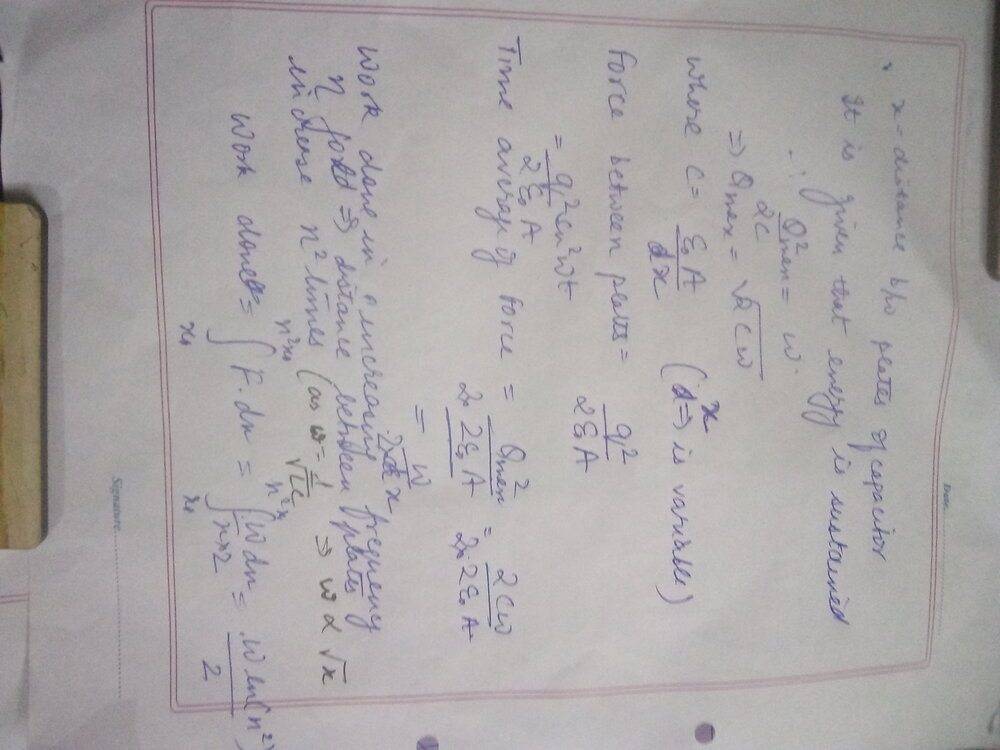
16195584671893895411783627819363.jpg
 
Last edited:
Physics news on Phys.org
1619559658292.png


For those who want to read it without breaking their neck ...

I can also decipher another relevant equation (## \ \omega = \displaystyle {1\over\sqrt{LC}}\ ##)
So inceasing ##\omega## n times means changing ##\ d \rightarrow n^2d\ ##.
Unclear to me what is conserved -- is ##\ q\ ## the same as ##\ Q_{\text{max}}\ ## ? and is that invariant ?
Then where does the mechanical work energy go ?

##\ ##
 
I'm sorry for inconvenience ..I shall delete this thread and reframe the entire Q properly again
 
Pinging @DaveE

Congratulations with the badge ! I'm sure there is no broom, and I'm certain they don't have cookies either (my clumsy way to distinguish you from @davenn)​
@Anubhav shouldn't apologize too much. Plenty effort demonstrated. I'm just filing away at his (her?) assumptions to test them. Can you handle this one in a more didactically responsible way :smile: ?

I ask myself: Would there be much difference between this case of changing ##d## and the DC case ?

##\ ##
 
BvU said:
Pinging @DaveE

Congratulations with the badge ! I'm sure there is no broom, and I'm certain they don't have cookies either (my clumsy way to distinguish you from @davenn)​
@Anubhav shouldn't apologize too much. Plenty effort demonstrated. I'm just filing away at his (her?) assumptions to test them. Can you handle this one in a more didactically responsible way :smile: ?

I ask myself: Would there be much difference between this case of changing ##d## and the DC case ?

##\ ##
Hello sir..Thanks for your I read your reply and gave it a thought again...
Also I have posted a typed image of Question as certain elements were missing in Q which I wrote
I am happy to inform you that after discussion with my friends I was able to solve it and got the right answer.
Actually I had assumed the Total energy of LC oscillations to be constant. Obviously that was wrong.
In my another attempt I wrote Change in energy of LC oscillations [i.e change in Qmax^2/(2C)] as function of integration of F(x).dx (where x is distance between plates)
Differentiation of this leads to a differential equation solving which gives Qmax as function of x..
Then change in energy of LC oscillations gives Total work done.
Ans comes out to be W(n-1)
Screenshot_20210428-183828~2.png
 
  • Like
Likes   Reactions: BvU
Assumption: current does not change. (No dissipation, is like amperian currents in a permanent magnet).
So:
## V_C \rightarrow nV_C ##
## V^2_C \rightarrow n^2V^2_C ##
## C \rightarrow C/n^2 ##
So ## 1/2 ~CV_C^2 ## is unchanged; inductance energy is unchanged; circuit energy is unchanged; work = 0.

Probably wrong somewhere.Probably assumption of no current change.
 
Last edited:

Similar threads

  • · Replies 5 ·
Replies
5
Views
2K
Replies
7
Views
2K
Replies
6
Views
1K
  • · Replies 2 ·
Replies
2
Views
1K
  • · Replies 21 ·
Replies
21
Views
1K
  • · Replies 2 ·
Replies
2
Views
3K
  • · Replies 15 ·
Replies
15
Views
896
  • · Replies 3 ·
Replies
3
Views
2K
  • · Replies 2 ·
Replies
2
Views
3K
  • · Replies 15 ·
Replies
15
Views
2K