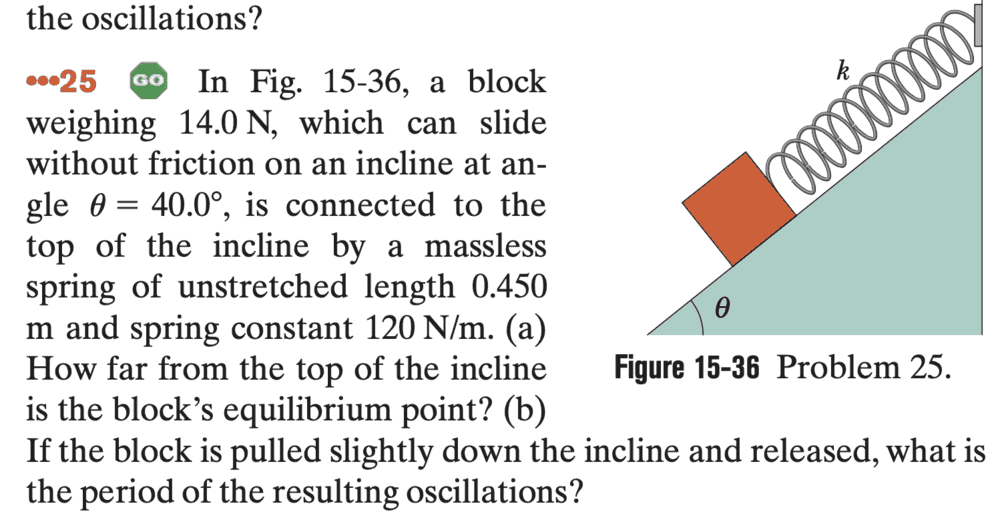
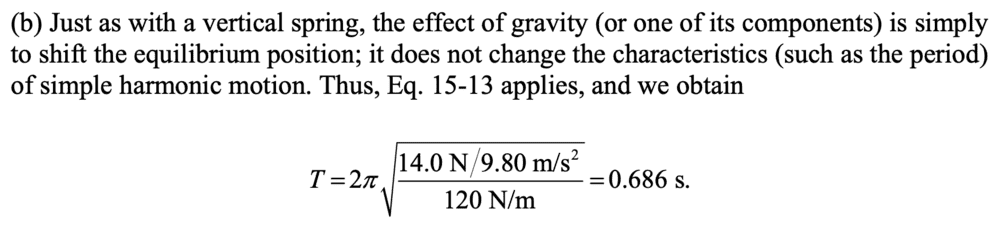
Compare a horizontal spring to a vertical spring with mass. If there is no difference here, then there will be no difference for intermediate angles.
For a horizontal spring, the equation of motion is given by:
##m\frac{d^2x}{dt^2}=-kx \tag{1}##
Where x is the displacement from the equilibrium position, which is the unloaded spring length, and m is the mass of the object. Now if we have a vertical spring the equation of motion is given by:
##m\frac{d^2y}{dt^2}=-ky - mg \tag{2}##
Where y displacement from the unloaded spring length. The new equilibrium position is found by force balance with zero acceleration:
##0=-ky_{eq} - mg \rightarrow y_{eq} = -mg/k \tag{3}##
So if we plug 3 into the right hand side of 2, we get:
##-ky - mg = -k(y-mg/k) = -k(y-y_{eq}) \tag{4}##
Now using 4 in 2 gives:
##m\frac{d^2y}{dt^2}=-k(y-y_{eq})\tag{5}##
And with a change in variables of ##x=y-y_{eq}## in 5, we have an expression identical to 1.
So, it seems that the only influence the weight of the object has is to change the equilibrium position, but that it doesn't change the equation of motion. A linear spring always oscillates about the equilibrium position, not the natural length of the spring. In the horizontal case, the equilibrium position happens to be the natural length of the spring, but not in the vertical (or inclined) case. Since the equations of motion are the same, the periods are the same.