Overhead power lines wires and strings deviation

Click For Summary

Discussion Overview

The discussion revolves around the calculation of the deviation angle of a suspension insulator string in an overhead power line setup, where the second tower is misaligned with respect to the tension insulator strings on the first and third towers. Participants explore the geometric and physical principles involved in determining the angle of deviation, considering factors such as wire tension and transverse loads.

Discussion Character

  • Technical explanation
  • Mathematical reasoning
  • Debate/contested

Main Points Raised

  • One participant inquires about calculating the angle of deviation for a suspension insulator string, noting that no external forces are applied.
  • Another participant suggests using geometry and trigonometry to find the line angle based on the offset and span, estimating it to be less than 2 degrees.
  • A different participant provides a calculation for the swing angle based on wire tension and weight spans, estimating a swing angle of less than 3 degrees, contingent on the tension value.
  • Clarification is sought regarding the calculation of transverse load, with a formula proposed: F=2*T*sin(α/2), where T is tension and α is the angle related to the insulator string.
  • Participants discuss the correct interpretation of angles in the context of the formula for transverse load, emphasizing the need to consider the total angle from both sides of the tower.
  • One participant acknowledges a previous misunderstanding regarding the angle used for calculating transverse load, indicating a shift in understanding about the relationship between angles and load calculations.
  • Another participant emphasizes the importance of vector analysis to validate the formula for transverse load, suggesting that a deeper understanding of the forces involved is necessary.

Areas of Agreement / Disagreement

Participants express varying levels of understanding regarding the calculations involved, with some agreeing on the need to use the total angle for transverse load calculations, while others remain uncertain about specific values and interpretations. The discussion does not reach a consensus on the exact calculations or the correct application of the formulas.

Contextual Notes

There are unresolved assumptions regarding the specific angles and tensions involved in the calculations, as well as the dependence on the geometric configuration of the power line setup. The discussion reflects a range of interpretations and calculations that have not been definitively settled.

Stefan Vasilev
Messages
3
Reaction score
0
Hello to all of you.

I have the following case to solve.

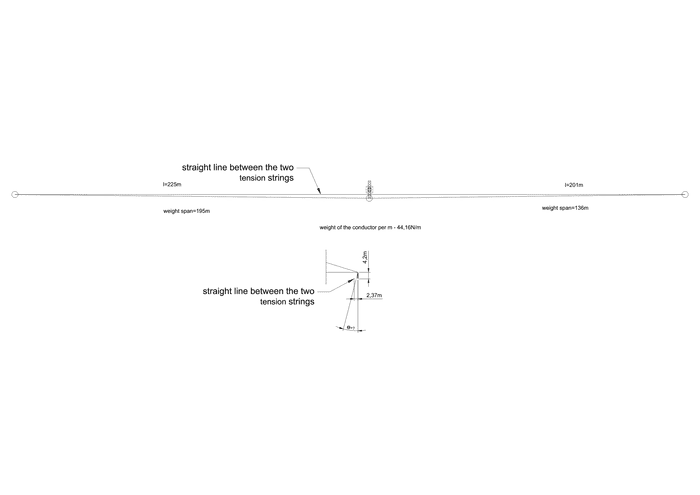
I have three overhead power line towers. The first and the third are with tension insulator strings, and the second is with suspension insulator string.
During the design process i noticed that the second tower is located incorrectly and the suspension insulator string is not in the straight line between the two tension insulator strings (located at tower one and three).

I have created a drawing in order to illustrate the problem.
pYeROJX.png

My question is how can I calculate the exact angle at which the suspension insulator string will deviate? No wind or other forces are applied to the constructor.

Many thanks in advance.
 
Physics news on Phys.org
You need to specify the wire tension, T. The line angle (not the swing angle) you can get from geometry and trig, based on the 2.7 meter offset in the approximate 200 m spans, and assuming initially the insulator is restrained from swing. It's less than a 2 degree line angle. Say 2 degrees for talking purposes.

Now to calculate the swing angle, you have the sum of the weight spans acting vertically down on the insulators, that's about 15 kN, but transversely, you have the load from the wire tensions on either side of the insulators, and using vector resultant approach, the transverse load is 2T sin ( line angle/2). Assuming T is 20 kN (is it?) , I get a transverse load of about 700 N. Thus, swing angle is inv tan 700/15000 or about less than 3 degrees. That will kick out the bottom of the 4.2 m insulator length about 0.2 m. Roughly. Of course, if wire tension is higher, swing is greater... plus wind...
 
Hello PhanthomJay,
thank you for your reply.

You are pretty close for the tension - it's about 40MPa, which for this conductors makes about 17,6kN.
What I was not sure was how to calculate the transverse load from the conductors tension.
At first I got confused that I have to use the angle between the straight line and the insulator string suspension point (as shown on the second part of the picture below), but then i got confused about not using the tension in the formula.

I just would like you to confirm that I got this right - the transverse load is calculated by F=2*T*sin(α/2), where
F - transverse load in kN
T - tension in kN
α - angle as shown on the picture bellow

TXiob9x.png


Many thanks again in advance.
 
Stefan Vasilev said:
Hello PhanthomJay,
thank you for your reply.

You are pretty close for the tension - it's about 40MPa, which for this conductors makes about 17,6kN.
What I was not sure was how to calculate the transverse load from the conductors tension.
At first I got confused that I have to use the angle between the straight line and the insulator string suspension point (as shown on the second part of the picture below), but then i got confused about not using the tension in the formula.

I just would like you to confirm that I got this right - the transverse load is calculated by F=2*T*sin(α/2), where
F - transverse load in kN
T - tension in kN
α - angle as shown on the picture bellow

TXiob9x.png


Many thanks again in advance.
that angle alpha is shown on one side of the tower in question...the total line angle at that middle tower must include the angle from the other side also, more or less total angle is twice that. That's the angle to use in your F=2Tsin(theta/2) equation, where theta is the sum of the two 'alphas' from each side if you know what I mean. But your swing angle is shown as 29 degrees which is way off...you've got a lot of weight acting down (sum of weight spans x 44N/m is about 14 kN), and the transverse load F is about in the order of only 700 N or so, so swing angle is more like inv tan 700/14,000 or about 3 degrees in rough numbers.
 
What I was saying was that when I tried to solve this problem, I tried to find the transverse load from the sine of this 29 deg angle, which was obviously a mistake. The angle between the suspension insulator string and the straight line has nothing to do with the calculations for transverse load.

Now I get it (correct me if I am wrong) - the angle theta in this formula <<F=2Tsin(theta/2)>> is the sum of my alpha (on the side where I had it placed) + the other sides angle. In this case they are almost the same as the first span is pretty much as long as the second one.
 
Stefan Vasilev said:
What I was saying was that when I tried to solve this problem, I tried to find the transverse load from the sine of this 29 deg angle, which was obviously a mistake. The angle between the suspension insulator string and the straight line has nothing to do with the calculations for transverse load.

Now I get it (correct me if I am wrong) - the angle theta in this formula <<F=2Tsin(theta/2)>> is the sum of my alpha (on the side where I had it placed) + the other sides angle. In this case they are almost the same as the first span is pretty much as long as the second one.
yes, that's right. But you should convince yourself why this formula f = 2T sin (theta/2) is correct, using a vector analysis for the resultant of the tension forces.
 

Similar threads

  • · Replies 2 ·
Replies
2
Views
2K
  • · Replies 5 ·
Replies
5
Views
2K
  • · Replies 50 ·
2
Replies
50
Views
14K
  • · Replies 3 ·
Replies
3
Views
1K
  • · Replies 1 ·
Replies
1
Views
1K
  • · Replies 3 ·
Replies
3
Views
3K
  • · Replies 4 ·
Replies
4
Views
1K
  • · Replies 1 ·
Replies
1
Views
6K
  • · Replies 1 ·
Replies
1
Views
1K
  • · Replies 56 ·
2
Replies
56
Views
6K