P-adic metric calculate limit

  • Thread starter Thread starter Lambda96
  • Start date Start date
  • Tags Tags
    Metric
Click For Summary
SUMMARY

The discussion centers on the calculation of limits in p-adic analysis, specifically the limits of the sequences ##\lim_{n \to \infty} p^n## and the series ##\sum_{k=0}^{\infty} p^k##. The participants confirm that ##\lim_{n \to \infty} p^n = \infty## and that the series converges to ##\frac{p}{p-1}##. Additionally, they discuss the distance between ##p^n## and zero in the p-adic metric, concluding that this distance approaches zero as ##n## increases. The conversation also touches on the broader implications of p-adic properties in relation to real numbers.

PREREQUISITES
  • Understanding of p-adic numbers and their properties.
  • Familiarity with limits and series in mathematical analysis.
  • Knowledge of the p-adic metric and its implications.
  • Basic concepts of convergence in series.
NEXT STEPS
  • Study the properties of p-adic numbers in depth.
  • Learn about the convergence criteria for series in p-adic analysis.
  • Explore the relationship between p-adic numbers and real numbers.
  • Investigate the work of Helmut Hasse on quadratic forms and their implications in algebraic topology.
USEFUL FOR

Mathematicians, students of number theory, and anyone interested in advanced mathematical concepts related to p-adic analysis and limits.

Lambda96
Messages
233
Reaction score
77
Homework Statement
Calculate the following limits ##\displaystyle{\lim_{n \to \infty}} p^n## and ##\sum\limits_{k=0}^{\infty} p^k##
Relevant Equations
none
Hi,

I'm not sure if I have calculated the task here correctly
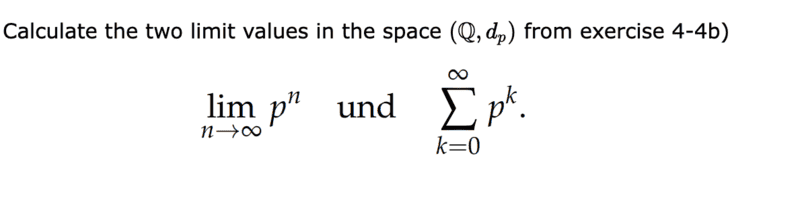
Bildschirmfoto 2024-05-11 um 21.17.34.png

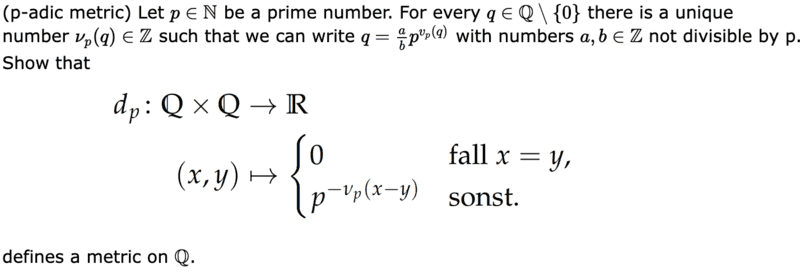
Task 4-4b looked like this
Bildschirmfoto 2024-05-11 um 21.30.06.png


I have now obtained the following with ##n=-v_p(x-y)##

$$\displaystyle{\lim_{n \to \infty}} p^n= \infty$$
$$\sum\limits_{n=0}^{\infty} p^n=\frac{p}{p-1}$$

Is that correct?
 
Physics news on Phys.org
Lambda96 said:
Homework Statement: Calculate the following limits ##\displaystyle{\lim_{n \to \infty}} p^n## and ##\sum\limits_{k=0}^{\infty} p^k##
Relevant Equations: none

Hi,

I'm not sure if I have calculated the task here correctly

View attachment 345019
Task 4-4b looked like this
View attachment 345020

I have now obtained the following with ##n=-v_p(x-y)##

$$\displaystyle{\lim_{n \to \infty}} p^n= \infty$$
$$\sum\limits_{n=0}^{\infty} p^n=\frac{p}{p-1}$$

Is that correct?
a) What is the distance between ##p^n## and ##0##?

b) What is ##\displaystyle{\left(\sum_{k=0}^\infty p^k \right)\cdot (1-p)}##?

Here is another short introduction to p-adic numbers:
https://www.physicsforums.com/insig...l-number-systems-that-we-have/#p-adic-Numbers
 
Last edited:
  • Like
Likes   Reactions: Lambda96
Thank you fresh_42 for your help 👍

Regarding a)
Isn't the distance calculated as follows? ##| n-0 |_p=| p^n |_p=p^{-n}##

Regarding b)
##\sum\limits_{k=0}^{\infty} p^k \cdot (1-p)=1##
 
Lambda96 said:
Thank you fresh_42 for your help 👍

Regarding a)
Isn't the distance calculated as follows? ##| n-0 |_p=| p^n |_p=p^{-n}##

Regarding b)
##\sum\limits_{k=0}^{\infty} p^k \cdot (1-p)=1##
a) Yes. And if ##n\to \infty ## then ##\displaystyle{\lim_{n \to \infty}|p^{n}|_p=\lim_{n \to \infty}p^{-n}}=?##
b) Yes.

Convergence of series is easier in p-adic analysis:
$$
\lim_{n \to \infty}a_np^n=0 \Longrightarrow \sum_{n=k}^{\infty}a_np^n < \infty \;(k\in \mathbb{Z}\, , \,a_n\in \{0,1,\ldots,p-1\})
$$
and all elements of ##\mathbb{Q}_p ## are a limit of such a series.
 
  • Like
Likes   Reactions: Lambda96
Thanks again for your help fresh_42 👍


The limit value of ##\displaystyle{\lim_{n \to \infty}} p^{-n}## should then be ##\displaystyle{\lim_{n \to \infty}} p^{-n}=0##
 
  • Like
Likes   Reactions: WWGD and fresh_42
Lambda96 said:
Thanks again for your help fresh_42 👍


The limit value of ##\displaystyle{\lim_{n \to \infty}} p^{-n}## should then be ##\displaystyle{\lim_{n \to \infty}} p^{-n}=0##
Yes. The distance between ##p^n## and zero in the p-adic metric goes to zero.
 
fresh_42 said:
Yes. The distance between ##p^n## and zero in the p-adic metric goes to zero.
Can you remind me of a result to the effect that a property that holds for all p-adics ; p=2,3,... also holds for the Reals? Can't remember the qualifications.
 
WWGD said:
Maybe somewhat more formal, or to highlight using theusing the p-adic valuation : ##Lim_{n \rightarrow \infty} \frac{1}{p^n} ##
All I could find was
Helmut Hasse (1898 - 1979) showed in his dissertation 1921 about quadratic forms that rational equations can be solved - up to many complicated technical details - if they can be solved for real numbers and all p-adic numbers.
I have a book about quadratic forms that deals with this kind of algebraic topology. But even the language needs an introduction, or do you know by heart what a (prime) spot is, or class numbers? It's all so long ago.
 
Last edited:
  • Like
Likes   Reactions: WWGD

Similar threads

  • · Replies 6 ·
Replies
6
Views
2K
  • · Replies 13 ·
Replies
13
Views
2K
  • · Replies 13 ·
Replies
13
Views
2K
  • · Replies 7 ·
Replies
7
Views
2K
  • · Replies 5 ·
Replies
5
Views
1K
  • · Replies 1 ·
Replies
1
Views
2K
  • · Replies 8 ·
Replies
8
Views
2K
  • · Replies 1 ·
Replies
1
Views
2K
  • · Replies 2 ·
Replies
2
Views
2K
  • · Replies 6 ·
Replies
6
Views
2K