Insights Partial Differentiation Without Tears - Comments

Click For Summary
SUMMARY

The discussion centers on the clarity of partial differentiation, particularly in the context of teaching variational calculus and Lagrange mechanics. The use of lambda calculus notation, specifically \(\lambda x . x^2\), is highlighted as a means to eliminate ambiguity in function representation. Participants emphasize the importance of visual aids, such as images of mountains, to illustrate concepts like partial derivatives, total derivatives, and covariant derivatives effectively. The need for explicit variable definitions in thermodynamics is also noted to enhance understanding.

PREREQUISITES
  • Understanding of lambda calculus notation
  • Familiarity with variational calculus
  • Knowledge of Lagrange mechanics
  • Basic concepts of thermodynamics
NEXT STEPS
  • Research lambda calculus and its applications in function representation
  • Explore visual teaching methods for complex mathematical concepts
  • Study the Euler-Lagrange equations in multi-dimensional spaces
  • Investigate the role of partial derivatives in thermodynamic equations
USEFUL FOR

Mathematics educators, students of calculus and thermodynamics, and anyone involved in teaching or learning variational calculus and Lagrange mechanics.
andrewkirk
Science Advisor
Homework Helper
Insights Author
Gold Member
Messages
4,140
Reaction score
1,741
andrewkirk submitted a new PF Insights post

Partial Differentiation Without Tears

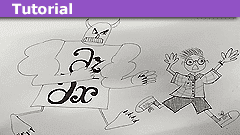
partial-differentiation.png


Continue reading the Original PF Insights Post.
 
  • Like
Likes phion, stevendaryl and Greg Bernhardt
Physics news on Phys.org
Some of the ambiguity with functions could be cleared up using the lambda calculus (or just the lambda notation), which makes explicit what arguments a function takes. There is always a confusion in an expression such as f(x) as to whether you mean the function, or whether you mean the value of f at a particular point x. The lambda calculus makes this clear. Your notation x\mapsto x^2 is basically equivalent (I think) to the lambda calculus, which would indicate that function by \lambda x . x^2. I think that the only reason people don't use the lambda notation is that it's a lot of trouble, and usually it's not necessary.
 
This issue is particularly important when teaching students variational calculus and Lagrange mechanics. In particular when the base space is multi-dimensional and the Euler-Lagrange equations involve a partial derivative with respect to the base space coordinates of a partial derivative with respect to the arguments of the Lagrangian. This has confused many a student.
 
I have a suggestion. Start with images to explain all the differentiation concepts on the first day before even simple total derivative is explained. Once students grasp what they are trying to express, then they can better focus on how.

Using this one image, I think the following concepts can be explained in just seconds.
  1. Partial derivatives: The rate of change of altitude as we walk toward the summit versus the rate of change of altitude as we walk parallel to the summit.
  2. Total derivative: Imagine the image reduced to a 2D profile choosing a planar slice through the mountain. Then height Y represents altitude, and it varies only with the horizontal variable X. The slope is the total derivative.
  3. Covariant derivative: Consider the color shading as another independent variable. Now imagine walking on the mountain following a contour with constant shade of green. The rate of change of altitude is now the derivative covariant with color.
summitrgb.jpg
 
  • Like
Likes Greg Bernhardt

Similar threads

  • · Replies 3 ·
Replies
3
Views
2K
  • · Replies 3 ·
Replies
3
Views
1K
  • · Replies 3 ·
Replies
3
Views
4K
  • · Replies 5 ·
Replies
5
Views
3K
  • · Replies 14 ·
Replies
14
Views
5K
  • · Replies 9 ·
Replies
9
Views
3K
  • · Replies 8 ·
Replies
8
Views
2K
  • · Replies 1 ·
Replies
1
Views
3K
  • · Replies 10 ·
Replies
10
Views
2K
  • · Replies 2 ·
Replies
2
Views
2K