Particle Deceleration in Relativistic Jets?

Click For Summary
SUMMARY

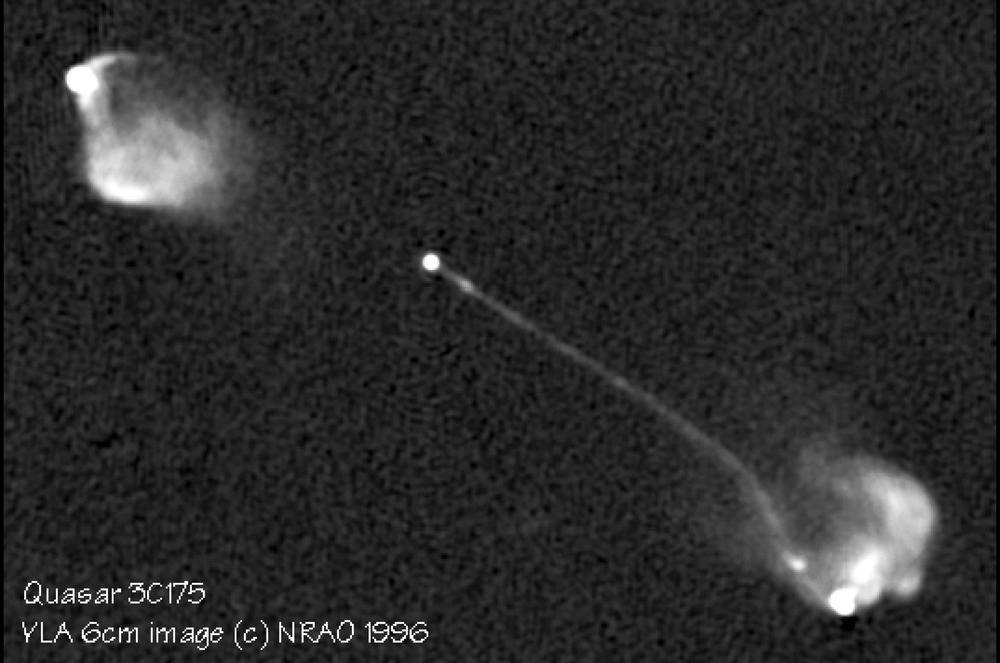
The discussion centers on the behavior of particles in relativistic jets, specifically addressing how electrons with relativistic velocities maintain their speed despite gravitational deceleration. The participants reference the VLA image of the quasar 3C 175 and discuss the implications of relativistic momentum and energy calculations for electrons with kinetic energies of 10 GeV and 1000 GeV. Key conclusions include that both electrons experience similar deceleration in a uniform gravitational field, and the energy loss for the higher-energy electron is significantly greater than for the lower-energy electron, despite their similar velocities after one second in a gravitational field.

PREREQUISITES
  • Understanding of relativistic physics, particularly the concepts of relativistic momentum and energy.
  • Familiarity with gravitational effects on high-velocity particles.
  • Knowledge of the VLA imaging technique and its application in astrophysics.
  • Basic mathematical skills for manipulating equations related to energy and velocity in special relativity.
NEXT STEPS
  • Study the principles of relativistic momentum and how they differ from classical momentum.
  • Learn about gravitational effects on particles in relativistic jets, focusing on General Relativity.
  • Explore the VLA imaging technique and its significance in observing quasars and black holes.
  • Investigate the relationship between kinetic energy and velocity in relativistic contexts, including energy loss calculations.
USEFUL FOR

Astrophysicists, physicists studying high-energy particles, and anyone interested in the dynamics of relativistic jets and gravitational effects on particle motion.

metastable
Messages
514
Reaction score
53
I have a question about this picture:

It shows matter traveling at relativistic velocities away from a black hole:
x313.jpg

"Figure 5.21: This VLA image of the radio-loud quasar 3C 175 shows the core, an apparently one-sided jet, and two radio lobes with hot spots of comparable flux densities. The jet is intrinsically two sided but relativistic, so Doppler boosting brightens the approaching jet and dims the receding jet. Both lobes and their hot spots are comparably bright and thus are not moving relativistically. Image credit: NRAO/AUI/NSF Investigators: Alan Bridle, David Hough, Colin Lonsdale, Jack Burns, & Robert Laing."

I'm confused by the image, because in a different thread it was stated:
the deceleration due to gravity is independent of the outward speed.

If the deceleration due to gravity is independent of the outward speed, how is it thought that the particles that have relativistic velocity with respect to the black hole retain a velocity which is so close to the speed of light after traveling many so many light years "upwards" away from the super massive black hole?
 
Space news on Phys.org
Qualitatively speaking, a small velocity less a certain amount of deceleration is a small velocity. A large velocity less that same amount of deceleration is a large velocity. The jets started with an enormous velocity.

There are subtleties around the behaviour of relativistic particles (velocity isn't well defined in the casual way you are using it), but that's the gist of it.
 
Ibix said:
The jets started with an enormous velocity.

There are subtleties around the behaviour of relativistic particles (velocity isn't well defined in the casual way you are using it), but that's the gist of it.

10gev kinetic electron (hovering observer)-->

B = 0.5109989461MeV = electron rest mass

Z = 10000MeV = initial electron kinetic energy (lab frame) = 10gev

E = Electron Total Energy

E = B+Z

E = 10000.5109989461MeV

E = B/sqrt(1-(V^2/C^2))

can be rearranged to:

E = B/sqrt(1-A)

A = V^2/C^2

E = B/sqrt(1-A)

can be rearranged to:

A = -1*((B^2-E^2)/E^2)

A = -1*((0.5109989461^2-10000.5109989461^2)/10000.5109989461^2)

A = 0.999999997389067614404

A = V^2/C^2

can be rearranged to:

V = C*sqrt(A)

C = 299792458m/s

V = 299792458*sqrt(0.999999997389067614404)

V = 299792457.6086310809697

10gev Electron V=299792457.6086310809697m/s from hovering observer

-----

1000gev kinetic electron (hovering observer)-->

B = 0.5109989461MeV = electron rest mass

Z = 1000000MeV = initial electron kinetic energy (lab frame) = 1000gev

E = Electron Total Energy

E = B+Z

E = 1000000.5109989461MeV

E = B/sqrt(1-(V^2/C^2))

can be rearranged to:

E = B/sqrt(1-A)

A = V^2/C^2

E = B/sqrt(1-A)

can be rearranged to:

A = -1*((B^2-E^2)/E^2)

A = -1*((0.5109989461^2-1000000.5109989461^2)/1000000.5109989461^2)

A = 0.999999999999738880344

A = V^2/C^2

can be rearranged to:

V = C*sqrt(A)

C = 299792458m/s

V = 299792458*sqrt(0.999999999999738880344)

V = 299792457.9999608591483

1000gev Electron V=299792457.9999608591483m/s from hovering observer

------------------------

Conclusions:

1000gev Electron V=299792457.9999608591483m/s from hovering observer
10gev Electron V=299792457.6086310809697m/s from hovering observer
Velocity difference between 1000gev and 10gev electron from hovering observer: 0.3913297781786m/s
(299792457.9999608591483/299792457.6086310809697)=100.0000001305335635527%
100.0000001305335635527%-100% = 0.00000013053...%

Can I say the 1000gev electron covers a given meter only 0.00000013...% faster, but has 10,000% as much energy compared to the 10gev electron, to a hovering observer?
 
What is the relevance of that to your question?
 
If the two particles spend 1 second (according to a hovering observer) transiting a region where the gravitational acceleration is fairly consistently 1m/s^2 (to a hovering observer), is it safe to assume the 0.00000013% difference in speed is effectively a rounding error, and both the 10gev and 1000gev electrons will have decelerated by almost exactly 1m/s in 1 second as recorded by the same hovering observer?
 
You didn't answer. How is this relevant to your original question?
 
It was stated in the OP:

re: "the deceleration due to gravity is independent of the outward speed."

I am asking for confirmation whether it is thought in this scenario that both particles (10gev and 1000gev electron) decelerate approximately 1m/s in 1 second to the hovering observer, while transiting a fairly consistently 1m/s^2 gravity region (as measured by a hovering observer).

Based on the statement "the deceleration due to gravity is independent of the outward speed" I'll assume the correct answer is both will decelerate by approximately 1m/s.
 
metastable said:
1000gev Electron V=299792457.9999608591483m/s from hovering observer

V=299792457.9999608591483m/s - 1m/s = 299792456.9999608591483m/s

299792456.9999608591483m/s

E = Electron Total Energy

E = B/sqrt(1-(V^2/C^2))

E = 0.5109989461/sqrt(1-(299792456.9999608591483^2/299792458^2))

E = 0.5109989461/sqrt(1-(299792456.9999608591483^2/299792458^2))

E = 6256.145768696381MeV

B = Electron Rest Energy = 0.5109989461MeV

E-B = 6256.145768696381MeV - 0.5109989461MeV = 6255.634769750281MeV

Z = E-B = Final Kinetic Energy of 1000gev electron after 1 second in 1m/s^2 gravity = 6.25GeV

1000-6.25 = 993.75

993.75/1000 = 99.375%

Can I say after 1 second traversing a fairly uniform 1m/s^2 gravity region, a 1000gev kinetic electron (to a hovering observer) loses 99.375% of its kinetic energy (according to the same hovering observer)?
 
metastable said:
Based on the statement "the deceleration due to gravity is independent of the outward speed" I'll assume the correct answer is both will decelerate by approximately 1m/s.

If we assume for the sake of argument that you are correct that electrons traveling at almost the speed of light will take 1 second to cover a region over which the deceleration due to gravity is, to a good enough approximation, a constant 1 m/s^2, then yes, obviously this statement is correct.

However, you just pulled those numbers out of thin air. You have no idea whether they're anywhere even close to being relevant for the jets you are asking about. You need to actually do the math to see what the relevant numbers are.
 
  • #10
metastable said:
I have a question about this picture:

It shows matter traveling at relativistic velocities away from a black hole:

View attachment 245386
"Figure 5.21: This VLA image of the radio-loud quasar 3C 175 shows the core, an apparently one-sided jet, and two radio lobes with hot spots of comparable flux densities. The jet is intrinsically two sided but relativistic, so Doppler boosting brightens the approaching jet and dims the receding jet. Both lobes and their hot spots are comparably bright and thus are not moving relativistically. Image credit: NRAO/AUI/NSF Investigators: Alan Bridle, David Hough, Colin Lonsdale, Jack Burns, & Robert Laing."

I'm confused by the image, because in a different thread it was stated:If the deceleration due to gravity is independent of the outward speed, how is it thought that the particles that have relativistic velocity with respect to the black hole retain a velocity which is so close to the speed of light after traveling many so many light years "upwards" away from the super massive black hole?
In special relativity, acceleration due to gravity the particle's momentum rather than its speed.

Classically, subtracting from momentum and speed are the same thing: the momentum ##p = mv## is proportional to speed. In fact, you can rewrite Newton's second law in terms of momentum:

$$\sum\vec{F} = {d\vec{p} \over dt}$$

This equation is also correct in special relativity, provided we use the relativistic momentum. The relativistic momentum is:

$$\vec{p} = \gamma m \vec{v}$$
$$\gamma = {1 \over \sqrt{1 - {|\vec{v}|^2 \over c^2}}}$$

The "acceleration due to gravity" in relativistic terms is then the derivative of ##\gamma \vec{v}## rather than just the derivative of ##\vec{v}##.
 
Last edited:
  • #11
First, the exact same thing happens on Earth with Newtonian gravity. The acceleration (down, so it's negative) due to gravity is independent of velocity. That is exactly the same as "the deceleration due to gravity is independent of the outward speed ".

Second, the wall-O-numbers doesn't clarify anything. Especially when you refuse to clarify when asked.

Third, writing 16 significant digits is innumerate. And hard to read.
 
  • Like
Likes   Reactions: Dale
  • #12
kimbyd said:
In special relativity, acceleration due to gravity

...cannot be analyzed; you need General Relativity if gravity is present (i.e., if spacetime is curved).
 
  • #13
PeterDonis said:
If we assume for the sake of argument that you are correct that electrons traveling at almost the speed of light will take 1 second to cover a region over which the deceleration due to gravity is, to a good enough approximation, a constant 1 m/s^2, then yes, obviously this statement is correct.

Assuming what you say is all correct, can I then say that the more kinetic energy an electron initially has to the hovering observer, the more it will lose in the first second in the region which is to a good approximation uniform 1m/s^2 gravity? For example can I say an electron with KE proportional to 1m/s to a hovering observer loses all of its upward kinetic energy in one second (to the hovering observer), but the kinetic energy lost in one second by the 1m/s electron is much less than the kinetic energy lost in one second by an electron with V=299792457.9999608591483m/s to the hovering observer?

In other words can I say in a gravity field which is to a good approximation uniform 1m/s^2 gravity, the V=299792457.9999608591483m/s electron loses 993.75GeV kinetic energy in one second, and the V=1m/s electron loses 0.0000000000028428ev in one second, to the hovering observer?
 
Last edited:
  • #14
metastable said:
V=299792457.9999608591483

More innumerate nonsense. Are you even reading what other people are writing?
 
  • Like
Likes   Reactions: weirdoguy
  • #15
I can’t strip off decimals without drastically changing the energy. The specified velocity = 1000GeV to a hovering observer.
 
  • #16
PeterDonis said:
...cannot be analyzed; you need General Relativity if gravity is present (i.e., if spacetime is curved).
Sure you can, using a pseudoclassical approximation. The acceleration will be off by a factor of two at high velocity (if the simplest approximation is used), but the overall concepts aren't really broken by looking at it in this way.
 
  • #17
metastable said:
Assuming what you say is all correct, can I then say that the more kinetic energy an electron initially has to the hovering observer, the more it will lose in the first second in the region which is to a good approximation uniform 1m/s^2 gravity? For example can I say an electron with KE proportional to 1m/s to a hovering observer loses all of its upward kinetic energy in one second (to the hovering observer), but the kinetic energy lost in one second by the 1m/s electron is much less than the kinetic energy lost in one second by an electron with V=299792457.9999608591483m/s to the hovering observer?

In other words can I say in a gravity field which is to a good approximation uniform 1m/s^2 gravity, the V=299792457.9999608591483m/s electron loses 993.75GeV kinetic energy in one second, and the V=1m/s electron loses 0.0000000000028428ev in one second, to the hovering observer?
No. Because as I pointed out above, the acceleration doesn't change ##\vec{v}##. It changes ##\gamma\vec{v}##.

If the particle is moving at 0.995c, then ##\gamma = 10##. So the value ##9.995c## gets reduced by 1m/s, meaning that the speed only drops by about 0.1m/s instead.

Now, as I mentioned earlier in response to PeterDonis, this isn't quite right. This approximation doesn't really work properly for relativistic objects (gravity is twice as strong as you'd expect from the Newtonian approximation for relativistic objects). But the basic concept remains reasonable: the force of gravity subtracts from the momentum, not the velocity. Close to the speed of light, large changes in momentum only translate to small changes in velocity.
 
  • #18
kimbyd said:
Sure you can, using a pseudoclassical approximation.

What is a "pseudoclassical approximation"?
 
  • #19
metastable said:
Assuming what you say is all correct

Actually, it isn't; @kimbyd's point is well taken, that "deceleration" actually affects ##\gamma v##, not ##v##.
 
  • #20
PeterDonis said:
What is a "pseudoclassical approximation"?
There are a few different ones. In this case I mean combining Newtonian gravity with special relativity. Which means using ##F = dp/dt## for Newton's second law, Newtonian gravity for the force, and the relativistic momentum.

As I mentioned, it isn't correct: as speeds get near the speed of light, the deflection in a gravitational field you would expect from this approximation is a factor of two off (the actual deflection is twice that predicted here).

You can fix this up to get the right answer for photons by simply multiplying the force by a factor of two. But I don't think you can fix it in general because it requires a velocity-dependent force term, which is a radical departure from Newtonian behavior, and would likely have a number of unexpected side effects if you tried to do anything. I think at that point it's better to just drop the approximation entirely.

Another semiclassical interpretation that's available involves taking Newtonian gravity and adding extra terms to the force equation (the first being proportional to ##1/r^3##). This works for non-relativistic particles in fairly strong gravitational fields when plain Newtonian gravity starts to break down, and was successfully used to predict the correct orbit of Mercury for the first time.
 
  • #21
PeterDonis said:
Actually, it isn't; @kimbyd's point is well taken, that "deceleration" actually affects γvγv\gamma v, not vvv.

metastable said:
In other words can I say in a gravity field which is to a good approximation uniform 1m/s^2 gravity, the V=299792457.9999608591483m/s electron loses 993.75GeV kinetic energy in one second, and the V=1m/s electron loses 0.0000000000028428ev in one second, to the hovering observer?

Can I say the upward V=299792457.9999608591483m/s electron (1000gev to hovering observer):
A) loses approximately 0.0000000000028428ev in one second to the hovering observer in a gravitational field which closely approximates uniform 1m/s^2
B) loses a significantly different amount of energy than 0.0000000000028428ev in one second to the hovering observer in a gravitational field which closely approximates uniform 1m/s^2
 
  • #22
kimbyd said:
In this case I mean combining Newtonian gravity with special relativity.

AFAIK you can't do that consistently, since Newtonian gravity has instantaneous action at a distance and is incompatible with Lorentz invariance.

Do you have a reference for this? I have not seen anything like this in a relativity textbook.
 
  • #23
metastable said:
a gravitational field which closely approximates uniform 1m/s^2

It has to be uniform over a length of one light-second, since that's how far the electron will travel in one second (to a very high accuracy). You can't just wave your hands and say this happens; you have to actually do the math and see what kind of gravitational source would make it possible, and within what range of radial coordinates from the source.
 
  • #24
PeterDonis said:
AFAIK you can't do that consistently, since Newtonian gravity has instantaneous action at a distance and is incompatible with Lorentz invariance.

Do you have a reference for this? I have not seen anything like this in a relativity textbook.
I've only seen it used in tests for gravitational lensing which demonstrate that the Newtonian-like setup predicts the wrong answer.

I used it here because it's a simple enough explanation that at least captures the essence of what's going on, even though it's wrong in detail.
 
  • #25
metastable said:
Can I say the upward V=299792457.9999608591483m/s electron (1000gev to hovering observer):
A) loses approximately 0.0000000000028428ev in one second to the hovering observer in a gravitational field which closely approximates uniform 1m/s^2
B) loses a significantly different amount of energy than 0.0000000000028428ev in one second to the hovering observer in a gravitational field which closely approximates uniform 1m/s^2
The right way to talk about this phenomenon is to ignore the concept of uniform acceleration entirely, and instead examine gravitational redshift. If your particles are highly-relativistic, you an treat them as if they were photons with the same energy and your answer won't be far off. The calculations for gravitational redshift are rather different from anything discussed in this thread.
 
  • #26
kimbyd said:
I've only seen it used in tests for gravitational lensing which demonstrate that the Newtonian-like setup predicts the wrong answer.

Again, can you give a reference? Every textbook discussion of this that I've read makes the point that you can't combine SR with a Newtonian gravity force, for the reason I've already said. That makes me skeptical that anyone has actually constructed such a model. I have seen some pop science discussions that talk about such a thing, but pop science is not science. If there is an actual textbook or peer-reviewed paper that constructs such a model, I would really like to see it. If there isn't, I don't accept that such a model exists, at least not a consistent one, for thee reasons I have already given.

kimbyd said:
I used it here because it's a simple enough explanation that at least captures the essence of what's going on

And I disagree with this statement. I think it's an inconsistent "model" which promotes misunderstanding. That's why I'm skeptical that anyone has actually constructed one in a valid source (textbook or peer-reviewed paper).
 
  • #27
kimbyd said:
There are a few different ones. In this case I mean combining Newtonian gravity with special relativity. Which means using F=dp/dtF = dp/dt for Newton's second law, Newtonian gravity for the force, and the relativistic momentum.

As I mentioned, it isn't correct: as speeds get near the speed of light, the deflection in a gravitational field you would expect from this approximation is a factor of two off (the actual deflection is twice that predicted here).

1) When a pulse of light climbs vertically out of a gravity well it redshifts - the magnitude of its momentum changes.

2) When another pulse of light climbs out of the same gravity well starting from the same spot as the first one, and originally moving to the horizontal direction, it redshifts - the magnitude of its momentum changes the same amount as in case 1, as required by the conservation of energy.

In case 2 the direction of the momentum vector changes too, and the curvature of space has some effect on that. But not in case 1, there is no extra change of magnitude of momentum by a factor of two.

... So if we have a light pulse that is diverging and whose center of mass is climbing vertically, the center of mass of that light pulse loses vertical speed "extra" fast. Because deflection does occur. This seems to be an inelastic collision because the rest mass of the light pulse increases.
 
Last edited:
  • #28
PeterDonis said:
It has to be uniform over a length of one light-second, since that's how far the electron will travel in one second (to a very high accuracy). You can't just wave your hands and say this happens; you have to actually do the math and see what kind of gravitational source would make it possible, and within what range of radial coordinates from the source.

Can I say:

https://en.wikipedia.org/wiki/TON_618
66 billion times the mass of the Sun

https://en.wikipedia.org/wiki/Solar_mass
M☉ = (1.98847±0.00007)×10^30 kg

TON 618 Black Hole Mass = (66*10^9)*(1.98847*(10^30))kg

TON 618 Black Hole Mass = 1.3123902*10^41kg

https://en.wikipedia.org/wiki/Gravitational_constant
G = 0.0000000000667430

Acceleration m/s^2 = ( Gravitational Constant * Mass Kg ) / ( ( Distance Meters )^2 )

A = Acceleration m/s^2 = 1
B = Gravitational Constant = 0.0000000000667430 = G
C = Mass Kilograms = 1.3123902*10^41 kg
D = Distance Meters = XX.XXX

A = ( B * C ) / ( D^2 )

can be rearranged to:

D = sqrt( ( (B) * (C) ) / (A) )

therefore:

D = sqrt( ( (B) * (C) ) / (A) )

D = sqrt( ( (0.0000000000667430) * (1.3123902*10^41) ) / (1) )

D = 2959609080919302.761288 meters

^TON 618 has 1m/s^2 at a distance of 2959609080919302.761288 meters.

E = 299792458m = Distance traveled by light in one second in meters

-------------------------

D1 = sqrt( ( (0.0000000000667430) * (1.3123902*10^41) ) / (0.999) )

D1 = 2961089996238855.592312

D2 = sqrt( ( (0.0000000000667430) * (1.3123902*10^41) ) / (1.001) )

D2 = 2958130385308179.157293

F = D1 - D2 = Length of Region which closely approximates uniform 1m/s^2 gravity

F = 2961089996238855.592312m - 2958130385308179.157293m = 2959610930676.435019m

F = 2959610930676.43m = Length of Region which closely approximates uniform 1m/s^2 gravity

E = 299792458m = Distance traveled by light in one second in meters

F > E

F / E = 9872.19...

^The length of the region which closely approximates uniform 1m/s^2 gravity is much longer than the distance light covers in one second -- the roughly uniform 1m/s^2 region around ultra-massive black hole TON 618 is roughly 9872.19 times longer than one light second, to a hovering observer.

metastable said:
Can I say the upward V=299792457.9999608591483m/s electron (1000gev to hovering observer):
A) loses approximately 0.0000000000028428ev in one second to the hovering observer in a gravitational field which closely approximates uniform 1m/s^2
B) loses a significantly different amount of energy than 0.0000000000028428ev in one second to the hovering observer in a gravitational field which closely approximates uniform 1m/s^2
 
Last edited:
  • #29
metastable said:
66 billion times the mass of the Sun

Irrelevant, since this isn't the source of the jets you are asking about.
 
  • Like
Likes   Reactions: Vanadium 50
  • #30
PeterDonis said:
If we assume for the sake of argument that you are correct that electrons traveling at almost the speed of light will take 1 second to cover a region over which the deceleration due to gravity is, to a good enough approximation, a constant 1 m/s^2, then yes, obviously this statement is correct.

PeterDonis said:
Irrelevant, since this isn't the source of the jets you are asking about.

metastable said:
I'm confused by the image, because in a different thread it was stated:

"the deceleration due to gravity is independent of the outward speed."

If the deceleration due to gravity is independent of the outward speed, how is it thought that the particles that have relativistic velocity with respect to the black hole retain a velocity which is so close to the speed of light after traveling many so many light years "upwards" away from the super massive black hole?
I thought "for the sake of argument" you were earlier willing to discuss a close approximation of a uniform 1m/s^2 region. I can't locate a reference for the mass of quasar 3c175 so I am substituting a different quasar, TON 618, and I am asking if my calculation of the amount of energy lost by a relativistic electron in such a region is approximately accurate.

metastable said:
Can I say the upward V=299792457.9999608591483m/s electron (1000gev to hovering observer):
A) loses approximately 0.0000000000028428ev in one second to the hovering observer in a gravitational field which closely approximates uniform 1m/s^2
B) loses a significantly different amount of energy than 0.0000000000028428ev in one second to the hovering observer in a gravitational field which closely approximates uniform 1m/s^2
 

Similar threads

  • · Replies 4 ·
Replies
4
Views
2K
  • · Replies 25 ·
Replies
25
Views
5K
  • · Replies 8 ·
Replies
8
Views
4K
  • · Replies 11 ·
Replies
11
Views
4K
  • · Replies 5 ·
Replies
5
Views
4K
  • · Replies 19 ·
Replies
19
Views
5K
  • · Replies 12 ·
Replies
12
Views
5K
  • · Replies 1 ·
Replies
1
Views
3K
  • · Replies 1 ·
Replies
1
Views
4K