Particle displacement vs time graph of sound. How can this happen?

Click For Summary
SUMMARY

The discussion clarifies the relationship between particle displacement and pressure in sound waves. Maximum particle displacement corresponds to a region of atmospheric pressure, while minimum displacement indicates rarefaction. The key takeaway is that maximum pressure occurs between maximum and minimum displacement points. Understanding this relationship is crucial for interpreting displacement vs. time graphs of sound waves.

PREREQUISITES
  • Understanding of sound wave propagation
  • Familiarity with particle displacement concepts
  • Knowledge of pressure and density relationships in gases
  • Ability to interpret graphs, specifically displacement vs. time graphs
NEXT STEPS
  • Study the principles of wave mechanics in sound
  • Learn about the relationship between pressure and density in ideal gases
  • Explore graphical representations of sound waves, focusing on displacement vs. time
  • Investigate animations and simulations of sound wave behavior in different mediums
USEFUL FOR

Students and educators in physics, audio engineers, and anyone interested in the mechanics of sound wave propagation and analysis.

sameeralord
Messages
659
Reaction score
3
Hello everyone :smile: ,

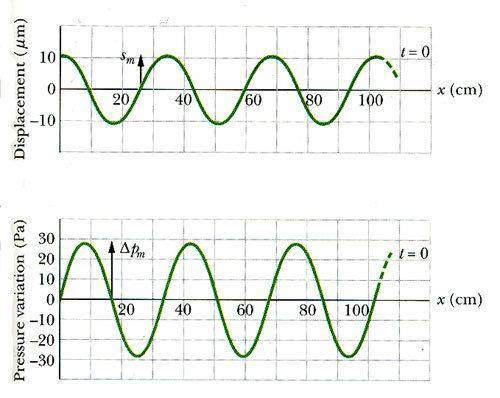
I'm so confused with particle displacement vs time graph and pressure vs time graph of sound. I thought maximum displacement of a particle is its compression and minimum displacement is its rarefaction. For some strange reason the graphs show exactly the opposite. How can the particles be at atmospheric pressure when the displacement is maximum. Your help would be greatly appreciated. Thanks :smile:
sound-graphs.jpg
 
Physics news on Phys.org
You need to understand how to read the displacement graph. If there were no sound wave, there would be undisturbed particles at every point x. The displacement at coordinate x tells you the displacement of the particles whose undisturbed position is at x. Thus if the displacement is a maximum at point x, it means that the particles that usually reside at point x have been displaced to the right (positive direction); If the displacement is a minimum, it means they've been displaced to the left. Thus the position where the pressure is maximum would be between a maximum and minimum of displacement. Make sense?
 
Note that in an ideal gas, pressure is proportional to density, when the temperature is kept constant.

Looking at your displacement graph, the molecules that are normally at x = 0 have moved to the right (+x direction), and the molecules that are normally at x = 18 have moved to the left. So in the region between x = 0 and x = 18, the density of the gas is higher than normal, and so is the pressure.
 
Thanks both of you for your replies :wink: They were both very helpful!

That was a great response jtbell I think I got it. Is it when particles move right and then particle further move left high pressure region is caused meaning compression and vise versa for rarefaction.

However as I just realized this is a displacement distance of wave graph. However my graph in my notes is identical but it has time in the axis. This is the closest pic I found in the interent. It is basically the same graph but with time in the x axis. I don't think it would make a difference. Would it? If that is so I got it :cool:

Thanks again for your replies! :cool:
 
This information is really very helpful ... thanks :D
 
Hello there!
I understood in part what you have said here. But how can compression and rarefaction regions correpond to zero particle displacement?
 
Nevermind, I got it :)
Thank you anyway!
 

Similar threads

  • · Replies 11 ·
Replies
11
Views
6K
  • · Replies 8 ·
Replies
8
Views
7K
  • · Replies 8 ·
Replies
8
Views
3K
  • · Replies 3 ·
Replies
3
Views
3K
  • · Replies 13 ·
Replies
13
Views
3K
  • · Replies 1 ·
Replies
1
Views
3K
  • · Replies 9 ·
Replies
9
Views
4K
  • · Replies 2 ·
Replies
2
Views
3K
  • · Replies 2 ·
Replies
2
Views
15K
  • · Replies 1 ·
Replies
1
Views
2K