Quick Question about Pendulum Graphs

Click For Summary

Discussion Overview

The discussion centers on the interpretation of position-time and velocity-time graphs for a pendulum, specifically addressing the implications of curved lines on these graphs and the nature of acceleration in pendulum motion. Participants explore concepts related to constant versus changing acceleration and how these concepts are represented graphically.

Discussion Character

  • Debate/contested
  • Technical explanation
  • Conceptual clarification

Main Points Raised

  • Some participants assert that curved lines on a velocity-time graph indicate increasing or decreasing acceleration, while others challenge this interpretation, suggesting that acceleration should be constant in the context of gravity acting on the pendulum.
  • One participant expresses confusion over the meaning of curved lines on a displacement-time graph, initially believing they indicate constant acceleration, and questions what constant acceleration would look like graphically.
  • Another participant clarifies that while a displacement-time graph can be curved, it does not necessarily imply constant acceleration, and provides examples of how constant acceleration appears in other scenarios, such as a falling object.
  • There is a discussion about the nature of tangential acceleration in pendulum motion, with some participants noting that it is not constant due to the forces acting on the pendulum.
  • Participants express differing views on the implications of their classroom teachings regarding graph interpretations, with some acknowledging potential misunderstandings.

Areas of Agreement / Disagreement

Participants do not reach a consensus on the interpretation of curved lines in displacement-time graphs or the nature of acceleration in pendulum motion. Multiple competing views remain regarding the implications of these graphs and the underlying physics.

Contextual Notes

Participants reference classroom teachings and personal interpretations, indicating that there may be misunderstandings or miscommunications regarding the concepts of acceleration and its graphical representation.

Abu
Messages
39
Reaction score
1
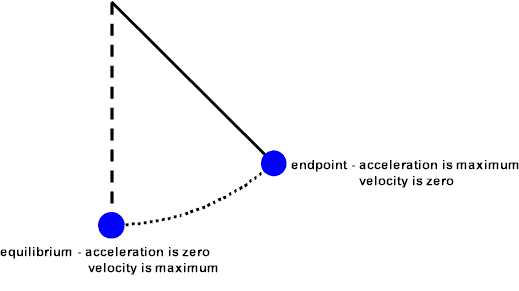
Hi everyone. I just have a very quick question regarding position time graphs and velocity time graphs for a pendulum.
226529dc-d552-4a64-9ed2-6236250b77d3.gif


As we know, at the maximum displacement, the acceleration is at its maximum and the velocity is zero, and vice versa when the displacement is zero.

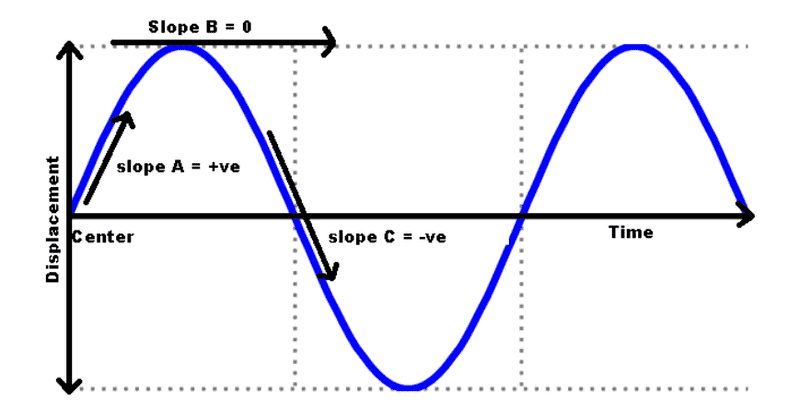
When we put this information on a velocity time graph, it looks like this:
2-2.png


When we have curved lines on a velocity time graph, as seen above, this means that there is increasing and decreasing acceleration, correct? Specifically, that means that the value of the acceleration itself is decreasing or increasing (for example, 10 m/s^2, 8 m/s^2, 5 m/s^2).

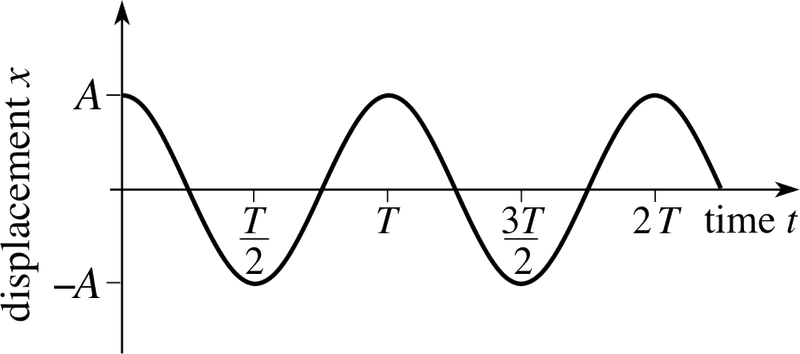
This information put onto a position time graph looks something like this:
phys5_1f_2.png


As we can see, there is once again curved lines. However, on a position or displacement time graph, these curved lines don't mean increasing acceleration or decreasing acceleration like they do for the velocity time graph, but instead they mean constant acceleration or constant deceleration.

So how can the displacement time graph use curved lines? It implies that the acceleration is a constant number that doesn't change, which is obviously not true as we see that the acceleration is zero at 0 displacement and the acceleration is at it's maximum value at the largest displacement, so obviously there must be a change, not constant.

I hope my question makes sense, thank you all for your patience.
 

Attachments

  • 226529dc-d552-4a64-9ed2-6236250b77d3.gif
    226529dc-d552-4a64-9ed2-6236250b77d3.gif
    3.4 KB · Views: 5,134
  • 2-2.png
    2-2.png
    12.5 KB · Views: 12,875
  • phys5_1f_2.png
    phys5_1f_2.png
    15.3 KB · Views: 3,011
Physics news on Phys.org
Abu said:
As we can see, there is once again curved lines. However, on a position or displacement time graph, these curved lines don't mean increasing acceleration or decreasing acceleration like they do for the velocity time graph, but instead they mean constant acceleration or constant deceleration.

So how can the displacement time graph use curved lines? It implies that the acceleration is a constant number that doesn't change, which is obviously not true as we see that the acceleration is zero at 0 displacement and the acceleration is at it's maximum value at the largest displacement, so obviously there must be a change, not constant.
Why in the world do you think that curved lines on a displacement vs time graph imply constant acceleration?
 
Doc Al said:
Why in the world do you think that curved lines on a displacement vs time graph imply constant acceleration?
Sorry, it's just what I've been taught in class. I was told that those curved lines on a displacement time graph would imply a constant acceleration or constant deceleration. I'm assuming that is wrong?

What would constant acceleration look like on a displacement-time graph, then? Or what does increasing/decreasing acceleration look like?

Thank you for your response and time.
 
Abu said:
When we have curved lines on a velocity time graph, as seen above, this means that there is increasing and decreasing acceleration, correct? Specifically, that means that the value of the acceleration itself is decreasing or increasing (for example, 10 m/s^2, 8 m/s^2, 5 m/s^2).
No, just think about this. Acceleration should always be constant, gravity is not changing it's force along the path of the pendulum. What's changing is the velocity here. That's why its a velocity graph.
Abu said:
As we can see, there is once again curved lines. However, on a position or displacement time graph, these curved lines don't mean increasing acceleration or decreasing acceleration like they do for the velocity time graph, but instead they mean constant acceleration or constant deceleration.

So how can the displacement time graph use curved lines? It implies that the acceleration is a constant number that doesn't change, which is obviously not true as we see that the acceleration is zero at 0 displacement and the acceleration is at it's maximum value at the largest displacement, so obviously there must be a change, not constant.
I do not understand what you are saying here.
Abu said:
Sorry, it's just what I've been taught in class. I was told that those curved lines on a displacement time graph would imply a constant acceleration or constant deceleration. I'm assuming that is wrong?
You are obviously very confused, go back to your teacher and discuss it with them and ask them to explain what they might have said in class.
 
Abu said:
Sorry, it's just what I've been taught in class. I was told that those curved lines on a displacement time graph would imply a constant acceleration or constant deceleration. I'm assuming that is wrong?
Yes, that is wrong. I suspect (and hope!) that you've just misheard what your teacher was saying in class. It's true that if something has a constant acceleration, then its displacement over time graph would be curved, but that does not mean that any curved displacement graph means constant acceleration.

Abu said:
What would constant acceleration look like on a displacement-time graph, then?
A good example of constant acceleration would be a falling object. Imagine tossing something straight up into the air. What would its displacement versus time graph look like?

Something like this:
displacement.jpg

When you examine a displacement - time graph, consider the slope of the graph at any point. (The slope of the line tangent to the graph at any point.) That slope describes the velocity at that point. In the above graph, the velocity (and thus the slope) starts out high and positive, keeps getting lower until at the top the velocity is momentarily zero, and then starts picking up speed as the object comes down (the velocity -- slope -- is negative). Given that, what would the velocity graph look like?

Something like this:
img_full_46320.gif


Note that the velocity graph is a straight line. (Unlike your pendulum motion example.) And the slope of the velocity graph gives the acceleration, which for a projectile is a constant (and negative).
Abu said:
Or what does increasing/decreasing acceleration look like?
In the case of the pendulum motion, the acceleration is not constant. It turns out that a graph of the acceleration versus time would also be sinusoidal, just like the displacement graph.
 

Attachments

  • displacement.jpg
    displacement.jpg
    5.3 KB · Views: 2,461
  • img_full_46320.gif
    img_full_46320.gif
    3 KB · Views: 2,035
  • Like
Likes   Reactions: Abu
lekh2003 said:
Acceleration should always be constant, gravity is not changing it's force along the path of the pendulum. What's changing is the velocity here.
While gravity is constant, the string also exerts a force on the pendulum. The tangential acceleration, which is what is being described here, is not constant.
 
  • Like
Likes   Reactions: lekh2003
Doc Al said:
While gravity is constant, the string also exerts a force on the pendulum. The tangential acceleration, which is what is being described here, is not constant.
Ahh, ok. I was mistaken.
 
Doc Al said:
Yes, that is wrong. I suspect (and hope!) that you've just misheard what your teacher was saying in class. It's true that if something has a constant acceleration, then its displacement over time graph would be curved, but that does not mean that any curved displacement graph means constant acceleration.A good example of constant acceleration would be a falling object. Imagine tossing something straight up into the air. What would its displacement versus time graph look like?

Something like this:
View attachment 217955
When you examine a displacement - time graph, consider the slope of the graph at any point. (The slope of the line tangent to the graph at any point.) That slope describes the velocity at that point. In the above graph, the velocity (and thus the slope) starts out high and positive, keeps getting lower until at the top the velocity is momentarily zero, and then starts picking up speed as the object comes down (the velocity -- slope -- is negative). Given that, what would the velocity graph look like?

Something like this:
View attachment 217956

Note that the velocity graph is a straight line. (Unlike your pendulum motion example.) And the slope of the velocity graph gives the acceleration, which for a projectile is a constant (and negative).

In the case of the pendulum motion, the acceleration is not constant. It turns out that a graph of the acceleration versus time would also be sinusoidal, just like the displacement graph.
Ah okay, thank you so much for your reply.

So it isn't necessarily wrong to say that a curved line on a displacement time graph represents constant acceleration or constant deceleration, but in some cases that curved line could mean an increasing or decreasing acceleration instead, right? I'm guessing the two variations would like pretty similar?

By the way, thank you very much for the effort and time you put into helping me, I really appreciate it.
 
Abu said:
So it isn't necessarily wrong to say that a curved line on a displacement time graph represents constant acceleration or constant deceleration, but in some cases that curved line could mean an increasing or decreasing acceleration instead, right?
I would put it more simply: A curved line on a displacement time graph implies some kind of acceleration (since the velocity is changing), but whether that acceleration is constant or changing depends on the details of that graph.

Abu said:
I'm guessing the two variations would like pretty similar?
In the projectile motion case, the displacement time graph is a parabola, but in the pendulum case the graph is sinusoidal. Those graphs look pretty different to me! :smile:
 
  • Like
Likes   Reactions: Abu

Similar threads

  • · Replies 49 ·
2
Replies
49
Views
4K
  • · Replies 13 ·
Replies
13
Views
2K
  • · Replies 1 ·
Replies
1
Views
2K
  • · Replies 1 ·
Replies
1
Views
2K
  • · Replies 8 ·
Replies
8
Views
3K
  • · Replies 25 ·
Replies
25
Views
4K
  • · Replies 1 ·
Replies
1
Views
2K
  • · Replies 13 ·
Replies
13
Views
2K
  • · Replies 17 ·
Replies
17
Views
2K
  • · Replies 13 ·
Replies
13
Views
3K