Particle in a box : Schrodinger Eq

Click For Summary

Homework Help Overview

The discussion revolves around the wave function solutions for a particle in a box scenario, specifically comparing two forms of the wave equation: one using sine and cosine functions and the other using exponential functions. Participants are exploring the relationship between these forms and their implications in quantum mechanics.

Discussion Character

  • Conceptual clarification, Mathematical reasoning

Approaches and Questions Raised

  • The original poster attempts to prove a wave equation using a different form than commonly presented and questions whether the two forms represent the same physical state. Participants discuss the validity of both forms and the implications of complex phases in wave functions.

Discussion Status

Participants have provided insights into the equivalence of the wave functions in terms of physical states, noting that while they are not the same wave function, they correspond to the same physical state. The discussion is ongoing, with multiple interpretations being explored regarding the necessity of using complex factors.

Contextual Notes

There is a focus on the normalization of wave functions and the linearity of the Schrödinger equation, with participants questioning the conventions used in selecting specific forms of the wave functions.

postechsung
Messages
3
Reaction score
1
Homework Statement
Particle in a box
Relevant Equations
Schrodinger Eq
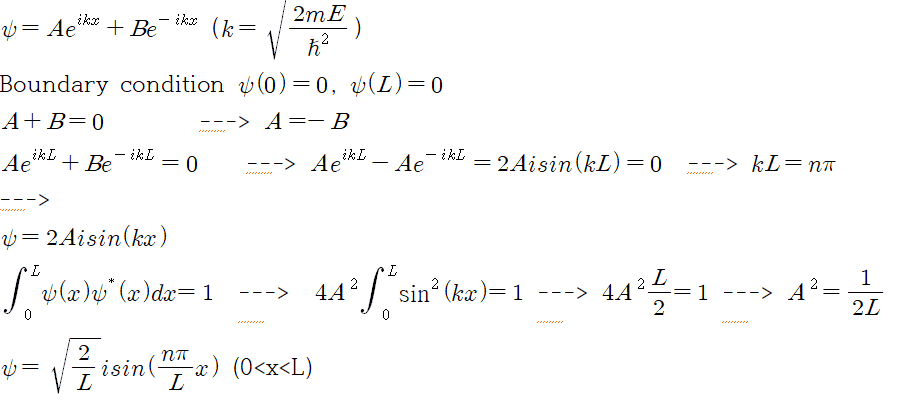
Hi, I'm trying to prove a wave equation of particle in a box situation.
In many solutions, they used a equation like Eq = Asin(kx)+Bcos(kx).
Instead, I want to prove using Eq = Aexp(ikx) + Bexp(-ikx).
So, this is my solution.
1603111981005.png

However, the original (well-known) solution is without i. (psi = sqrt(2/L) sin(n pi x/L)
Is two wave function is same? or is there any error in my solution?
Sorry for my bad English. I'm new to here and looking forward to get help.

THANKS!
 
Physics news on Phys.org
They are same. Any factor of magnitude 1 ,##e^{i\phi}##, can be multiplied to the answer.
 
  • Like
Likes   Reactions: postechsung
postechsung said:
However, the original (well-known) solution is without i. (psi = sqrt(2/L) sin(n pi x/L)
Is two wave function is same? or is there any error in my solution?
It's not the same wave function, but it corresponds to the same physical state. Physical states are defined up a an arbitrary complex phase ##e^{i \phi}##.
 
  • Like
Likes   Reactions: postechsung
DrClaude said:
It's not the same wave function, but it corresponds to the same physical state. Physical states are defined up a an arbitrary complex phase ##e^{i \phi}##.
If it's not the same wave function, does it mean there is an error in my solution?
Thanks for replying!
 
postechsung said:
If it's not the same wave function, does it mean there is an error in my solution?
Thanks for replying!
Both ##\psi_n(x)## and ##i\psi_n(x)## are normalised solutions of the equation. The mathematics cannot prefer one to the other. As the equation is linear, any solution can be expressed as a linear combination of ##\psi_n(x)## or a linear combination of ##i\psi_n(x)##. These are, therefore, equally valid as a set of basis solutions (eigenfunctions).

The only reason to choose ##\psi_n(x)## (by convention) is that the ##i## is unnecessary. And, having the eigenfunctions real valued may make them slightly easier to work with.
 
  • Like
Likes   Reactions: postechsung
anuttarasammyak said:
They are same. Any factor of magnitude 1 ,##e^{i\phi}##, can be multiplied to the answer.
DrClaude said:
It's not the same wave function, but it corresponds to the same physical state. Physical states are defined up a an arbitrary complex phase ##e^{i \phi}##.
PeroK said:
Both ##\psi_n(x)## and ##i\psi_n(x)## are normalised solutions of the equation. The mathematics cannot prefer one to the other. As the equation is linear, any solution can be expressed as a linear combination of ##\psi_n(x)## or a linear combination of ##i\psi_n(x)##. These are, therefore, equally valid as a set of basis solutions (eigenfunctions).

The only reason to choose ##\psi_n(x)## (by convention) is that the ##i## is unnecessary. And, having the eigenfunctions real valued may make them slightly easier to work with.

Thanks for amazing answers for solving my question.
 
  • Like
Likes   Reactions: PeroK

Similar threads

Replies
8
Views
1K
  • · Replies 1 ·
Replies
1
Views
1K
  • · Replies 4 ·
Replies
4
Views
2K
  • · Replies 6 ·
Replies
6
Views
2K
  • · Replies 1 ·
Replies
1
Views
2K
Replies
2
Views
1K
  • · Replies 6 ·
Replies
6
Views
2K
  • · Replies 2 ·
Replies
2
Views
2K
  • · Replies 3 ·
Replies
3
Views
2K
  • · Replies 31 ·
2
Replies
31
Views
5K