Passive Harmonic Filters (Power System)

Click For Summary

Discussion Overview

The discussion revolves around the use of passive harmonic filters in power systems, specifically focusing on their configuration and functionality in relation to non-linear loads. Participants explore questions about the effectiveness of these filters when the load is not grounded and the implications of different connection types (wye vs. delta) for harmonic current management.

Discussion Character

  • Exploratory
  • Technical explanation
  • Debate/contested

Main Points Raised

  • One participant questions whether a passive filter can effectively divert harmonic currents to ground if the non-linear load is not connected to ground, suggesting that the lack of a closed path for harmonics may hinder the filter's operation.
  • Another participant emphasizes that without a return wire, the load cannot draw current, implying that the "earth" connection serves as a necessary return path, which they refer to as "neutral."
  • Concerns are raised about the impedance of the path to ground, with a suggestion that a conductor may be needed to reduce this impedance for effective filtering.
  • There is a discussion about the appropriateness of delta connections for passive filters, particularly regarding the third harmonic, which is characterized as a zero sequence current. One participant argues that a delta connection would not provide a closed loop for this harmonic.
  • A participant reflects on their earlier questions, expressing confusion about the terminology used in literature regarding harmonic currents being "diverted to ground."

Areas of Agreement / Disagreement

Participants express differing views on the necessity of grounding for the operation of passive filters and the implications of using delta versus wye connections. The discussion remains unresolved, with multiple competing perspectives on these technical aspects.

Contextual Notes

Participants note potential confusion stemming from terminology in literature, particularly regarding the role of grounding and the nature of harmonic currents. The discussion highlights the importance of clear definitions and assumptions in understanding the operation of passive filters.

EEstudent90
Hi again, got a few questions (marked with numbers) for passive filters used to filter harmonic currents in the power system.
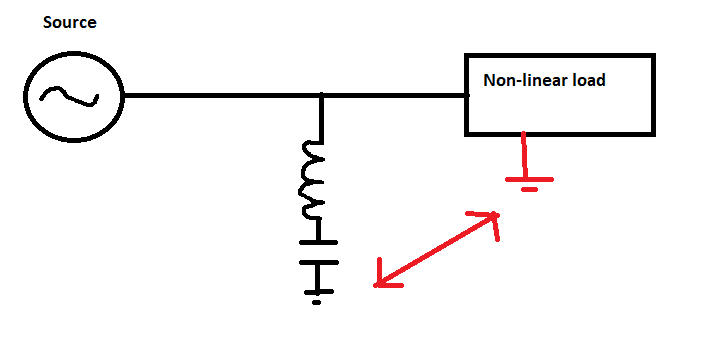
  1. Look at my one-line diagram below. Let's say I have a passive filter connected in shunt with respect to the load and the passive filter "diverts" the harmonic currents it is tuned for (let's say 5th harmonic) to ground. If my non-linear load is not connected to ground, would the passive filter work? We do not have any closed path for the harmonics to circulate in (if we neglect the capacitance between the load and earth), so I don't see how it could work. But I could use a delta connected passive filter, to provide the closed loop right? (Question 3 is somewhat related to this aswell).
  2. The main idea of a shunt passive filter is to provide a low impedance path for the tuned harmonic, so if the current has to flow through ground as shown in my picture below, this would be a relatively high impedance path right? Would we have to install a conductor to reduce this impedance?
upload_2017-9-24_12-8-4.png


Next question:
3. I have seen that you can connect the passive filters in either wye or delta. If I chose a delta connected passive filter, and I would want to provide a closed low impedance path for the third harmonic this would not work right? As the third harmonic is a so called zero sequence current, and the delta connection would look like a dead end, i.e. not a closed loop.

So if I wanted to compensate the third harmonics using a passive filter, I would need a similar setup as shown in my paint drawing above?Sorry if my post is a bit messy, I tried my best. Thanks for any help.
Best regards​
 
Engineering news on Phys.org
EEstudent90 said:
If my non-linear load is not connected to ground,
If the load doesn't have a return wire then it draws no current so is not a load. The "earth" wire you want to not have is just a convenient way to represent the essential second wire for current that powers the load. I think it should be termed the "neutral". The purpose of the filter is to provide a path that bypasses the harmonic current around the load, so the passive filter needs to correctly connect in shunt with the load. The connections need to be low resistance, so will be copper wires (even if one is named "earth").
 
MainsFilterCircuits.gif
 
  • Like
Likes   Reactions: donpacino
NascentOxygen said:
If the load doesn't have a return wire then it draws no current so is not a load. The "earth" wire you want to not have is just a convenient way to represent the essential second wire for current that powers the load. I think it should be termed the "neutral". The purpose of the filter is to provide a path that bypasses the harmonic current around the load, so the passive filter needs to correctly connect in shunt with the load. The connections need to be low resistance, so will be copper wires (even if one is named "earth").

I realize now that Q1 and Q2 might have been "stupid" :), I guess I got confused when I read a pdf I was studying saying "harmonic currents are diverted to ground" and should have thought about it before posting.
 

Similar threads

  • · Replies 2 ·
Replies
2
Views
2K
  • · Replies 5 ·
Replies
5
Views
2K
  • · Replies 9 ·
Replies
9
Views
2K
  • · Replies 6 ·
Replies
6
Views
3K
Replies
2
Views
2K
  • · Replies 46 ·
2
Replies
46
Views
4K
  • · Replies 8 ·
Replies
8
Views
3K
  • · Replies 41 ·
2
Replies
41
Views
7K
  • · Replies 2 ·
Replies
2
Views
2K
  • · Replies 9 ·
Replies
9
Views
2K