PDE and the separation of variables

Join the discussion
Ask a follow-up here, or get your own question answered by working scientists, mathematicians and engineers — people, not an autocomplete.
Real named experts · corrections over time · the nuance an AI answer skips
11 replies · 2K views
Magnetons
Messages
22
Reaction score
3
Homework Statement
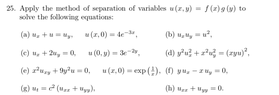
Apply the method of separation of variables ##u(x,y)=f(x)g(y)## to solve the equation .
Relevant Equations
##u_{t}=c^{2}(u_{xx}+u_{yy})##
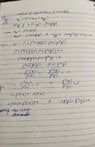
using the equation ##u(x,y)=f(x)g(y)##, first, I substitute the value of ##u_{xx}## and ##u_{yy}## in the given PDE. after that solve the ODEs but I can't understand about the ##u_{t}##.In my solution, I put ##u_{t}=0## because u is only the function of x and y. Is it the right approach, to me it seems wrong
 

Attachments
  • My_sol.jpeg
    My_sol.jpeg
    34.7 KB · Views: 143
Physics news on Phys.org
BvU said:
Aren't you supposed to separate in a different way ? In u(t) and u(x,y) for example :wink:

##\ ##

don't know it is how the question is given in the book
 
BvU said:
Well, you run into trouble with ##u_t=0##, so I suggest to try something different.

##\ ##
something different ..
 
Magnetons said:
Homework Statement: Apply the method of separation of variables ##u(x,y)=f(x)g(y)## to solve the equation .
Relevant Equations: ##u_{t}=c^{2}(u_{xx}+u_{yy})##

using the equation ##u(x,y)=f(x)g(y)##, first, I substitute the value of ##u_{xx}## and ##u_{yy}## in the given PDE. after that solve the ODEs but I can't understand about the ##u_{t}##.In my solution, I put ##u_{t}=0## because u is only the function of x and y. Is it the right approach, to me it seems wrong

If they wanted you to assume [itex]u_t = 0[/itex], would they not have just asked for [itex]u_{xx} + u_{yy} = 0[/itex]?

Perhaps you are expected to make the leap to [itex]u = h(t)f(x,y)[/itex].
 
Reply
  • Like
Likes   Reactions: BvU
pasmith said:
If they wanted you to assume [itex]u_t = 0[/itex], would they not have just asked for [itex]u_{xx} + u_{yy} = 0[/itex]?

Perhaps you are expected to make the leap to [itex]u = h(t)f(x,y)[/itex].
No ## u_t = 0 ## doesn't mention in question i assume it .
 

Attachments

  • Q26 .png
    Q26 .png
    13.6 KB · Views: 171
Magnetons said:
don't know it is how the question is given in the book
Yeah, they managed to confuse you (on purpose?) writing ##u(x,y)=f(x)g(y)## instead of ##u(p,q)=f(p)g(q)## or something less suggestive...

Your post #8 explains why. (and post#7 IS exercise 25 (h) ! )

##\ ##
 
BvU said:
Yeah, they managed to confuse you (on purpose?) writing ##u(x,y)=f(x)g(y)## instead of ##u(p,q)=f(p)g(q)## or something less suggestive...

Your post #8 explains why. (and post#7 IS exercise 25 (h) ! )

##\ ##
how should I solve this equation