PDE and the separation of variables

Click For Summary

Homework Help Overview

The discussion revolves around applying the method of separation of variables to solve a partial differential equation (PDE), specifically in the context of the heat equation. Participants are exploring the implications of assuming certain variables are independent and how to properly set up the separation of variables.

Discussion Character

  • Exploratory, Assumption checking, Problem interpretation

Approaches and Questions Raised

  • Participants discuss the substitution of variables in the PDE and question the validity of setting ##u_{t}=0##. There are suggestions to separate the variables differently, considering functions of time and space. Some participants express confusion over the problem's presentation and its implications.

Discussion Status

The discussion is ongoing, with participants providing alternative perspectives on how to approach the problem. Some suggest reconsidering the assumption of ##u_{t}=0##, while others point out potential confusion in the problem's wording. No consensus has been reached, but various interpretations are being explored.

Contextual Notes

Participants note that the problem is presented in a way that may lead to misunderstandings regarding the separation of variables. There is mention of specific exercises from a textbook, indicating that the context may be influenced by the way the question is framed.
Magnetons
Messages
22
Reaction score
3
Homework Statement
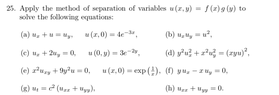
Apply the method of separation of variables ##u(x,y)=f(x)g(y)## to solve the equation .
Relevant Equations
##u_{t}=c^{2}(u_{xx}+u_{yy})##
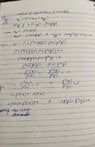
using the equation ##u(x,y)=f(x)g(y)##, first, I substitute the value of ##u_{xx}## and ##u_{yy}## in the given PDE. after that solve the ODEs but I can't understand about the ##u_{t}##.In my solution, I put ##u_{t}=0## because u is only the function of x and y. Is it the right approach, to me it seems wrong
 

Attachments

  • My_sol.jpeg
    My_sol.jpeg
    34.7 KB · Views: 124
Physics news on Phys.org
Aren't you supposed to separate in a different way ? In u(t) and u(x,y) for example :wink:

##\ ##
 
Google 'heat equation'
 
BvU said:
Aren't you supposed to separate in a different way ? In u(t) and u(x,y) for example :wink:

##\ ##

don't know it is how the question is given in the book
 
Well, you run into trouble with ##u_t=0##, so I suggest to try something different.

##\ ##
 
BvU said:
Well, you run into trouble with ##u_t=0##, so I suggest to try something different.

##\ ##
something different ..
 
Magnetons said:
Homework Statement: Apply the method of separation of variables ##u(x,y)=f(x)g(y)## to solve the equation .
Relevant Equations: ##u_{t}=c^{2}(u_{xx}+u_{yy})##

using the equation ##u(x,y)=f(x)g(y)##, first, I substitute the value of ##u_{xx}## and ##u_{yy}## in the given PDE. after that solve the ODEs but I can't understand about the ##u_{t}##.In my solution, I put ##u_{t}=0## because u is only the function of x and y. Is it the right approach, to me it seems wrong

If they wanted you to assume u_t = 0, would they not have just asked for u_{xx} + u_{yy} = 0?

Perhaps you are expected to make the leap to u = h(t)f(x,y).
 
  • Like
Likes   Reactions: BvU
pasmith said:
If they wanted you to assume u_t = 0, would they not have just asked for u_{xx} + u_{yy} = 0?

Perhaps you are expected to make the leap to u = h(t)f(x,y).
No ## u_t = 0 ## doesn't mention in question i assume it .
 

Attachments

  • Q26 .png
    Q26 .png
    13.6 KB · Views: 153
Magnetons said:
don't know it is how the question is given in the book
Yeah, they managed to confuse you (on purpose?) writing ##u(x,y)=f(x)g(y)## instead of ##u(p,q)=f(p)g(q)## or something less suggestive...

Your post #8 explains why. (and post#7 IS exercise 25 (h) ! )

##\ ##
 
  • #10
BvU said:
Yeah, they managed to confuse you (on purpose?) writing ##u(x,y)=f(x)g(y)## instead of ##u(p,q)=f(p)g(q)## or something less suggestive...

Your post #8 explains why. (and post#7 IS exercise 25 (h) ! )

##\ ##
how should I solve this equation
 
  • #11
pasmith said:
make the leap to u = h(t)f(x,y).
 
  • Like
Likes   Reactions: Magnetons
  • #12
Found a satisfactory solution ?

##\ ##
 

Similar threads

Replies
1
Views
2K
Replies
2
Views
2K
  • · Replies 5 ·
Replies
5
Views
2K
  • · Replies 21 ·
Replies
21
Views
2K
Replies
5
Views
2K
  • · Replies 5 ·
Replies
5
Views
2K
Replies
5
Views
4K
  • · Replies 2 ·
Replies
2
Views
1K
  • · Replies 2 ·
Replies
2
Views
2K
  • · Replies 5 ·
Replies
5
Views
4K