SUMMARY
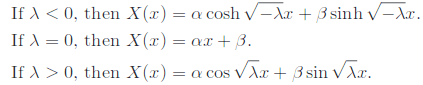
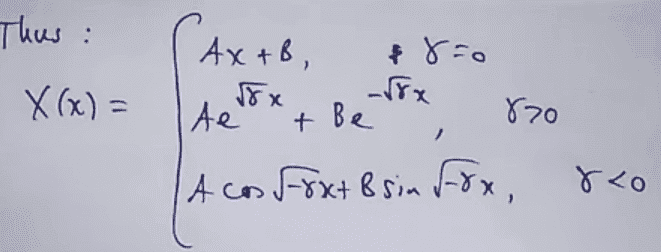
The discussion focuses on the heat equation and the implications of the parameter lambda in the context of separation of variables. Specifically, it addresses the scenario where lambda equals zero and explores whether this case yields a different equation. The key takeaway is that when lambda equals zero, the equation simplifies to a second-order differential equation, specifically ##\frac{d^2}{dx^2}X(x)=0##, which has linear solutions.
PREREQUISITES
- Understanding of partial differential equations (PDEs)
- Familiarity with the heat equation
- Knowledge of separation of variables technique
- Basic calculus and differential equations
NEXT STEPS
- Study the implications of lambda values in the heat equation
- Explore solutions to the equation ##\frac{d^2}{dx^2}X(x)=0##
- Learn about boundary conditions in the context of PDEs
- Investigate the role of eigenvalues in solving differential equations
USEFUL FOR
Students and researchers in mathematics, physicists studying heat transfer, and engineers working with thermal systems will benefit from this discussion.