Penetration Depth Review - Exam Prep

Click For Summary
SUMMARY

This discussion focuses on solving a physics problem related to penetration depth and evanescence waves using a He-Ne laser (λ = 623 nm). The problem requires calculating the angle of incidence at the air-prism boundary and the penetration depth into water. The correct angle of incidence is determined to be 41.6 degrees, using the refractive indices n1 = 2 and n2 = 1.33. For penetration depth, the formula y = 1/α is utilized, where α = 2ωn1/c, leading to a penetration depth of half the wavelength of light in the medium associated with n1.

PREREQUISITES
  • Understanding of Snell's Law and refractive indices
  • Familiarity with evanescent waves and their properties
  • Knowledge of wave propagation and penetration depth concepts
  • Basic understanding of laser physics, specifically He-Ne lasers
NEXT STEPS
  • Study Snell's Law and its applications in optics
  • Learn about evanescent waves and their significance in optical physics
  • Research penetration depth calculations in various media
  • Explore the properties of He-Ne lasers and their applications in experiments
USEFUL FOR

Students preparing for physics exams, particularly those focusing on optics and wave phenomena, as well as educators looking to enhance their understanding of evanescent waves and penetration depth calculations.

nmsurobert
Messages
288
Reaction score
36
This is a review problem for an upcoming exam. I'm pretty sure a problem very similar to this will be on the exam. And surprise surprise I'm freaken lost.

1. Homework Statement

A high index prism is used to launch an evanescence wave at the water/prism interface as shown. A He-Ne laser (λ = 623 mm) is used as the light source.
a) find the required angle to excite the evanescence wave.
b) calculate the penetration depth, the distance into the water at which the amplitude of the evanescence wave has dropped to a value of 1/e of its maximum value at the interface, into the water.
This is the picture connected to the problem.
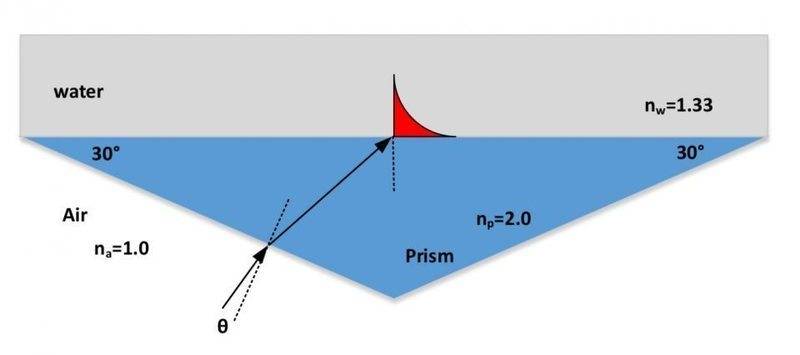
image.jpeg

Homework Equations

The Attempt at a Solution


For part (a) I thought sinθ*n1 = sin90*n2, where n1 = 1 and n2 = 2, solve for θ would give me a solution. It did for for one of his homework assignments. But it doesn't work here.

For (b) I think I need to get the answer to part (a) first but even then I'm still stuck. My book had two sentences related to penetration depth so it's no help at all.
 
Physics news on Phys.org
ok for (b) i found that to get the drop by e-1 the wave has to propagate a distance of y = 1/α. where α = 2ωn1/c.

if i solve for ω and plug it in the i get y = 5x10⁻⁸.

does that sound right?
 
for part (a) is n1 = 2 and n2 = 1.33? i get a solution with that. 41.6 degrees
 
nmsurobert said:
for part (a) is n1 = 2 and n2 = 1.33? i get a solution with that. 41.6 degrees
I think they're looking for the angle of incidence θ at the air-prism boundary. So you need to deal with both interfaces. One to find the critical angle of incidence for the prism-water boundary, the second to find the angle of incidence required at the air-prism boundary.

nmsurobert said:
ok for (b) i found that to get the drop by e-1 the wave has to propagate a distance of y = 1/α. where α = 2ωn1/c.

I'm not too familiar with the details of penetration depth. But those expressions only reference one refractive index, n1. Is there some context surrounding the expressions that would clarify the scenario?

From your information, y = 1/α = (c/ω)/(2n1) = (λ/n1)(1/2)

That would make the penetration depth a half wavelength of the light in whatever medium n1 is associated with.
 

Similar threads

Replies
1
Views
2K
  • · Replies 1 ·
Replies
1
Views
2K
Replies
5
Views
2K
  • · Replies 1 ·
Replies
1
Views
4K
Replies
6
Views
2K
  • · Replies 6 ·
Replies
6
Views
3K
  • · Replies 1 ·
Replies
1
Views
2K
  • · Replies 9 ·
Replies
9
Views
2K
  • · Replies 3 ·
Replies
3
Views
30K
  • · Replies 1 ·
Replies
1
Views
6K