Jolb said:
I'd like to know how to interpret Penrose diagrams. I'm having trouble understanding what it is they're actually showing and why they'd be useful.
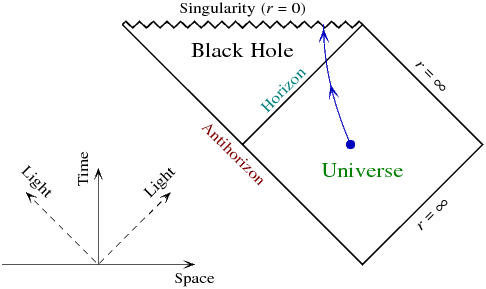
Two key advantages of Penrose diagrams are that they show causal structure easily (i.e., which parts of the spacetime can send or receive causal influences to or from which other parts of the spacetime), and that they make the conformal structure of the spacetime obvious (i.e., what kinds of "infinity" are in the spacetime and how they are structured).
Jolb said:
Why is it useful to squish down the geometry of spacetime so that infinity is on the edges?
Because there are different kinds of "infinity" that a spacetime can have, and it's useful to know which kinds a particular spacetime has.
For example, consider the diamond labeled "Universe" in the diagram you gave. The right corner of the diamond is called "spacelike infinity" or ##i^0##; the two 45 degree lines on the right (labeled r = infinity) are called "future null infinity" (the upper one), or ##\mathscr{I}^+##, and "past null infinity" (the lower one), or ##\mathscr{I}^-##, and the top and bottom corners are called "future timelike infinity" (the top one), or ##i^+##, and "past timelike infinity" (the bottom one), or ##i^-##. The diagram tells us some key things about these infinities:
##i^0## is a single point: that means all spacelike lines that go to infinity (a spacelike line can be thought of as a "line of constant time") all meet at a single point at infinity. There are some spacetimes that don't have a spacelike infinity at all, so the diagram is useful in telling us that this isn't one of them.
##i^+## and ##i^-## are also single points: that means all timelike lines (i.e., all possible worldlines of ordinary objects with nonzero rest mass) converge in the infinite past and the infinite future. There are spacetimes which do not have future and/or past timelike infinities, but instead have something else there, such as a singularity (not to be confused with the black hole singularity in this spacetime); again, the diagram is useful in telling us what we are dealing with.
##\mathscr{I}^+## and ##\mathscr{I}^-## are not points, but lines; this indicates that light rays coming in from the infinite past, and light rays going out to the infinite future, (a) do *not* go to or come from "the same place" as spacelike lines or timelike lines, which is important in itself; and (b) do not all go to or come from "the same place" even among themselves--different light rays go to or come from different points at infinity. This allows us to label light rays according to which particular point at infinity they go to or come from, which can be useful.
Jolb said:
What significance does it have to cross from the lower diamond to the top left triangle, other than that now you're inside the event horizon?
Notice that the event horizon itself is a 45-degree line. 45-degree lines in Penrose diagrams are causal boundaries--in this case, the horizon is the boundary of a region of spacetime, the black hole, that cannot send causal signals to future infinity (null and timelike). The Penrose diagram makes this obvious: no point in the upper left triangle can be connected by a causal line (45 degrees upward or more vertical than that) to any point in the "Universe" diamond or its boundaries at infinity.
This also shows another reason why squishing down the geometry so infinity is brought into a finite point is useful: if you didn't do that, it would be harder to tell whether or not a particular point can be connected to infinity by a causal line. With infinity at a finite point on the diagram, it's simple.
Jolb said:
Is the diagram showing us that the horizon is a coordinate singularity
No. Being a coordinate singularity depends on the coordinates you use. The horizon is not a coordinate singularity in Penrose coordinates (the ones used to draw the diagram).
Jolb said:
and that's why it would be located toward the future at infinity?
The horizon is not at infinity; it's not on a boundary of the diagram. One key thing that the diagram doesn't communicate well: the horizon doesn't actually connect to ##i^+## (the top point of the "Universe" diamond); that connection is blocked by the singularity at the top of the diagram.
Jolb said:
Is this also showing that the event horizon becomes light-like when viewed from some reference frame accellerated such that it doesn't fall into the singularity?
The event horizon is lightlike in any reference frame; being lightlike is an invariant property and is not frame-dependent. However, it is true that the fact of the horizon being lightlike can be easily read off from a Penrose diagram, unlike some other coordinate diagrams: the horizon is a 45-degree line.