binzing
- 281
- 0
I already know how to make good photos and what I like, I'm trying to go pro. I was just asking if you thought it was a good deal. It comes with prolly like 5 or 6 lenses. For $300!
binzing said:I already know how to make good photos and what I like, I'm trying to go pro. I was just asking if you thought it was a good deal. It comes with prolly like 5 or 6 lenses. For $300!
It's notabeaver.lisab said:
 We have lots of notabeavers in our area. We used to have a family of them in our yard before I relocated them some miles away. They are notawelcome here.
 . This was taken in Av mode. I later changed to manual, and made the shutter speed sufficiently fast to get a couple of other images with the bee clearly in focus.
 binzing said:OK, here's everything it comes with.
Albinar ADG 28 mm f 1:2.8, Sigma 35mm to 70mm f2.8-22, JC Penney 80mm to 200mm f4.5-22, Minolta 50mm f1.7-22, Minolta 50mm f1.7-16, 2x teleconverter, set of 14, 21, and 28mm Minolta Extension Tubes, Minolta Auto Winder, Sunpak MX - 1D Hot Shoe Adapter, Sunpak MX - 2D Hot Shoe Adapter, 16" Elect, Cable Release and Misc.
This is word-for-word. All that for $300 what do you think?
Cool picture, neutrino. I'd leave the shadows as they are. If you process the photo, just sharpen it.neutrino said:Sunday! I got to use my camera again after a week. I noticed a flower in front of our house that I usually miss. It was just after mid-day and the bright sun above created a nice photo-op. (although I was cramped for space.) And there was this insect (I'm just going to call it a bee) to boot!
I haven't processed this shot, and I'm looking for tips. The shadow at the bottom right has to go, right? Too bad the bee appears fuzzy
neutrino said: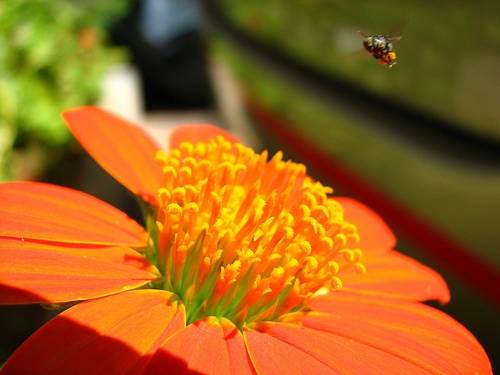
Sunday! I got to use my camera again after a week. I noticed a flower in front of our house that I usually miss. It was just after mid-day and the bright sun above created a nice photo-op. (although I was cramped for space.) And there was this insect (I'm just going to call it a bee) to boot!
I haven't processed this shot, and I'm looking for tips. The shadow at the bottom right has to go, right? Too bad the bee appears fuzzy
A larger version can be found http://farm3.static.flickr.com/2391/2270482871_ce3cbc9133_b.jpg".
binzing said:OK, here's everything it comes with.
Albinar ADG 28 mm f 1:2.8, Sigma 35mm to 70mm f2.8-22, JC Penney 80mm to 200mm f4.5-22, Minolta 50mm f1.7-22, Minolta 50mm f1.7-16, 2x teleconverter, set of 14, 21, and 28mm Minolta Extension Tubes, Minolta Auto Winder, Sunpak MX - 1D Hot Shoe Adapter, Sunpak MX - 2D Hot Shoe Adapter, 16" Elect, Cable Release and Misc.
This is word-for-word. All that for $300 what do you think?
Mech_Engineer said: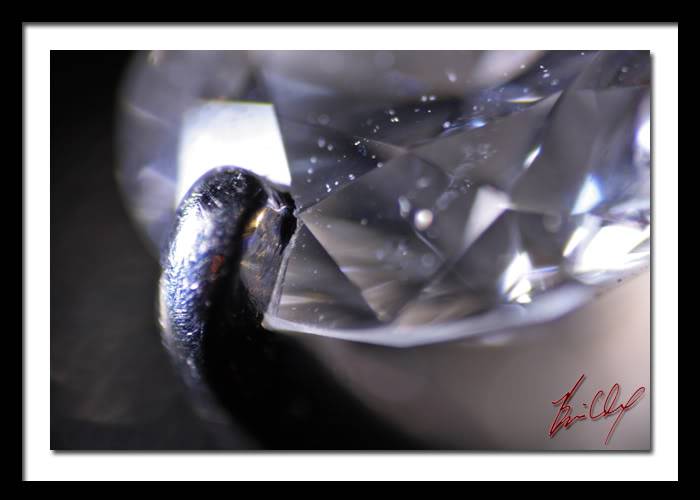
It may help to reduce the aperture on shots like this to get the depth of field a little larger so that more of the flower is in focus. This will increase the exposure time, so flying bees will be blurred. I like to catch them when they're working, so blur won't be as much of a problem.neutrino said:Thanks for the feedback, Astro and larkspur. I actually made an error in my earlier post. This was taken in manual mode, but 1/1000s wasn't fast enough.
larkspur, I had trouble focussing due to the glare from the sun. The flower was bright and the tightly-packed stamens didn't help much. :(
larkspur said:Thats a cool shot. What is being done to the diamond? I see the little flecks coming off in nice detail.
In manual mode, it's best to increase the f/stop (reduce aperture size) to get a greater depth of field as turbo mentioned. For that reason, I prefer manual as opposed to autofocus. I still have to get around to using my new DSLR.neutrino said:Thanks for the feedback, Astro and larkspur. I actually made an error in my earlier post. This was taken in manual mode, but 1/1000s wasn't fast enough.
larkspur, I had trouble focussing due to the glare from the sun. The flower was bright and the tightly-packed stamens didn't help much. :(
turbo-1 said:It is a bit on the pricey side, but the image quality is great over all of its focal length range, and I have noticed that a lot of nature photographers are using this lens instead of (or along with) primes. Critters tend to move around, and since they aren't posing for you (most of the time) you often need to be able to change focal length on the fly. The built-in image stabilization (with 2 modes available) and very fast auto-focus capabilities make this a very versatile lens in fast-changing situations. I've got another 30D that pretty much stays mounted to a 28-135mm zoom, so two cameras can cover a LOT of ground. When I was shooting film, I used to tote 3-4 Olympus bodies, all with prime lenses.
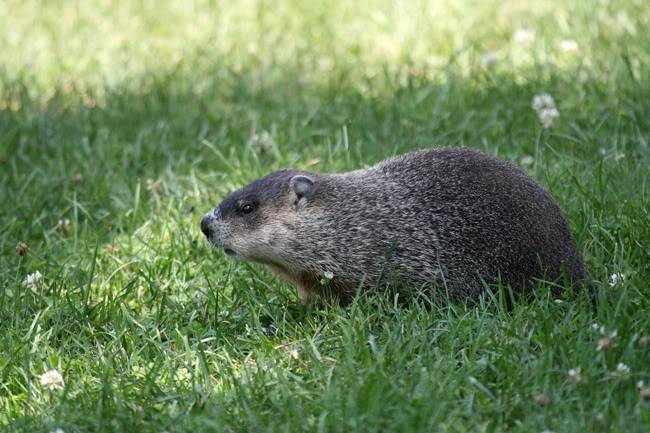
turbo-1 said:I went to a park along the Kennebec river looking for raptors one day last summer, but the only interesting character I found was this fellow.
turbo-1 said:It may help to reduce the aperture on shots like this to get the depth of field a little larger so that more of the flower is in focus. This will increase the exposure time, so flying bees will be blurred. I like to catch them when they're working, so blur won't be as much of a problem.
http://i183.photobucket.com/albums/x318/turbo-1/thistle_bee.jpg
Astronuc said:In manual mode, it's best to increase the f/stop (reduce aperture size) to get a greater depth of field as turbo mentioned. For that reason, I prefer manual as opposed to autofocus. I still have to get around to using my new DSLR.
turbo-1 said:neutrino, with my camera, you can half-way depress the shutter button to set the autofocus, then re-frame your shot while holding the button, then fully depress to get the shot. I tend to use autofocus a lot more than I thought I would for that feature alone.
 )
)It seems the detail in the petals have been lost somewhat. Needs a tiny bit of yellow in the reds(selective color).neutrino said:Here's another shot from the same batch as the previous photo. (please wear a pair of sunglasses before viewing the flower.
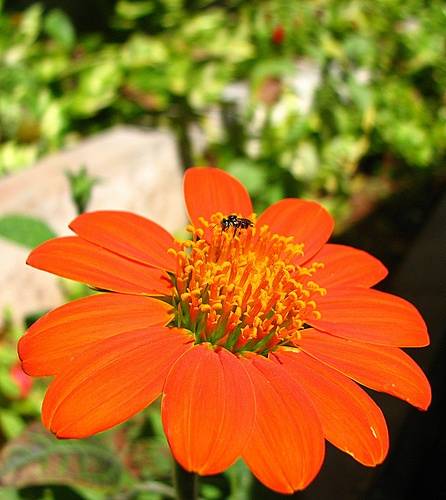
Crop and unsharp mask. Does any of you think the background stuff on top is distracting?