Phase Diagrams at Very Low Concentration of one Component

Click For Summary
SUMMARY

The discussion centers on the behavior of thorium during the casting of uranium alloys at very low concentrations, specifically when uranium decays to thorium. It is established that thorium fractionates to the slag and crucible rather than remaining in the uranium melt, despite its low concentration, typically in parts per billion or million. Material scientists argue that such low concentrations are too dilute to form separate phases; however, the mechanisms driving this fractionation are linked to the partition coefficient, indicating that thorium has a significantly higher affinity for slag than for uranium. This phenomenon occurs in various scenarios, including bomb reduction and simple casting processes.

PREREQUISITES
  • Understanding of phase diagrams and partition coefficients
  • Knowledge of uranium and thorium isotopes and their decay processes
  • Familiarity with casting processes in metallurgy
  • Basic principles of material science related to alloy behavior
NEXT STEPS
  • Research the partition coefficient of thorium in uranium alloys
  • Study the effects of convection and induction mixing on melt behavior
  • Explore phase diagrams for uranium-thorium systems
  • Investigate the implications of radiogenic decay in metallurgical processes
USEFUL FOR

Material scientists, metallurgists, and researchers involved in uranium casting and alloy development will benefit from this discussion, particularly those focusing on the behavior of trace elements in high-temperature processes.

doollas
Messages
4
Reaction score
0
What happens to one of the components when it is at VERY low concentration in a two component alloy? My problem: Uranium decays to thorium. The thorium isotopes it decays to typically have pretty short half lives. During casting, it is well known that thorium fractionates to the slag, crucible, or pretty much anywhere else besides the uranium melt. However, the thorium is at VERY low concentrations (radiogenic Thorium at parts per billion, typically natural thorium isn't there but if it is, we are still talking at maybe a part per million). When talking with a material scientists thus far, they claim that anything at that low of concentration is too dilute to form any separate phases, so what mechanisms could be driving this fractionation? The phase diagram for the two is below. Maybe I'm reading it wrong and this is obvious to some of you, any help would be greatly appreciated!
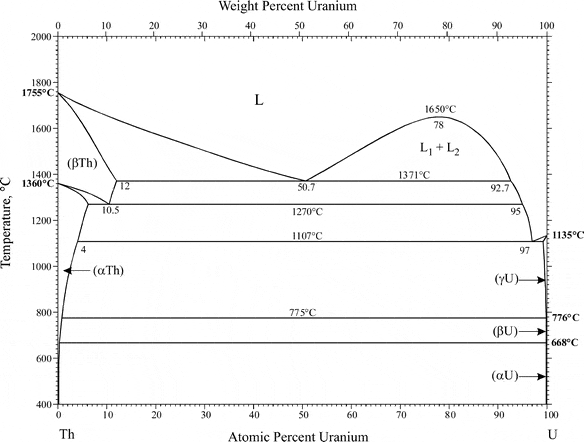
UTh.gif
 
Engineering news on Phys.org
"Slag" isn't part of the phase diagram, so it's not exactly a phase diagram question, more of a partition coefficient one - if Th has a higher affinity for "slag" than uranium, that's where it will go, even if on its own it would not phase-separate from U.
 
So that would happen just through random contact due to convection/induction mixing the melt? This fractionation happens in all kinds of scenarios whether it is a bomb reduction, simple casting where there is just an oxide slag, etc. The Th tends to concentrate on just about everything BUT the U, so it sounds like Th has a very high partition coefficient for everything in these scenarios but U, with respect to U (K=>>>>1 [slag,crucible]/[U melt])? Thanks!
 
Well, don't quote me, 'cos I'm no expert on uranium casting; but "sticking to something else" is conceptually different from "phase-separating from uranium", and in principle, if favourable, will still happen at very low concentrations where phase separation wouldn't be expected to. That's what I thought anyway.
 

Similar threads

Replies
3
Views
2K
  • · Replies 21 ·
Replies
21
Views
3K
  • · Replies 10 ·
Replies
10
Views
2K
  • · Replies 13 ·
Replies
13
Views
5K
  • · Replies 2 ·
Replies
2
Views
5K
Replies
10
Views
13K
  • · Replies 0 ·
Replies
0
Views
2K
  • · Replies 6 ·
Replies
6
Views
35K
  • · Replies 49 ·
2
Replies
49
Views
12K
Replies
3
Views
2K