Physics Graph Word Problem -- Motion of a person skiing down a slope

Click For Summary
SUMMARY

The discussion focuses on solving a physics problem involving the motion of a skier down a slope, specifically using the equations of motion under uniform acceleration. Key concepts include the use of the SUVAT equations, particularly the equation d = 0.5at^2, where d represents displacement, a is acceleration, and t is time. The gravitational acceleration of 9.8 m/s² is mentioned, but it is clarified that the skier's acceleration may differ since they are not in free fall. Participants emphasize the importance of plotting graphs based on the derived equations to visualize the skier's motion.

PREREQUISITES
  • Understanding of basic kinematics and motion equations
  • Familiarity with the SUVAT equations
  • Knowledge of graphing techniques for mathematical functions
  • Concept of uniform acceleration in physics
NEXT STEPS
  • Study the SUVAT equations in detail, focusing on their applications in various motion scenarios.
  • Learn how to derive and manipulate the equation d = 0.5at^2 for different values of acceleration.
  • Practice graphing quadratic functions to represent motion under uniform acceleration.
  • Explore the effects of varying acceleration on displacement and velocity in real-world scenarios.
USEFUL FOR

This discussion is beneficial for physics students, educators, and anyone interested in understanding the principles of motion and graphing techniques in kinematics.
Lui4
Messages
22
Reaction score
2
Homework Statement
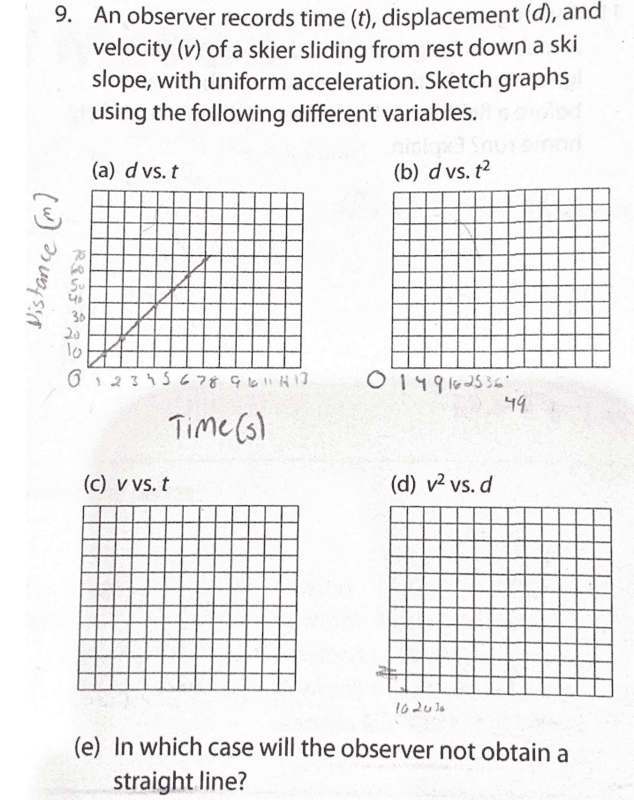
An observer records time (t), displacement (d), and velocity (v) of a skier sliding from rest down a ski slope, with uniform acceleration. Sketch graphs using the following different variables.
Relevant Equations
The graphs. See below.
I was able to do the first graph knowing that acceleration is 9.8 and my distance goes up by 10s (y-axis) and my time goes up by 1s (x-axis). For the other 3 graphs, I'm not sure where to begin because I don't know how to figure out my velocity

1608006323549.png
 
Last edited by a moderator:
Physics news on Phys.org
What does the phrase "uniform acceleration" mean, with regards to time, displacement and velocity ? Are you familiar with the 'SUVAT' equations ?
 
You first must write the relevant equations and then do the graphs!
So , let's start from scratch, what equation do you know, in the case of moving in a straight line with uniform acceleration a, that relates d (displacement) and t(time), and given that the initial velocity ##v_0=0##,i.e the skier starts from rest.
 
  • Like
Likes   Reactions: Lui4
hmmm27 said:
What does the phrase "uniform acceleration" mean, with regards to time, displacement and velocity ? Are you familiar with the 'SUVAT' equations ?
I'm not sure what it means either but the guess I made is 9.8 because the gravitational pull of the Earth is 9.8m/s. The only information given is what is shown in the pictures I attached of the question.
 
Delta2 said:
You first must write the relevant equations and then do the graphs!
So , let's start from scratch, what equation do you know, in the case of moving in a straight line with uniform acceleration a, that relates d (displacement) and t(time), and given that the initial velocity ##v_0=0##,i.e the skier starts from rest.
I'm not sure of what equation to use in a straight line with uniform acceleration. The guess that I made is that we go up by 9.8m/s because 9.8 is the gravitational pull of the earth. I'm not sure where to start with the problem at all.
 
Lui4 said:
I'm not sure of what equation to use in a straight line with uniform acceleration.
That is basic theory, and if you don't know this I doubt if I ll be able to help you. Oh well, let's see does the equation $$d=\frac{1}{2}at^2$$ ring a bell to you?
 
Yes this does ring a bell this is taken from the formula d=volt+1/2at^2. Now that I know this formula what exactly do I need to do with it as there is no numbers given. The solution that I think using this equation would be 0.5 x 9.8 which would leave us at D=4.9t^2. I don't think that is correct but that is my thought process.
 
  • Like
Likes   Reactions: Delta2
Why do you think that you are required to mark numbers on the graphs ?
 
  • Like
Likes   Reactions: Delta2
Lui4 said:
Yes this does ring a bell this is taken from the formula d=volt+1/2at^2. Now that I know this formula what exactly do I need to do with it as there is no numbers given. The solution that I think using this equation would be 0.5 x 9.8 which would leave us at D=4.9t^2. I don't think that is correct but that is my thought process.
ok much better, though your final equation D=4.9t^2 is not necessarily correct, because we don't know if the acceleration of the skier is equal to 9.8, all we are given from the problem data is that his acceleration is uniform (constant). The acceleration of the skier would be 9.8 if the skier was doing a free fall, however he doesn't do a free fall, he moves down a slope (incline).

So we ll just keep the unknown acceleration ##a## of the skier as parameter to the equation $$d=\frac{1}{2}at^2$$. Using this equation you can make the first two graphs a) and b). So let's start with a) what do you think the graph for a) will be given that equation that relates d and t?
 
  • #10
Okay I understand the point you made of if the skier was in free fall it would be 9.8 but since he is moving down a slope It's not 9.8. I also understand that the skier moves at a constant rate. The last part of your response is where I'm confused. My only guess would be 1/2 is equal to 0.5 meaning it would be something like d=0.5at^2 but that's the same thing just in decimal form. My original question is how to figure out the information I need to plot. You have given me the formula but I don't know what to do with it.
 
  • #11
hmmm27 said:
Why do you think that you are required to mark numbers on the graphs ?
Mark Numbers? We need numbers for the x and y-axis and that's what I'm trying to figure out. After we figure that out I don't know what to plot.
 
  • #12
Lui4 said:
Okay I understand the point you made of if the skier was in free fall it would be 9.8 but since he is moving down a slope It's not 9.8. I also understand that the skier moves at a constant rate. The last part of your response is where I'm confused. My only guess would be 1/2 is equal to 0.5 meaning it would be something like d=0.5at^2 but that's the same thing just in decimal form. My original question is how to figure out the information I need to plot. You have given me the formula but I don't know what to do with it.
yes 1/2 is the same as 0.5.

To plot the graph a) label the horizontal axis with the values of time 0,1,2,3,4,..., and the vertical axis as 0,##a##,##2a##,##3a##,...,. You know for example for t=1 we have ##d=0.5a(1^2)=0.5a##, for t=2 we ll have ##d=0.5a(2^2)=2a##, and so on you can plot the graph. If you plot it well, it will be a parabola with its vertex at the point (0,0).

To plot the graph b) you need to do a small trick: Set ##x=t^2## and then you will have ##d=0.5ax## and plot this graph with the horizontal axis the values of x=0,1,2,3,... and the vertical axis as in graph a). if you plot it will it will be a sloped line passing through the origin.
 
Last edited:
  • #13
Lui4 said:
I also understand that the skier moves at a constant rate.
A constant rate of what ? Velocity ?

Look, if it helps get you in the swing of things, use a=1 or 2.

So,
at t=0, what is the displacement ?
at t=1, what is the displacement ?
at t =... you can see where I'm going with this, yes ?
 
  • #14
hmmm27 said:
Look, if it helps get you in the swing of things, use a=1 or 2.
Yes that might be a good advice if he has difficulty considering distance d with the unknown acceleration ##a## as parameter.
 
  • #15
I'd prefer if he started juggling the equations first, as you indicated a few posts ago. OTOH grinding through has its advantages.
 
  • Like
Likes   Reactions: Delta2

Similar threads

  • · Replies 5 ·
Replies
5
Views
2K
Replies
12
Views
4K
  • · Replies 4 ·
Replies
4
Views
6K
Replies
7
Views
2K
  • · Replies 30 ·
2
Replies
30
Views
4K
Replies
12
Views
2K
Replies
39
Views
3K
  • · Replies 2 ·
Replies
2
Views
2K
  • · Replies 11 ·
Replies
11
Views
2K
  • · Replies 5 ·
Replies
5
Views
2K