Physics of Human Caused Earthquakes?

  • Thread starter Thread starter Delta Force
  • Start date Start date
  • Tags Tags
    Human Physics
Click For Summary

Discussion Overview

The discussion centers on the physics of human-caused earthquakes, particularly in relation to hydraulic fracturing and wastewater injection in Oklahoma. Participants explore the mechanisms behind induced seismicity, the role of geological faults, and comparisons with other activities like reservoir creation and nuclear testing. The scope includes theoretical and conceptual aspects of induced seismicity.

Discussion Character

  • Exploratory
  • Technical explanation
  • Debate/contested

Main Points Raised

  • Some participants question why Oklahoma has seen a rise in seismic activity since 2011, despite having a low earthquake history prior to that, suggesting a link to hydraulic fracturing and fluid injection.
  • Others note that the faults in Oklahoma may have reached equilibrium, and human activities could have upset this balance, leading to increased seismic activity.
  • There is a discussion about the orientation of faults and how the direction of stress affects the likelihood of induced earthquakes, with some suggesting that not all faults are equally susceptible to human-induced stress.
  • One participant mentions that while hydraulic fracturing is often blamed for induced seismicity, it has been used since the 1940s, and other factors may contribute to the observed seismic events.
  • Current understanding suggests that induced seismicity is related to static friction at faults, where increased pore pressure from fluid injection can disturb the effective stress state, potentially activating faults.
  • Statistical evidence is cited to support a strong correlation between fracking activities and increased earthquake frequency, with specific references to timing and depth correlations.

Areas of Agreement / Disagreement

Participants express a range of views on the causes of induced seismicity, with some agreeing on the role of pore pressure and fault orientation, while others highlight the complexity and variability of factors involved. The discussion remains unresolved regarding the relative contributions of different human activities to seismic events.

Contextual Notes

Limitations include the potential for hidden faults not represented in current maps, the incomplete understanding of all contributing factors to induced seismicity, and the historical context of stress states in geological formations.

Delta Force
Messages
81
Reaction score
7
I'm not sure if this is the right area of the forum (it may be more Earth physics) or even the right site for this (it might be more of a geology question), but I'm wondering if someone more knowledgeable in physics could explain the physics of human caused earthquakes to me. Recently the United States Geological Survey updated its seismic activity maps to account for human activity and determined that Oklahoma has an earthquake risk profile similar to Alaska and California. Here's the map:
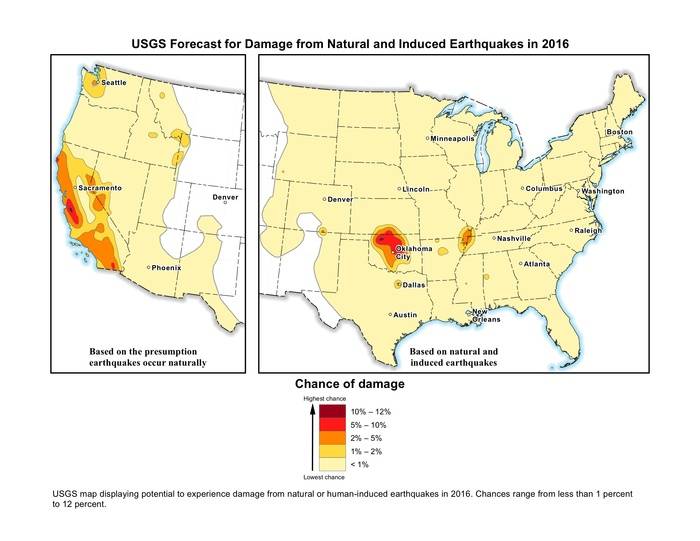
yellow-map-chance-of-earthquake-oklahoma.jpg


However, Oklahoma doesn't have much of an earthquake history before 2011, when the area seems to have awakened, and fluid and steam injection has been done for decades. Oklahoma is a major center of hydraulic fracturing, which is a relatively new technology, but there doesn't seem to be similar levels of induced seismic activity elsewhere as a result of hydraulic fracturing.

Could someone clarify the physics of how this process might work, and why other activities involving large amounts of mass (such as reservoirs) and energy (such as nuclear tests) don't seem to have created induced seismic activity, or at least nothing as dramatic as what's occurring in Oklahoma?
 
Earth sciences news on Phys.org
Evo said:
One of the issues with Oklahoma are the faults.

This might help you understand.

https://fivethirtyeight.com/feature...stry-awakened-oklahomas-sleeping-fault-lines/

So the faults in the area had reached equilibrium, but human activity in the area upset that?

It seems strange that dams and nuclear testing has never resulted in something so dramatic. There are reservoirs in areas known to have seismic activity, sometimes even near fault lines, and nuclear tests (even atmospheric tests/detonations) are powerful enough to create earthquakes. Why have relatively stable faults in Oklahoma burst back into activity when active faults in areas such as the Columbia Basin and California weren't as dramatically disturbed by water resource development? The area around Las Vegas, Nevada, even has the Hoover Dam and Nevada Test Site nearby, and despite being a seismically active region it seemingly wasn't disturbed by those activities either.
 
They were saying that's it's when the faults are pushed in the same direction.

From the article
But there are a lot of other faults and wastewater wells that aren’t associated with earthquakes. There are a couple of reasons for this. First, our map doesn’t represent all the faults in Oklahoma. It’s just an interpretation of the known fault segments, and some faults may be hidden. Second, the orientation of the faults seems to matter, Choy told me. The most likely places for human-made earthquakes are faults where the stresses are additive — where the naturally occurring pressures and the human-made pressures are pushing the fault in the same way. The map shows that the most-active faults in Oklahoma are oriented in a different way than the silent ones.

Definitely more studies need to be done.
 
  • Like
Likes   Reactions: Delta Force
Delta Force said:
Oklahoma is a major center of hydraulic fracturing, which is a relatively new technology, but there doesn't seem to be similar levels of induced seismic activity elsewhere as a result of hydraulic fracturing.

Fracking actually goes back to the 40's, but the https://earthquake.usgs.gov/research/induced/myths.php it's not the main cause of human-induced earthquakes. I also would not take absence of evidence as evidence of absence, especially from Wikipedia. Especially squared when the cited source says "list incomplete".
 
  • Like
Likes   Reactions: Evo, Delta Force and berkeman
Current wisdom has it that induced seismicity is related to static friction at a fault. Injecting liquids into the subsurface in large volumes, such as in secondary oil recovery and injection of aqueous wastes, raises the pore pressure within the receiving formations. Prior to injection, the rock strata were in a historical state of stress established over geological time scales. Increasing the pore pressure disturbs the state of effective stress in the rocks, both normal to fault faces and tangent to the faces. If the ratio of the tangential stress to the normal stress exceeds the coefficient of static friction, the fault is expected to be activated. Most of these injections occur at depths > 3000 ft.
 
  • Like
Likes   Reactions: Delta Force, FactChecker and fresh_42
Chestermiller said:
Current wisdom has it that induced seismicity is related to static friction at a fault. Injecting liquids into the subsurface in large volumes, such as in secondary oil recovery and injection of aqueous wastes, raises the pore pressure within the receiving formations. Prior to injection, the rock strata were in a historical state of stress established over geological time scales. Increasing the pore pressure disturbs the state of effective stress in the rocks, both normal to fault faces and tangent to the faces. If the ratio of the tangential stress to the normal stress exceeds the coefficient of static friction, the fault is expected to be activated. Most of these injections occur at depths > 3000 ft.
Good info. The statistical evidence of a connection between fracking activity and earthquake frequency is extremely strong. It's not just a general correlation between fracking waste injection sites and earthquake frequency. It's the correlation in many specific locations, the timing of sudden extreme increases, and the correspondence between injection depth and earthquake depth, that makes it so convincing.
 
  • Like
Likes   Reactions: Delta Force

Similar threads

  • · Replies 3 ·
Replies
3
Views
3K
  • · Replies 6 ·
Replies
6
Views
7K
  • · Replies 3 ·
Replies
3
Views
2K
  • · Replies 46 ·
2
Replies
46
Views
9K
  • · Replies 8 ·
Replies
8
Views
3K
Replies
1
Views
6K
  • · Replies 16 ·
Replies
16
Views
5K
  • · Replies 7 ·
Replies
7
Views
3K
  • · Replies 6 ·
Replies
6
Views
4K
  • · Replies 4 ·
Replies
4
Views
2K