Physics of the mountain car problem

  • Context: Undergrad 
  • Thread starter Thread starter Rupert Young
  • Start date Start date
  • Tags Tags
    Car Physics
Click For Summary
SUMMARY

The mountain car problem illustrates the dynamics of an underpowered vehicle navigating a hilly landscape, specifically modeled by the equation cos(3*(x+(pi/2))). The key insight is that the car's inertia allows it to overshoot the balance point of forces, causing it to oscillate between slopes rather than stop. The discussion emphasizes the necessity of using both forward and reverse actions to gain sufficient momentum to reach the hilltop, akin to rocking a car out of a snowbank. The equations provided, particularly the second one, are noted to be dimensionally inconsistent and poorly documented.

PREREQUISITES
  • Understanding of basic physics concepts such as force, acceleration, and inertia
  • Familiarity with mathematical modeling of motion using equations
  • Knowledge of the mountain car problem and its implications in control theory
  • Ability to analyze and interpret equations in the context of physical systems
NEXT STEPS
  • Study the principles of inertia and its effects on motion in physics
  • Learn about control strategies in dynamic systems, particularly in the context of the mountain car problem
  • Explore the implications of dimensional analysis in physical equations
  • Review the Wikipedia article on the mountain car problem for additional insights and equations
USEFUL FOR

Students of physics, engineers working on dynamic systems, and anyone interested in control strategies for underpowered vehicles will benefit from this discussion.

Rupert Young
Messages
28
Reaction score
2
I'm a bit confused by the physics of the mountain car problem.
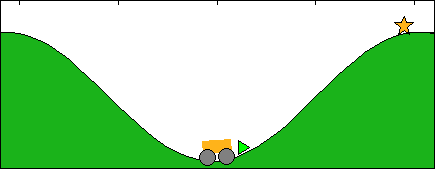
Mcar.png


The problem concerns driving an underpowered car up a mountain.

I had expected that the car would be able drive up to a point where the forward force due to acceleration is equal to the opposing force due to gravity and that the car would then just stop.

However, I am finding that the car falls back down and goes up the other slope, and continues to oscillates in that way.

What am I misunderstanding?

Here are the equations.

The landscape curve is given by, cos(3*(x+(pi/2))), where x is the position.

And,
Velocity = Velocity + (Action) * 0.001 + cos(3 * Position) * (-0.0025)
Position = Position + Velocity

where Action = 1
and starting position = -0.5, which is the bottom of the valley.
 
Physics news on Phys.org
Your expectation is wrong. The car's inertia will carry it beyond the point where forces balance, so velocity will go negative and the car will slip back.

I think you are intended to learn that the driver must use both forward and reverse to get enough head start to make it to the top of the hill. It is like rocking a car back and forth to get out of a slippery spot in a snow bank during winter.
 
Your equations do not make much sense, especially the second one which is dimensionally inconsistent.
What do you call "action" in this context? In physics action has a well defined meaning but it doe snot seem this is what you mean here.
There is no force "due to acceleration". The acceleration is due to the net force.
If the car starts with some initial velocity and the engine is shutdown, the only force is gravity and this force will produce the acceleration (opposite to the car's velocity) which will result in the car eventually stopping. Once it stops, the same force will accelerate it down the hill, where is come from. And the process repeats.
 
Oh, so the car is powered. Thank you for the link.
 
The equations in the Wiki article linked are poorly written and poorly documented. But I think the focus is not on accurate physics, but rather on control strategies to achieve a goal, given a set (any set) of equations.
 

Similar threads

  • · Replies 8 ·
Replies
8
Views
2K
  • · Replies 8 ·
Replies
8
Views
3K
  • · Replies 14 ·
Replies
14
Views
3K
  • · Replies 66 ·
3
Replies
66
Views
5K
  • · Replies 15 ·
Replies
15
Views
4K
  • · Replies 11 ·
Replies
11
Views
2K
  • · Replies 17 ·
Replies
17
Views
3K
  • · Replies 4 ·
Replies
4
Views
2K
Replies
1
Views
1K
  • · Replies 4 ·
Replies
4
Views
2K