Pinch-Off and Saturation Of MOSFET

  • Thread starter Thread starter Dr_Pill
  • Start date Start date
  • Tags Tags
    Mosfet Saturation
Click For Summary
SUMMARY

The discussion centers on the concepts of pinch-off and saturation in MOSFETs, specifically addressing the interaction between VDS (drain-source voltage) and VGS (gate-source voltage). It is established that when VGS exceeds the threshold voltage (VTh), and VGD (gate-drain voltage) is less than VTh, the MOSFET enters saturation, causing the pinch-off point to shift left as VDS increases beyond VGS - VTh. Additionally, the electric field created between the drain and the channel is responsible for sweeping electrons towards the drain, driven by electrostatic forces.

PREREQUISITES
  • Understanding of MOSFET operation principles
  • Familiarity with voltage parameters: VGS, VDS, VGD, and VTh
  • Knowledge of electric fields in semiconductor physics
  • Basic circuit analysis skills
NEXT STEPS
  • Study the MOSFET operating regions: cutoff, triode, and saturation
  • Learn about the impact of VGS and VGD on MOSFET performance
  • Explore the concept of electric fields in semiconductor devices
  • Investigate the ID vs VDS characteristics curve for MOSFETs
USEFUL FOR

Electrical engineers, semiconductor physicists, and students studying MOSFET operation and characteristics will benefit from this discussion.

Dr_Pill
Messages
41
Reaction score
0
Hi,

I don't understand pinch-off in MOSFETS.
I have two big issues:

1.
VDS is pointing from drain to source, so the voltage works in the horizontal plane.VGS on the other hand,is in the vertical plane.
So how they can cooperate? How does increasing VDS till VGS - VTh get you in pinch-off.
Why does increasing VDS above VGS - VTh result in the moving of the pinch-off point to the left?
In what sense are VGS and VDS interacting with each other, I don't see it.

2.
I don't get how electrons are swept from the shortened channel bye the electric field of the depletion regio towards the drain.
With all the voltages from Gate and Drain and built in voltages of depletion regio, I don't know where the electric field is pointing at.

Here's a sketch, a messed up sketch from me in Paint:
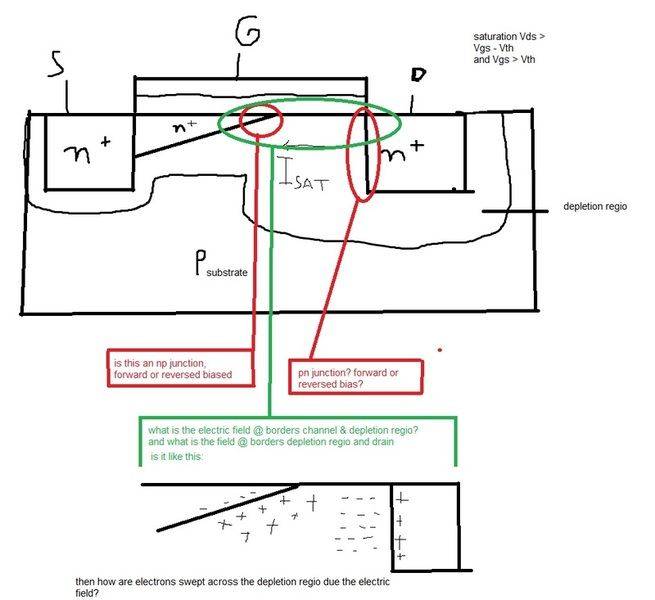
7tyPfhx.jpg


Hope some people can explain it to me.
Thanks in advance.
 
Engineering news on Phys.org
Hi.

Change the point of view of the voltages. Instead VDS, analyze VGD. So, you have VGS, VGD (so VDS = VD - VS = VGS - VGD).
Think about this: A MOS transistor is, in principle, purely simmetryc. (look into the schematic, you can switch S with D).

If VGS > vt, and VGD > vt , (then VDS = VGS - VGD > 0) the MOS works in triode mode (the channel is entirely formed across L).
Now, if you want to analyze another mode, for example saturation:

VGS > vt, VGD < vt (channel isn't formed in the drain-side) then:

VGD = VG - VD < vt ---> VS + VG - VD < vt + VS --> VSD < vt + VSG --> VDS > VGS - vt
(It's easier connecting S to 0 V)
----------------------------------------------------------------------------------
Why does increasing VDS above VGS - VTh result in the moving of the pinch-off point to the left?

This happen because you're forcing no channel forming en the D-Side.
-------------------------------------------------------------------------------------
I don't get how electrons are swept from the shortened channel bye the electric field of the depletion regio towards the drain.

The Electric Field betweed the Drain and the channel is very large, and the density of electrons it's huge in the channel, so, it's a electrostatic force driving the electrons (some of them, see the ID vs VDS curve).
 

Similar threads

  • · Replies 4 ·
Replies
4
Views
4K
  • · Replies 7 ·
Replies
7
Views
2K
  • · Replies 1 ·
Replies
1
Views
2K
  • · Replies 1 ·
Replies
1
Views
3K
  • · Replies 2 ·
Replies
2
Views
3K
  • · Replies 6 ·
Replies
6
Views
32K
  • · Replies 1 ·
Replies
1
Views
21K
  • · Replies 6 ·
Replies
6
Views
2K
  • · Replies 1 ·
Replies
1
Views
3K
  • · Replies 4 ·
Replies
4
Views
7K