Pixel pitch, Airy disk diameter and maximum aperture

Click For Summary

Discussion Overview

The discussion centers on the relationship between maximum aperture, Airy disk diameter, and pixel pitch in imaging systems. Participants explore how diffraction limits resolution and the conditions under which this occurs, including theoretical and practical implications for sensor design and performance.

Discussion Character

  • Technical explanation
  • Debate/contested
  • Mathematical reasoning

Main Points Raised

  • Some participants inquire about the threshold aperture at which diffraction begins to limit sensor resolution, proposing different relationships between Airy disk diameter and pixel pitch.
  • One participant suggests that the Airy disk radius can be estimated using the formula r = 0.6*(f-number), while another questions the derivation of this value and its dependence on wavelength.
  • There is a discussion on how to calculate the aperture where further reduction in pixel size does not enhance resolution due to diffraction, with various equations proposed.
  • Some participants note that the actual point spread function (PSF) is typically larger than the Airy disk, and that there is no single metric for resolution, complicating the analysis.
  • Concerns are raised about the implications of using non-shift-invariant detectors and the effects of aliasing on image quality.

Areas of Agreement / Disagreement

Participants express differing views on the relationships between aperture, Airy disk, and pixel pitch, with no consensus reached on the best approach or equations to use. The discussion remains unresolved regarding the optimal conditions for sensor design in relation to diffraction limits.

Contextual Notes

Participants highlight limitations in their analysis, including the dependence on specific wavelengths and the complexity of real-world imaging systems, which may not conform to simplified theoretical models.

D_K
Messages
3
Reaction score
0
Hi,
How to determine a threshold aperture, at which the diffraction begins to limit resolution of the sensor ? Which situation reflects that point:

1) Airy disk diameter / 2 = 2 x pixel pitch
http://www.outbackphoto.com/dp_essentials/dp_essentials_02/essay.html"
(third pixel detects the dark gap between two points)

2) Airy disk diameter / 2 = 1 x pixel pitch

3) Airy disk diameter = pixel pitch
it seems that http://en.wikipedia.org/wiki/Airy_disk" , and many webpages

#1 and #2 just meet the http://books.google.pl/books?id=5Yn...nd digital imaging By R. E. Jacobson&f=false", #3 is far further.
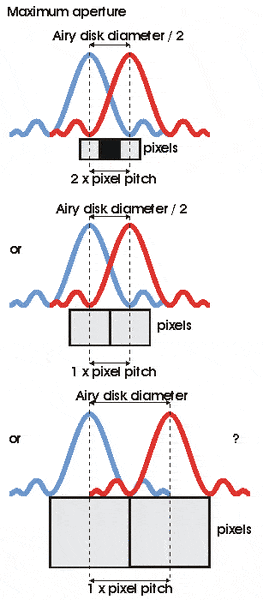
airy-disk.gif


And how to draw such plot:
http://books.google.pl/books?id=5Yn...and digital imaging By R. E. Jacobson&f=false
(Page 80, Fig 6.11)
using software like http://www.padowan.dk/graph/" or eventually Google Charts ? I mean simplified function equation or equations.

Thanks
 

Attachments

  • airy-disk.gif
    airy-disk.gif
    17.6 KB · Views: 1,119
Last edited by a moderator:
Science news on Phys.org
Are you asking how the Airy disk radius relates to the lens aperture and focal length? That's straightforward: the radius (in microns) can be estimated as r = 0.6*(f-number), where the f-number is given by F/D, where F is the focal length and D the entrance pupil diameter.

Equivalently, this is given by r = 0.3/NA, where NA is the numerical aperture of the lens.

You are very much correct that the Airy disk should be matched to the pixel size for optimized imaging performance.
 
No, how maximum aperture (and coresponding Airy disk radius or diameter) relates to the pixel pitch:

2 * P = D / 2 or
P = D / 2 or
P = D

where
D – Airy disk diameter
P – pixel pitch

How to calculate the aperture, at which making the pixels of the image sensor smaller does not increase image resolution any more, because the diffraction begins to limit the resolution (Airy disk is to large, but how much, how it's diameter or radius relates to the pixel pitch).

And why did you use equations other then these:

r = D / 2 = 1.22 * wavelength * y * K / f
for infinity y = f -->
r = D / 2 = 1.22 * wavelength * K

where
r - Airy disk radius
D - Airy disk diameter
y - picture distance
f - focal length
K - f-number (entrance pupil diameter d = f / K)

Where is 0.6 derived from and why your equation lacks the wavenlength ?

Regarding the second question I made in the middletime plots based on Gaussian approximation from http://en.wikipedia.org/wiki/Airy_disk#Approximation_using_a_Gaussian_profile", but not sure if correct:

airy-disk-2.gif


wavelength = 550 nm
f-number = 8

red curve:
1 * exp(-(x * (550 * 8)) ^ 2 / (2 * (0.44 * 550 * 8) ^ 2))

blue curve:
1 * exp(-((x - 1.22) * (550 * 8)) ^ 2 / (2 * (0.44 * 550 * 8) ^ 2))

blue curve + red curve (--> green curve)
1 * exp(-(x * (550 * 8)) ^ 2 / (2 * (0.44 * 550 * 8) ^ 2)) + 1 * exp(-((x - 1.22) * (550 * 8)) ^ 2 / (2 * (0.44 * 550 * 8) ^ 2))

And this is only approximation, without those secondary "hills".

(airy-disk.zip contains the airy-disk.grf file for Graph).
 

Attachments

  • airy-disk.zip
    airy-disk.zip
    702 bytes · Views: 369
  • airy-disk-2.gif
    airy-disk-2.gif
    14 KB · Views: 1,107
Last edited by a moderator:
D_K said:
No, how maximum aperture (and coresponding Airy disk radius or diameter) relates to the pixel pitch:

<snip>
How to calculate the aperture, at which making the pixels of the image sensor smaller does not increase image resolution any more, because the diffraction begins to limit the resolution (Airy disk is to large, but how much, how it's diameter or radius relates to the pixel pitch).

The truth is, in reality it doesn't much matter which you choose for at least three reasons:
1) the actual PSF is almost always larger than an Airy disk
2) there's no single metric for resolution
3) using non-shift-invariant detectors (pixels) negates a lot of linear systems analysis. One practical issue is aliasing- the periodicity of the pixel array literally interferes with the periodicity in the image.

So, as a rule of thumb, if your pixel is half the size of a PSF, you are fully taking advantage of the optical system.

D_K said:
And why did you use equations other then these:
<snip>

Where is 0.6 derived from and why your equation lacks the wavenlength ?

Sorry- I simply set the wavelength to 0.5 microns (green light), and 1.22*0.5 = 0.6. If your system is not operating in the visible, then your numbers will be substantially different.
 
Andy Resnick said:
using non-shift-invariant detectors (pixels) negates a lot of linear systems analysis.
This is the basic problem. But they are so classical, being in use from tens of years or even longer ...
 
D_K said:
This is the basic problem. But they are so classical, being in use from tens of years or even longer ...

I'm not sure what you mean- the analysis of sampled imaging systems is fairly mature:

http://spie.org/x648.html?product_id=853462
http://www.opticsinfobase.org/abstract.cfm?URI=ao-36-29-7307
http://books.google.com/books?id=f3...epage&q="sampled imaging systems" PSF&f=false

and section 2.5 of this:

http://www.google.com/url?sa=t&sour...sg=AFQjCNEfV1MBFx3gSbA2tALKannEHimy8Q&cad=rja
 

Similar threads

  • · Replies 2 ·
Replies
2
Views
2K
  • · Replies 4 ·
Replies
4
Views
2K