How Do You Calculate Load Current Values in a Center-Tap Full Wave Rectifier?

Click For Summary
SUMMARY

The discussion focuses on calculating load current values in a center-tap full wave rectifier. Key calculations include determining the Peak, Average, and RMS values of load current, as well as the ripple factor and efficiency. The poster struggles with finding the value of Im, which is essential for these calculations. The absence of a smoothing capacitor is also noted, prompting questions about its impact on the ripple factor.

PREREQUISITES
  • Understanding of center-tap full wave rectifier circuits
  • Knowledge of electrical engineering concepts such as Peak, Average, and RMS current calculations
  • Familiarity with ripple factor and efficiency in rectifier circuits
  • Basic skills in circuit analysis and problem-solving
NEXT STEPS
  • Research how to calculate Peak, Average, and RMS values for a center-tap full wave rectifier
  • Learn about the effects of smoothing capacitors on ripple factor
  • Study efficiency calculations in rectifier circuits
  • Explore circuit simulation tools for visualizing rectifier performance
USEFUL FOR

Electrical engineering students, hobbyists working with rectifier circuits, and professionals seeking to understand load current calculations in power electronics.

snehil31
Messages
3
Reaction score
1
Homework Statement
In a centre-tap full wave rectifier shown in the figure, forward resistance of each diode is 50 Ω .

Solve for
i) Peak, Average, RMS value of load current
ii) Ripple factor
iii) Efficiency
Relevant Equations
I(avg) = (2Im/pi) , I(RMS) = Im/(root 2)
[New poster has been reminded by the Mentors to show their work on schoolwork problems]

I have tried many times to solve this problem, but can't understand how to get the value of Im and hence cannot find the Peak & other values of the load current. Please help me to solve and find the Peak, Average, RMS value of load current as well as ripple factor and efficiency of the centre-tap full wave rectifier.

Note:- The figure is attached below.
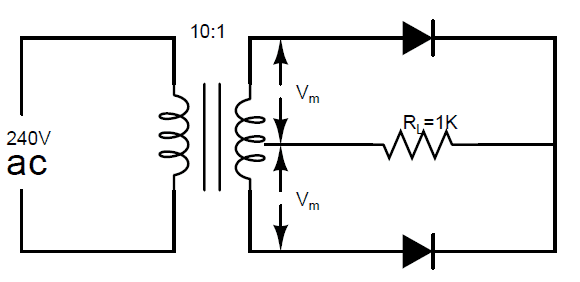
4.png
 
Last edited by a moderator:
Physics news on Phys.org
snehil31 said:
I have tried many times to solve this problem
Could you show us some of that work? Also, without any smoothing capacitor, what do you think the Ripple Factor will be?
 

Similar threads

  • · Replies 8 ·
Replies
8
Views
8K
  • · Replies 11 ·
Replies
11
Views
6K
  • · Replies 14 ·
Replies
14
Views
3K
Replies
17
Views
4K
  • · Replies 5 ·
Replies
5
Views
3K
  • · Replies 6 ·
Replies
6
Views
4K
  • · Replies 2 ·
Replies
2
Views
6K
Replies
2
Views
8K
Replies
6
Views
9K
  • · Replies 8 ·
Replies
8
Views
7K