Poisson distribution on a simulated (SSA) data set

Click For Summary

Discussion Overview

The discussion centers around fitting a histogram of a simulated data set to a Poisson distribution. Participants explore the appropriateness of this approach given the nature of the data, which is derived from a stochastic simulation, and seek guidance on determining the expected distribution.

Discussion Character

  • Exploratory, Technical explanation, Debate/contested

Main Points Raised

  • One participant seeks guidance on fitting a Poisson distribution to their simulated data and asks for help in determining the expected distribution.
  • Another participant questions whether it is appropriate to fit the data directly to a distribution, especially considering the data's time-series nature.
  • A participant acknowledges the concern about fitting the data directly but emphasizes that they were specifically instructed to use a Poisson distribution, suggesting that propensities might be used for predictions or approximations over long times.
  • One participant proposes that the mean of the sample can be used to approximate the λ parameter of the Poisson distribution, estimating it to be around 8.

Areas of Agreement / Disagreement

Participants express differing views on the appropriateness of fitting a Poisson distribution to the data, indicating that multiple competing perspectives remain unresolved.

Contextual Notes

There are limitations regarding the assumptions about the data's distribution and the dependence on the definitions of the parameters involved, which remain unresolved.

tolove
Messages
164
Reaction score
1
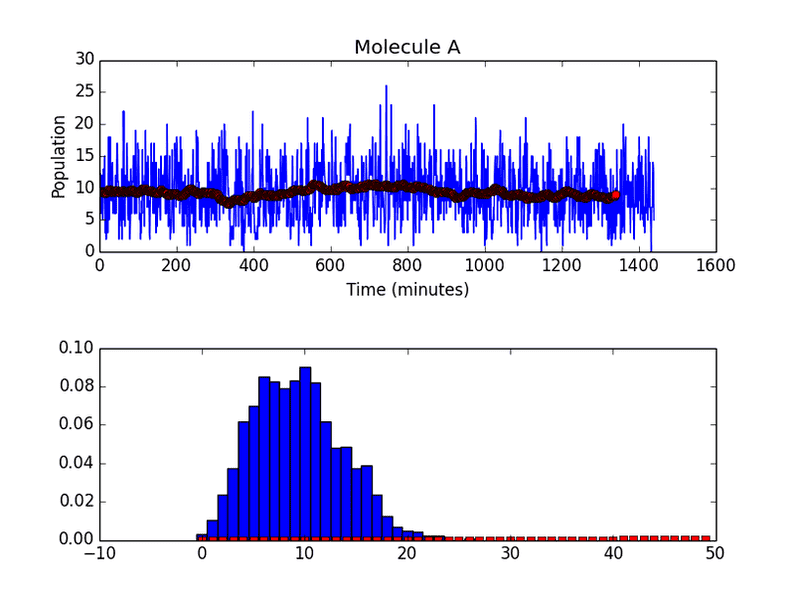
I've been asked to fit the histogram with a Poisson distribution as part of a mostly independent learning thing. The data was produced through a stochastic simulation.

Can someone get me started on how I would go about finding the expected distribution?

If you need additional information, or if you would like to see the code (python), please ask.
x6xrhFs.png


Thanks for your time!
 
Physics news on Phys.org
If your data is coming from time-series observations, then perhaps a more important question is *should* you be fitting the data directly to a distribution?
 
bpet said:
If your data is coming from time-series observations, then perhaps a more important question is *should* you be fitting the data directly to a distribution?

That's what I'm thinking, but I was specifically asked to set a Poisson distribution to this. So there must be a way that the propensities can be used to find a prediction. Or at least a close approximation for long times.

I don't know how to go about this, though.
 
tolove said:
That's what I'm thinking, but I was specifically asked to set a Poisson distribution to this. So there must be a way that the propensities can be used to find a prediction. Or at least a close approximation for long times.

I don't know how to go about this, though.

The mean of the sample approximates the λ parameter of the Poisson distribution. That defines the Poisson distribution. My guess is λ ~ 8.
 

Similar threads

  • · Replies 2 ·
Replies
2
Views
2K
  • · Replies 7 ·
Replies
7
Views
2K
  • · Replies 12 ·
Replies
12
Views
4K
  • · Replies 10 ·
Replies
10
Views
2K
  • · Replies 24 ·
Replies
24
Views
4K
  • · Replies 2 ·
Replies
2
Views
2K
  • · Replies 1 ·
Replies
1
Views
5K
  • · Replies 14 ·
Replies
14
Views
6K
  • · Replies 1 ·
Replies
1
Views
2K
  • · Replies 9 ·
Replies
9
Views
4K