Polymerization of acrylamide with K Persulfate without Bis

Click For Summary

Discussion Overview

The discussion centers around the polymerization of acrylamide using potassium persulfate as an initiator, specifically without the use of bis acrylamide as a crosslinker. Participants explore the mechanisms of free-radical polymerization, focusing on which double bonds in acrylamide (C=C or C=O) are involved in the polymerization process.

Discussion Character

  • Exploratory
  • Technical explanation
  • Debate/contested

Main Points Raised

  • One participant describes the process of free-radical polymerization, noting that the radical generated from potassium persulfate attacks a double bond in acrylamide.
  • Another participant seeks clarification on which double bond (C=C or C=O) is attacked during polymerization, expressing uncertainty about the stability and reactivity of the bonds.
  • A reference to a Wiki article suggests that radicals next to functional groups like carbonyls are more stable, which may influence the reaction pathway.
  • Some participants discuss the implications of charge transfer in radical reactions, with confusion about whether the case is ionic and how charges are managed during the reaction.

Areas of Agreement / Disagreement

Participants express differing views on whether the polymerization process involves ionic characteristics and which double bond is primarily attacked. The discussion remains unresolved, with no consensus on the specific mechanisms involved.

Contextual Notes

There are uncertainties regarding the roles of the C=C and C=O bonds in the polymerization process, as well as the nature of charge interactions in radical reactions. The discussion does not clarify the assumptions underlying these claims.

SchrodingersMu
Messages
14
Reaction score
0
Hi!
I recently did a lab where my group was to create a polymer via free-radical polymerization. We used acrylamide and potassium persulfate. We DID NOT use bis acrylamide crosslinker ( wasnt in our lab manual for some reason.)

I cannot find any web resources that show how acrylamide polymerizes with itself. I know, in this kind of free radical propagation, an initiator ( K persulfate) will change to have a radical under heating, etc. That radical then attacks a double bond. My question is- How would the double bonds in only acrylamide be attacked? We see that there are two options: c=c or c=o. In a typical reaction, the c=c bond is attacked. If the c=o bond is attacked, to me, it looks like it would be more stable, however. From my understanding, oxygen holds charges better than C, and also there would be some resonance from the lone pair on the amine group. If the c=o bond is attacked, though, would there be polymerization propagation?

Our polymer (after being heated) was a clear, semi-flexible thin plastic film

Below is a picture of the typical reaction with crosslinker ( in green, which we didnt have) initiator ( in orange, in the picture it is ammonium instead of potassium persulfate)
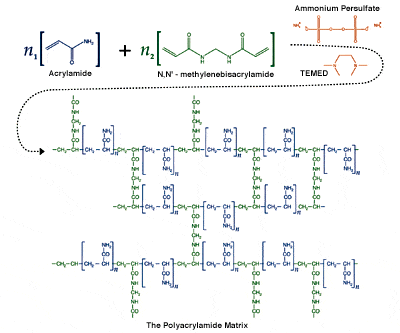
1_3_1a.gif


Any input is appreciated!
 
Chemistry news on Phys.org
SchrodingersMu said:
free radical propagation
SchrodingersMu said:
radical then attacks a double bond
Giving you what?
 
From my understanding, that will propagate the radical into the monomer, which then reacts with another double bond in another monomer. This leads to linking/ polymer chain lengthening
 
SchrodingersMu said:
how acrylamide polymerizes with itself
Which answers your question? Or not?
 
Sort of. I want to know which double bond(s) the polymerization will occur on, because we have both c=c and c=o
 
From Wiki: "
Likewise, radicals next to functional groups such as carbonyl, nitrile, and ether are more stable than tertiary alkyl radicals.

Radicals attack double bonds. However, unlike similar ions, such radical reactions are not as much directed by electrostatic interactions. For example, the reactivity of nucleophilic ions with α,β-unsaturated compounds (C=C–C=O) is directed by the electron-withdrawing effect of the oxygen, resulting in a partial positive charge on the carbonyl carbon. There are two reactions that are observed in the ionic case: the carbonyl is attacked in a direct addition to carbonyl, or the vinyl is attacked in conjugate addition, and in either case, the charge on the nucleophile is taken by the oxygen. Radicals add rapidly to the double bond, and the resulting α-radical carbonyl is relatively stable;" suggesting the amide function "protects" the carbonyl.
 
AH, nice! I don't get why
"the charge on the nucleophile is taken by the oxygen"
So the oxygen takes on the positive charge? I'm confused by that statement

Thanks for help btw!
 
SchrodingersMu said:
So the oxygen takes on the positive charge?
"... in the ionic case." Is this an ionic case? Persulfate splits to give you a radical anion which initiates the polymerization.
 
I think this is an ionic case.
Why would oxygen want to take a psoitive charge? Oxygen is super electronegative

Thanks again
 
  • #10
From where is it going to pick up a charge? You have a radical anion, SO4-1⋅ initiating the reaction. The charge is just along for the ride.
 

Similar threads

  • · Replies 1 ·
Replies
1
Views
9K
  • · Replies 1 ·
Replies
1
Views
6K
  • · Replies 2 ·
Replies
2
Views
25K
  • · Replies 1 ·
Replies
1
Views
4K
  • · Replies 3 ·
Replies
3
Views
8K
Replies
26
Views
14K
  • · Replies 6 ·
Replies
6
Views
9K
  • · Replies 8 ·
Replies
8
Views
5K
  • · Replies 21 ·
Replies
21
Views
12K
  • · Replies 5 ·
Replies
5
Views
5K