Positioning of Capacitance in Ionization Chamber's Equivalent Circuit

Click For Summary
SUMMARY

The discussion centers on the positioning of capacitance in the equivalent circuit of ionization chambers. Participants clarify that the capacitance, which includes both the chamber's capacitance and any parallel capacitance, should ideally be placed to the left of the voltage generator to maintain a meaningful voltage difference across the chamber. The conversation highlights the importance of voltage equilibrium in ionization chambers and the implications of capacitor placement on AC analysis. Additionally, the complexities of real ion chambers, including guard electrodes and Frisch grids, are acknowledged as they affect the measurement of small currents.

PREREQUISITES
  • Understanding of ionization chambers and their function in radiation detection.
  • Familiarity with equivalent circuit analysis in electrical engineering.
  • Knowledge of AC and DC circuit principles, particularly regarding voltage and capacitance.
  • Basic comprehension of noise analysis in electronic circuits.
NEXT STEPS
  • Research the design and application of ionization chambers in radiation detection.
  • Study equivalent circuit modeling techniques for capacitive components.
  • Learn about noise reduction techniques in electronic amplifiers related to capacitance.
  • Explore the role of guard electrodes and Frisch grids in ionization chamber design.
USEFUL FOR

This discussion is beneficial for electrical engineers, physicists working with radiation detection, and students studying circuit design and analysis, particularly in the context of ionization chambers.

Simobartz
Messages
13
Reaction score
1
TL;DR
Positioning of Capacitance in Ionization Chamber's Equivalent Circuit: Why Not to the Left of the Voltage Generator?
I'm delving into the topic of ionization chambers, but as someone without a background in electrical engineering, I'm finding the equivalent circuits a bit challenging to comprehend. Specifically, I'm puzzled by the placement of the chamber's capacitance and any parallel capacitance in the equivalent circuit. My understanding suggests that if the capacitor represents the ion chamber's capacitance, it should be positioned to the left of the voltage generator. However, as you can see in the attached picture, it is placed on the right. Why is it placed in this way?

note: in the picture C represents the capacitance of the chamber plus any parallel capacitance
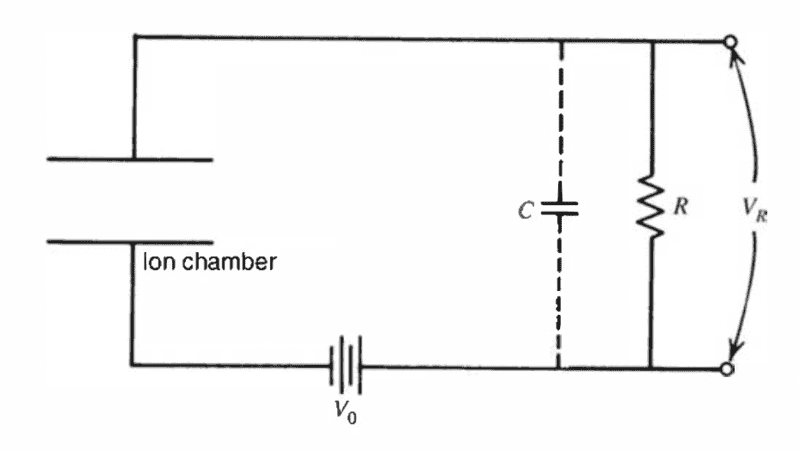
Schermata 2023-08-15 alle 11.01.11.png
 
Last edited by a moderator:
Engineering news on Phys.org
The impedance of the battery is taken as zero, so in math terms it's the same and when thinking about the RC constant of the output pulse it makes more sense to show them close together.

There is similar weirdness with AC analysis. If a signal line has a capacitor to Vcc, and another to ground these are in parallel in the AC small signal equivalent circuit. This is equivalent to assuming Vcc and Gnd are the same place.
 
the problem is that, if the chamber is on the right, the voltage difference at equilibrium across it is zero. While, on the left it is Vo. And the voltage difference is an important property for an ionization chamber. So, what do you mean when you say that they are mathematically equivalent?
 
Simobartz said:
the problem is that, if the chamber is on the right, the voltage difference at equilibrium across it is zero. While, on the left it is Vo. And the voltage difference is an important property for an ionization chamber. So, what do you mean when you say that they are mathematically equivalent?
Can you post a link to a datasheet for a typical ionization chamber that you are considering? (hopefully with application circuits included in the datasheet) Thanks.
 
You cannot put the chamber on the right of the circuit as it is. You can put the Capacitor on the left instead. This would change the DC voltage over it, but it's not a real capacitor, it's a lumped quantity most of which is from the chamber but also any cable capacitance.

If the capacitance is across the output then it's a meaningful quantity you want to know. For example the noise developed by the amplifier usually depends on the capacitance of the detector.

Most real ion chambers have a more complicated diagram because the current being measured is very small. Conduction through and over the insulators becomes significant so 'guard electrodes' are placed between the high voltage terminals and the collection electrode. These are grounded and the current between them and the high voltage terminal is not measured. Current leaked between two insulated electrodes both close to ground potential is much smaller (many orders of magnitude) than between a high voltage electrode and ground.

Ion chambers intended for spectroscopy can have an extra grid inside, called a 'Frisch grid' which makes the measured charge from different positions in the volume more equal.

All these arrangements still just result in a single equivalent C value at the output.
 
  • Informative
Likes   Reactions: berkeman

Similar threads

  • · Replies 20 ·
Replies
20
Views
10K
Replies
4
Views
3K
  • · Replies 12 ·
Replies
12
Views
8K
  • · Replies 7 ·
Replies
7
Views
2K
  • · Replies 7 ·
Replies
7
Views
2K
Replies
3
Views
2K
  • · Replies 1 ·
Replies
1
Views
2K
  • · Replies 32 ·
2
Replies
32
Views
9K
  • · Replies 1 ·
Replies
1
Views
2K
Replies
16
Views
4K