Possibility of multiple moons in Earth-Moon system

Click For Summary
SUMMARY

The discussion centers on the theoretical possibility of Earth having multiple moons arranged in a 1:2:4 orbital resonance, similar to the Galilean moons of Jupiter. Calculations using Kepler's Third Law suggest distances for three hypothetical moons: Moon1 at 241,000 km, Moon2 at 383,000 km, and Moon3 at 608,000 km from Earth. However, the stability of such a system is questioned due to the significant gravitational influence of the Sun and the mass of the existing Moon, which complicates the potential for additional moons. The consensus indicates that while the concept is intriguing, the formation of a stable multi-moon system around Earth is highly unlikely.

PREREQUISITES
  • Understanding of Kepler's Third Law of planetary motion
  • Familiarity with orbital mechanics and resonance
  • Knowledge of celestial mechanics and gravitational interactions
  • Basic mathematical skills for calculations involving distances and periods
NEXT STEPS
  • Research the implications of Kepler's Third Law on multi-satellite systems
  • Explore the concept of orbital resonance and its stability criteria
  • Investigate the effects of solar perturbations on satellite orbits
  • Learn about simulations using Gravity Simulator to model celestial mechanics
USEFUL FOR

Astronomers, astrophysicists, and space enthusiasts interested in orbital dynamics and the stability of celestial systems will benefit from this discussion.

Qshadow
Messages
27
Reaction score
0
I am interested in theoretical (what if) possibility of our Earth having more than one moon,
I wonder if they can be arranged at the same orbital resonance as the Galilean moons 1:2:4

If yes, would such system be stable?
If yes, should our Moon be the first, second or third satellite out of the three for the system to be most stable?

Assuming such system is possible and stable,
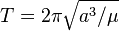
I have made some calculations based on the assumption that our Moon is second (Moon2), and using the Kepler's Third Law, for calculating the distance of all the moons as function of the orbital period T (see Orbital Period wiki):
50f9cad0c149bd3fe30446a17b834884.png


Moon1 distance: (((27.3*24*60*60)^2*398600)/(16*3.14^2))^(1/3) = 241,000 Km

Moon2 distance: (((27.3*24*60*60)^2*398600)/(4*3.14^2))^(1/3) = 383,000 Km

Moon3 distance: (((27.3*24*60*60)^2*398600)/(1*3.14^2))^(1/3) = 608,000 Km

is this correct way to do this, or am i missing something, and this is not the way to calculate this distances?
If no, please point me to correct info,
Thanks,
Qshadow.
 
Astronomy news on Phys.org
Qshadow said:
is this correct way to do this, or am i missing something, and this is not the way to calculate this distances?
Looks fine. Although you didn't have to use all those numbers. It's much easier to just use ratios:
In units of Lunar month and Lunar orbital radius, you can just write:
##a=\sqrt[3]{T^2}##
which will net you the ratio of Lunar orbital radius. E.g., for ##T=2## you get a=1.59 (of the radius), which is about 608 Mm.

Qshadow said:
I am interested in theoretical (what if) possibility of our Earth having more than one moon
This paper:
Formation of Regular Satellites from Ancient Massive Rings in the Solar System
suggests it being unlikely for Earth to form a multiple satellite system. At least as a result of accretion from ring material.

The specific question of the most stable configuration I won't be able to answer, sorry. Naively, I'd think if it works for Jupiter...
 
Bandersnatch said:
Naively, I'd think if it works for Jupiter...
...it is not allowed for ox.

But Moon is pretty far out and therefore strongly perturbed by Sun. Satellites outside Moon would therefore be expected to be in trouble.
 
Thanks Bandersnatch, your representation is much nicer indeed.

Bandersnatch said:
the paper is very interesting, it will take me some time to swallow it.

snorkack said:
Moon is pretty far out and therefore strongly perturbed by Sun. Satellites outside Moon would therefore be expected to be in trouble.
This is something that I was afraid of, but without some simulation or numerical calculation I can't know for sure.

Also, for the 1:2:4 orbital resonance rule, what is the maximum possible masses of the satellites that satisfy such rule? can it be that our Moon is too massive to allow for other satellites to exist even if they try to follow this orbital resonance?
 
More moons are problematic. Our moon is very massive compared to earth, so it will disturb other orbits significantly.
The outer border for moons is given by the hill sphere. I don't think you can fit a stable orbit between moon and the outer region of stability for Earth satellites.

Stable low Earth orbits (far away from the moon) are easy. Resonances I don't know. The orbit of moon is not circular, and changes its orientation over time due to perturbations from the sun. It would be tricky to fit a resonant orbit in that I think.
 
mfb said:
More moons are problematic. Our moon is very massive compared to earth, so it will disturb other orbits significantly.
Charon is even more massive, but is resonant with Nix and Hydra. Yet these are from 1:4, not closer in or inside Charon orbit.
 
I replied to your post on my forum with suggestions on how to use Gravity Simulator to answer your questions:
http://www.orbitsimulator.com/cgi-bin/yabb/YaBB.pl?num=1422283773/0#3
 
snorkack said:
...it is not allowed for ox.

But Moon is pretty far out and therefore strongly perturbed by Sun. Satellites outside Moon would therefore be expected to be in trouble.

The Earth being so close to the Sun is the problem. Semantics, I admit, but it's hard to get moons around planets close to the Sun because you don't have to be very far out before the Sun becomes a problem. The Earth is lucky to have even one moon.

Or unlucky. The Earth obtained a moon by having one collide with it.
 

Similar threads

  • · Replies 3 ·
Replies
3
Views
2K
  • · Replies 33 ·
2
Replies
33
Views
5K
  • · Replies 2 ·
Replies
2
Views
3K
  • · Replies 2 ·
Replies
2
Views
2K
  • · Replies 3 ·
Replies
3
Views
2K
  • · Replies 98 ·
4
Replies
98
Views
11K
  • · Replies 3 ·
Replies
3
Views
439
  • · Replies 2 ·
Replies
2
Views
2K
  • · Replies 1 ·
Replies
1
Views
2K
Replies
17
Views
4K