sol47739
- 38
- 3
- TL;DR
- I have some questions about the cathode ray experiments they did back in history and what the positive rays consist of about which I read in a book.
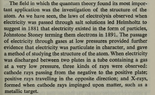
I read in the following book A history of the sciences by Stephen F. Mason. About the discovery of the electron the write what I attached in the picture.
I wonder what do these positive rays traveling in the opposite direction they talk about consist of? Some ions or what? I understand that the negative rays consist of electrons but positive rays? I can’t understand that it could be positrons since these cathode ray tubes are such simple equipment and at low energies that no positrons can appear. But what do they consist of? And what are they referring to?
I wonder what do these positive rays traveling in the opposite direction they talk about consist of? Some ions or what? I understand that the negative rays consist of electrons but positive rays? I can’t understand that it could be positrons since these cathode ray tubes are such simple equipment and at low energies that no positrons can appear. But what do they consist of? And what are they referring to?
Attachments