Potential difference between three capacitors in series

Click For Summary
SUMMARY

The discussion revolves around calculating the potential difference across three capacitors in series using the formula Vc = (Vt / Ct) * C. The total voltage (Vt) is 12V, and the total capacitance (Ct) is calculated as 3.3uF. Participants clarify that in a series circuit, the charge is the same across all capacitors, and the voltage drop can be determined using the relationship Q = CV. The final calculations confirm that each capacitor experiences a 4V drop, validating the application of Kirchhoff's law.

PREREQUISITES
  • Understanding of series and parallel capacitor configurations
  • Familiarity with Ohm's Law (V = IR)
  • Knowledge of the relationship between charge, capacitance, and voltage (Q = CV)
  • Basic principles of Kirchhoff's laws in electrical circuits
NEXT STEPS
  • Study the behavior of capacitors in series and parallel configurations
  • Learn about Kirchhoff's Voltage Law and its applications in circuit analysis
  • Explore the exponential rise of voltage in RC circuits
  • Practice solving capacitor problems using simulation software like LTspice or Multisim
USEFUL FOR

Electrical engineering students, hobbyists working with circuits, and anyone interested in understanding capacitor behavior in series configurations.

Ware182
Messages
7
Reaction score
0
Hi,
I'm having a problem with this circuit finding potential difference between capacitors. I know the answers by playing around on simulation software A=12v B=8v and C=4v however, I am struggling to use the formula provided Vc= (Vt/Ct)*C to find the answers. It works fine in a parallel circuit with components of the same value but I know that series is different.

1. Homework Statement
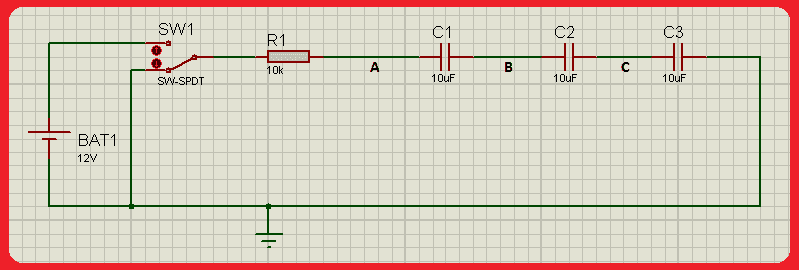
upload_2015-2-28_21-22-33.png


Using the formula Vc = (Vt / Ct) * C


  1. Calculate the voltage at A when SW1 is switched to 12V. 12V (v= I x R)
  2. Calculate the voltage at B when SW1 is switched to 12V. 8V
  3. Calculate the voltage at C when SW1 is switched to 12V. 4V
I have worked out Question A using ohms law- not the formula provided just to check against simulation software.
So far I understand that VC will be A, B, C
Vt is voltage total=12v
Ct is capacitance total 1/ct=1/c1+1/c2+1/c3 =3.3 recurring
vt/ct=3.6
Now I'm struggling to understand what I times 3.6 by to make either 4, 8 and 12 finishing the formula.

Can anyone help me please?
Thanks
 
Physics news on Phys.org
Symmetry should give you your answer with hardly any calculation at all. All components in series share the same current, so if all the capacitors are the same size, what can you say about the charges that end up on them?
 
Ware182 said:
vt/ct=3.6
Now I'm struggling to understand what I times 3.6 by to make either 4, 8 and 12 finishing the formula.
What does vt/ct yield? (what are the units?)
 
Hi Ware182. http://img96.imageshack.us/img96/5725/red5e5etimes5e5e45e5e25.gif

I'm not sure what form of answer they are looking for. Do you know about the exponential rise of voltage in a series RC circuit?
 
Last edited by a moderator:
VT/CT =3.6uF VT being voltage total of 12V, CT being Capacitance total of 3.3uF recurring

from the formula provided it states that I now times that answer by C (i'm guessing means capacitance) this does not give me the expected figures.

I'm thinking that the formula provided is incorrect for a series circuit, as it works perfectly on parallel.

Or is it me going wrong somewhere?
Thanks
 
NascentOxygen said:
Hi Ware182. http://img96.imageshack.us/img96/5725/red5e5etimes5e5e45e5e25.gif

I'm not sure what form of answer they are looking for. Do you know about the exponential rise of voltage in a series RC circuit?

long story short- no i don't know about exponential rise of Voltage in RC circuits

however thank you all for your prompt replies!
 
Last edited by a moderator:
Ware182 said:
VT/CT =3.6uF VT being voltage total of 12V, CT being Capacitance total of 3.3uF recurring

from the formula provided it states that I now times that answer by C (i'm guessing means capacitance) this does not give me the expected figures.

I'm thinking that the formula provided is incorrect for a series circuit, as it works perfectly on parallel.

Or is it me going wrong somewhere?
Thanks
I suspect that you may be mistaken in the formula that you're using.

For a capacitance C the relationship between the charge and voltage on it is given by

Q = CV

Now, in your case you've calculated a net capacitance Ct and you have a voltage Vt = 12V placed across it. What is the charge on that capacitance?

Next, what do you recall about how charges are distributed between capacitors in series?
 
gneill said:
I suspect that you may be mistaken in the formula that you're using.

For a capacitance C the relationship between the charge and voltage on it is given by

Q = CV

Now, in your case you've calculated a net capacitance Ct and you have a voltage Vt = 12V placed across it. What is the charge on that capacitance?

Next, what do you recall about how charges are distributed between capacitors in series?

so I can work out the charge for C1 by 10x10-6 x 12 = 120uC however I don't know how to apply that in a way to find the potential difference.

I understand that between each capacitor on this circuit it will drop 4V and 40 micro coulombs

However I don't understand how to use this information to solve the equation.
 
Ware182 said:
so I can work out the charge for C1 by 10x10-6 x 12 = 120uC however I don't know how to apply that in a way to find the potential difference.
No, the full 12V is not across every capacitor. The full 12V is across the total equivalent capacitance that you found, Ct. So you can find the charge on THAT capacitance.

Now, this is where my question about how charge is distributed amongst capacitors in series becomes critical. You need to know how this works! Since all components that are series connected always share the same current, any change in charge on capacitors in series must be identical. So if the charge on your equivalent capacitor Ct is Q, every one of the series capacitors that make up Ct has the same charge Q.

If you know the charge on a capacitor then you can find the voltage across that capacitor via Q = CV.

In this case you find the charge Q on Ct, then apply that charge to each of the capacitors that make up Ct to find their individual voltages.
 
  • #10
gneill said:
No, the full 12V is not across every capacitor. The full 12V is across the total equivalent capacitance that you found, Ct. So you can find the charge on THAT capacitance.

Now, this is where my question about how charge is distributed amongst capacitors in series becomes critical. You need to know how this works! Since all components that are series connected always share the same current, any change in charge on capacitors in series must be identical. So if the charge on your equivalent capacitor Ct is Q, every one of the series capacitors that make up Ct has the same charge Q.

If you know the charge on a capacitor then you can find the voltage across that capacitor via Q = CV.

In this case you find the charge Q on Ct, then apply that charge to each of the capacitors that make up Ct to find their individual voltages.

Ok, thank you, I will have a play and see what i can make of it.
 
  • #11
gneill said:
No, the full 12V is not across every capacitor. The full 12V is across the total equivalent capacitance that you found, Ct. So you can find the charge on THAT capacitance.

Now, this is where my question about how charge is distributed amongst capacitors in series becomes critical. You need to know how this works! Since all components that are series connected always share the same current, any change in charge on capacitors in series must be identical. So if the charge on your equivalent capacitor Ct is Q, every one of the series capacitors that make up Ct has the same charge Q.

If you know the charge on a capacitor then you can find the voltage across that capacitor via Q = CV.

In this case you find the charge Q on Ct, then apply that charge to each of the capacitors that make up Ct to find their individual voltages.

ok so I've spent all day on it and I think I've finally got it.

1/10 +1/10 + 1/10 = 0.3
1/0.3 = 3.3 recurring
Qt = 3.3 recurring * 12 = 40
40/10 = 4 (4V drop across each capacitor)
40/10 + 40/10 +40/10 = 12V (Applying Kirchoff's law to check)

can you confirm that this is the way you were trying to show me
 
Last edited by a moderator:
  • #12
Ware182 said:
can you confirm that this is the way you were trying to show me
Yes, that's the method.

Try to remember to attach units to results, even intermediate step results. That or work symbolically until the very end where you can plug in numbers. It's much easier to spot errors with variables than amongst a sea of numbers.
 
  • #13
Thanks for all your help. that's good advice I'll be sure to apply that.
 

Similar threads

Replies
20
Views
2K
  • · Replies 3 ·
Replies
3
Views
2K
  • · Replies 7 ·
Replies
7
Views
2K
Replies
4
Views
2K
Replies
1
Views
2K
  • · Replies 7 ·
Replies
7
Views
2K
  • · Replies 11 ·
Replies
11
Views
4K
  • · Replies 30 ·
2
Replies
30
Views
3K
  • · Replies 4 ·
Replies
4
Views
4K
Replies
4
Views
2K