Potential due to a rod with a nonuniform charge density

Join the discussion
Ask a follow-up here, or get your own question answered by working scientists, mathematicians and engineers — people, not an autocomplete.
Real named experts · corrections over time · the nuance an AI answer skips
2 replies · 1K views
archaic
Messages
688
Reaction score
214
Homework Statement
A rod of length ##L## lies on the x-axis such that its left tip is at the origin. It's charged and has a nonuniform charge density ##\lambda=\alpha x##, where ##\alpha>0##.
What is the potential at a point ##B## on its bisector? (Use the following as necessary: α, k, L, b, and d.)
Relevant Equations
$$dV=k\frac{dq}{r}$$
I'm not sure I understand why I need to use ##d##.. Maybe they want me to have the potential be zero at ##A##?
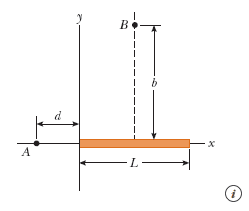
Screenshot_2020-09-15_08-49-38.png

In any case, I have found$$V(B)=\alpha k\int_0^L\frac{x}{\sqrt{b^2+\left(x-\frac{L}{2}\right)^2}}dx+C=\frac{\alpha kL}{2}\ln\left(\frac{\sqrt{L^2+4b^2}+L}{\sqrt{L^2+4b^2}-L}\right)+C$$and$$V(A)=\alpha k\int_0^L\frac{x}{d+x}dx+C=\alpha k\left(L+d\ln\left(\frac{d}{L+d}\right)\right)+C$$
 
Last edited:
Physics news on Phys.org
archaic said:
I'm not sure I understand why I need to use ##d##..
In any case, I have found$$V(B)=\alpha k\int_0^L\frac{x}{\sqrt{b^2+\left(x-\frac{L}{2}\right)^2}}dx+C=\frac{\alpha k}{2}\ln\left(\frac{\sqrt{L^2+4b^2}+L}{\sqrt{L^2+4b^2}-L}\right)+C$$
It says to use the variables as necessary. If it is not necessary don’t use it.

I get a different result for the integration. Yours seems to be dimensionally wrong.
I also tried checking yours by fixing the total charge at Q and letting L tend to zero. I got that it tends to infinity as ##\frac {kQ}{Lb}## instead of tending to ##\frac {kQ}{b}##.
 
Last edited:
haruspex said:
It says to use the variables as necessary. If it is not necessary don’t use it.

I get a different result for the integration. Yours seems to be dimensionally wrong.
I also tried checking yours by fixing the total charge at Q and letting L tend to zero. I got that it tends to infinity as ##\frac {kQ}{Lb}## instead tending to ##\frac {kQ}{b}##.
I forgot a factor of ##L##.. It's fixed now. Thank you!
You probably have found ##\alpha kL\,\mathrm{arsinh}(\frac{L}{2b})##, they're similar.
That's not the desired result, though..