Potential energy of a dipole in an external field

Click For Summary
SUMMARY

The potential energy of a dipole in an external electric field is derived from the contributions of the individual charges, represented as ##U = -E(qd)\cos{\theta}##, where ##\vec{p} = q\vec{d}##. The discussion highlights the significance of excluding the self-energy term ##U_{3} = -\frac{q^{2}}{4\pi\epsilon_{0}d}## from the potential energy calculation, as it does not affect the dynamics of the dipole in the external field. Instead, this term represents a constant that can be disregarded for practical purposes, emphasizing the importance of renormalization in classical field theory. The conversation also touches on the challenges of infinities in classical physics and the relevance of the Landau-Lifshitz prescription.

PREREQUISITES
  • Understanding of dipole moments and electric fields
  • Familiarity with potential energy calculations in electrostatics
  • Knowledge of renormalization concepts in classical and quantum field theories
  • Proficiency in mathematical notation related to physics, including vector notation
NEXT STEPS
  • Study the derivation of potential energy for dipoles in external electric fields
  • Learn about the implications of self-energy in electrostatics
  • Research the Landau-Lifshitz prescription for addressing infinities in classical field theory
  • Explore the Abraham-Lorentz-Dirac equation and its applications to charged particle dynamics
USEFUL FOR

Physicists, electrical engineers, and students studying electromagnetism, particularly those interested in dipole interactions and energy calculations in electric fields.

etotheipi
I'm considering the arrangement shown below. Let the positive charge be ##q##, and the negative be ##-q##. To derive the potential energy of this configuration, one usually adds the potential energies of both of the charges in the external field, taking the zero volts equipotential of the external field to be along the line at ##\theta = \frac{\pi}{2}##.

##U = qV_{1} - qV_{2} = q \times -\frac{Ed}{2}\cos{\theta} - q \times \frac{Ed}{2}\cos{\theta} = -E(qd)\cos{\theta} = -\vec{E} \cdot \vec{p}## where ##\vec{p} = q\vec{d}##.
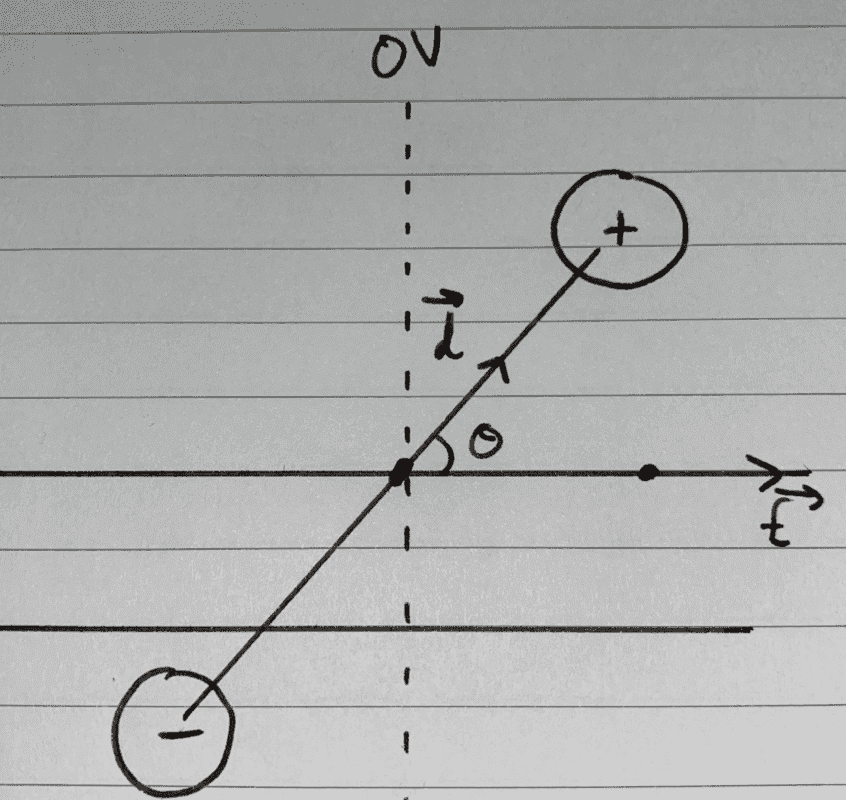
1583594528916.png


My question is, why isn't the potential energy of the two charges ##U_{3} = -\frac{q^{2}}{4\pi\epsilon_{0}d^{2}}## also included in the summation above?

Since, for any collection of charged particles, the potential energies of subsystems can be added pairwise (i.e. ##-\Delta U = (W_{12} + W_{21}) + (W_{13} + W_{31}) + (W_{23} + W_{32}) = -\Delta U_{a} - \Delta U_{b} - \Delta U_{c}##. And to me, there seem to be three charged things at play here: the source (whatever it happens to be, e.g. perhaps an infinite charged sheet), and the two charges.

Consequently, the potential energy should be the sum of that of the source and +ve charge, the source and -ve charge, and the two charges. Although I think this might be incorrect since I haven't defined ##0V## to be at infinite distance!
 
Physics news on Phys.org
##U_3## is simply a constant and doesn't do anything to the dynamics of the dipole in the external field. As any additive constants in the energy, they are physically insignifant.

That's a great gift in this context, because otherwise you'd also need the energy for each point charge itself, and this diverges. You can simply subtract this diverging infinite "self-energy".

That's the first place in physics where you renormalize. Renormalization thus not only occurs in quantum field theory but already in classical field theory. The only trouble with the classical theory is that for accelerating point charges there's no satisfactory exact solution for the problem of infinities. The best we can do is to use the Landau-Lifshitz prescription to cure the oddities of the (in)famous Abraham-Lorentz-Dirac equation for the motion of charged particles including radiation reaction.
 
  • Love
Likes   Reactions: etotheipi
etotheipi said:
My question is, why isn't the potential energy of the two charges ##U_{3} = -\frac{q^{2}}{4\pi\epsilon_{0}d^{2}}## also included in the summation above?

Correction: ##U_3=-\dfrac{q^{2}}{4\pi\epsilon_{0}d}.##
 
  • Like
Likes   Reactions: etotheipi
kuruman said:
Correction: ##U_3=-\dfrac{q^{2}}{4\pi\epsilon_{0}d}.##

Yep, bad mistake :oldeyes:
 
etotheipi said:
To derive the potential energy of this configuration, one usually adds the potential energies of both of the charges in the external field, taking the zero volts equipotential of the external field to be along the line at θ=π2θ=π2\theta = \frac{\pi}{2}.

You are calculating the work it takes to rotate the dipole in the given field.

etotheipi said:
My question is, why isn't the potential energy of the two charges [...] also included in the summation above?

This is the work done to assemble the dipole in the absence of the given field.

You could add the two together if you were interested in calculating the work it takes to assemble the dipole in the absence of any external field, and then to rotate it in the given field.
 
  • Informative
  • Like
Likes   Reactions: vanhees71 and etotheipi

Similar threads

  • · Replies 19 ·
Replies
19
Views
2K
  • · Replies 9 ·
Replies
9
Views
2K
  • · Replies 6 ·
Replies
6
Views
2K
  • · Replies 65 ·
3
Replies
65
Views
5K
  • · Replies 8 ·
Replies
8
Views
3K
  • · Replies 10 ·
Replies
10
Views
2K
  • · Replies 1 ·
Replies
1
Views
1K
Replies
1
Views
3K
  • · Replies 5 ·
Replies
5
Views
728
  • · Replies 1 ·
Replies
1
Views
2K