Potential of a hydrogenic ion given a wavefunction

Join the discussion
Registration is free. Start your own thread to ask a follow-up.
7 replies · 2K views · last reply
Manuel Galdon
Messages
4
Reaction score
0
EDIT: moved from technical forum, so no template

Hello, I have a problen which is about calculating an electrostatic potential for a hydrogenic atom in the ground state given its wavefunction. Since I know the wavefunction of the ground state I would find it by solving the Schrödinger equation, but the statement gives us an expression to calculate it.
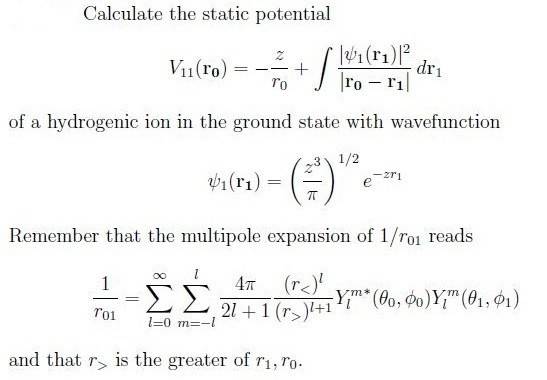
Typeset equations: static potential V11(r0) = -z/r0 + integral of |psi1(r1)|^2 / |r0 - r1| dr1; ground-state wavefunction psi1(r1) = (z^3/pi)^(1/2) e^(-z r1); multipole expansion 1/r01 = sum over l from 0 to infinity and m from -l to l of (4pi/(2l+1)) (r<^l / r>^(l+1)) Y_l^m*(theta0, phi0) Y_l^m(theta1, phi1), with r> the greater of r1, r0.


This is all what the problem says. Any ideas? Just put the wavefunction into the integral and go on ?

Thanks !
 
Last edited by a moderator:
Physics news on Phys.org
DaleSpam said:
Hi Manuel, welcome to PF!

Can you show some of your work so far?
For now I only have the multipolar expansion for l=0.

What do the indexes in the spherical harmonics stand for? Should I understand that the hydrogenic ion is an hydogen atom with 2 electrons and therefore the indexes in the spherical harmonics concern the electrons 1 and 2? I think I have never worked with such system, I am a little lost with the notation and, as you can see, the problem statement does not tell too much.
 
Attachments
  • Handwritten derivation of the potential V(r0) for a hydrogenic ion, using the 1/|r0 - r1| multipole expansion in spherical harmonics with the ground-state wavefunction psi(r1) = (Z^3/pi)^(1/2) e^(-Z r1).
    NuevoDocumento 1.jpg
    29.2 KB · Views: 478
Manuel Galdon said:
What do the indexes in the spherical harmonics stand for? Should I understand that the hydrogenic ion is an hydogen atom with 2 electrons and therefore the indexes in the spherical harmonics concern the electrons 1 and
A hydrogenic (or hydrogen-like) ion is an ion with only 1 electron. So for example He+.
 
So I should understand the problem as an atom with only one electron, right? Finally I got this expression [tex]\int\frac{1}{r_> e^{2zr_1}} dr_1[/tex]
If the electron is in the position r1 and we supose that r0>r1 , then have [tex] \int\frac{1}{r_0 e^{2zr_1}} dr_1 = \frac{1}{r_0}\int\frac{1}{e^{2zr_1}} dr=-\frac{e^{-2zr_0}}{2z}[/tex]

Do you agree? This is the electrostatic potential evaluated in r0. I guess this is the point where we have to evaluate it because the problem gives the formula for the potential evaluated in such point.
 
Last edited:
How did you get this
Manuel Galdon said:
[tex]\int\frac{1}{r_> e^{2zr_1}} dr_1[/tex]
?
In order to evaluate such an integral you have there, you can divide the integration range into two:
$$
\int_0^{r_0} \int_0^{\pi} \int_0^{2\pi} \frac{|\psi(r_1)|^2}{r_{01}} r_1^2 \sin\theta_1 dr_1 d\theta_1 d\phi_1 + \int_{r_0}^\infty \int_0^{\pi} \int_0^{2\pi} \frac{|\psi(r_1)|^2}{r_{01}} r_1^2 \sin\theta_1 dr_1 d\theta_1 d\phi_1
$$
In the first integral, ##r_1 < r_0##, and in the second one ##r_1 < r_0##. From this you can substitute the correct form of the expansion of ##1/r_{01}## given there.
 
I evaluated the integral without taking the limits into consideration and I only evaluated the radial part. How do you know about the angular parts involved here?

Regarding the expansion of r01, I used the expansion for l=0 since the atom is in the ground state. Do you agree?
 
Manuel Galdon said:
How do you know about the angular parts involved here?
The angular part must be involved because you are calculating a volume integral. ##d\mathbf{r}_1## is a volume element, and it is equal to ##
r_1^2 \sin\theta_1 dr_1 d\theta_1 d\phi_1##.
Manuel Galdon said:
Regarding the expansion of r01, I used the expansion for l=0 since the atom is in the ground state. Do you agree?
That series will indeed shrink down to one term corresponding to ##Y_{00}## but you have got to have an authentic reason to justify your reasoning.
Manuel Galdon said:
we supose that r0>r1
That's not how you should proceed to answer a physics problem. If there is still more reliable way to do things, you have to follow this path.
Now, just try plugging in the expansion of ##1/r_{01}## into the first integral I wrote in post #6.