Potential on each of these concentric spherical shells

Join the discussion
Ask a follow-up here, or get your own question answered by working scientists, mathematicians and engineers — people, not an autocomplete.
Real named experts · corrections over time · the nuance an AI answer skips
19 replies · 3K views
vcsharp2003
Messages
915
Reaction score
179
Homework Statement
What would be the potentials ##V_1## and ##V_2## on the surface of the concentric conducting shells shown in diagram?
Relevant Equations
Potential at a point ##r_1## due to a point charge ##q## is ##V_1=\frac {kq} {{r_1}}##
Each spherical shell will contribute to potential on the surface of inner shell and the same will apply to outer shell.

Due to inner shell ##V_1 = \frac {kQ} {{r_1}}## and due to outer shell ##V_1 = \frac {-kQ} {r_1}##. Therefore potential on inner surface is zero.

But the answers are ##V_1 = \frac {kQ} {{r_1}}## and ##V_2 = \frac {-kQ} {{r_2}}## .
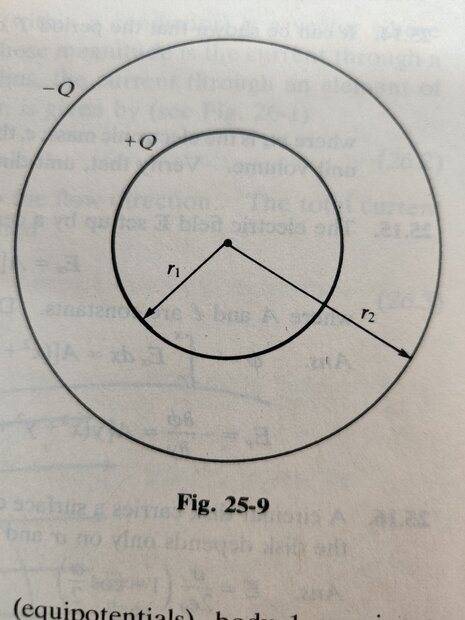
1638516104801974409618060706530.jpg
 
Physics news on Phys.org
vcsharp2003 said:
due to outer shell ##V_1 = \frac {-kQ} {r_1}##.
What is the potential at the outer shell due to the outer shell?: How does potential vary inside an empty, uniformly charged, spherical shell?
 
  • Like
Likes   Reactions: vcsharp2003 and Orodruin
haruspex said:
What is the potential at the outer shell due to the outer shell?: How does potential vary inside an empty, uniformly charged, spherical shell?

(1) At outer shell, ##V_2 = \frac {-kQ} {r_2}##

(2) For a charged spherical shell, the potential inside is constant since E=0 inside a spherical shell due to Gauss's law. Negative of voltage gradient gives us electric field and since E= 0 inside a spherical shell so voltage gradient must be zero inside the shell i.e. voltage is constant inside the shell. So, ##V_{inside}= V_2## where ##V_2## is potential on the surface of outer shell.
 
Last edited:
haruspex said:
What is the potential at the outer shell due to the outer shell?:

Will the charged inner shell also contribute to the potential on the outer shell?
 
vcsharp2003 said:
(1) At outer shell, ##V_2 = \frac {-kQ} {r_2}##

(2) For a charged spherical shell, the potential inside is constant since E=0 inside a spherical shell due to Gauss's law. Negative of voltage gradient gives us electric field and since E= 0 inside a spherical shell so voltage gradient must be zero inside the shell i.e. voltage is constant inside the shell. So, ##V_{inside}= V_2## where ##V_2## is potential on the surface of outer shell.
Right, so the potential at the inner shell due to the charge on the outer shell is...?
 
haruspex said:
Right, so the potential at the inner shell due to the charge on the outer shell is...?

Since inner shell is inside the outer shell, so it must be ##V_{12} = \frac {-kQ} {r_2}##
 
Last edited:
haruspex said:
Right, so the potential at the inner shell due to the charge on the outer shell is...?
Also, I think the potential on inner shell should be the algebraic sum i.e. ##V_1= V_{11}+V_{12} = \frac {kQ}{r_1} + \frac {-kQ}{r_2}## which is the sum of potential on inner shell due to inner shell plus the potential on inner shell due to outer shell.
 
Last edited:
vcsharp2003 said:
Also, I think the potential on inner shell should be the algebraic sum ##V_1+V_2## i.e ## \frac {kQ_1}{r_1} + \frac {-kQ_2}{r_2}## which is the sum of potential on inner shell due to inner shell plus the potential on inner shell due to outer shell.
Yes. But I find your ##V_1, V_2## notation confusing. You seem to use it sometimes for the net potential at a shell and sometimes for the potential at a shell due only to the charge on that shell.
 
  • Like
Likes   Reactions: Orodruin and vcsharp2003
haruspex said:
Yes. But I find your ##V_1, V_2## notation confusing. You seem to use it sometimes for the net potential at a shell and sometimes for the potential at a shell due only to the charge on that shell.
Yes, you're right. I have changed my previous posts so the subscripts are like 11 or 12. 11 subscript would mean potential on inner shell due to inner shell and 12 would mean potential on inner shell due to outer shell.
 
Similarly, I think the potential on outer shell should be the algebraic sum i.e. ##V_2=V_{22}+V_{21} =\frac {-kQ}{r_2} + \frac {kQ}{r_2}## which is the sum of potential on outer shell due to outer shell and potential on outer shell due to inner shell.
 
It makes a lot of sense now. So, we can now say that $$V_1 -V_2$$
$$= ( \frac {kQ}{r_1} + \frac {-kQ}{r_2}) - (\frac {-kQ}{r_2} + \frac {kQ}{r_2})$$
$$= \frac {kQ}{r_1} - \frac {kQ}{r_2}$$
 
Last edited:
vcsharp2003 said:
Similarly, I think the potential on outer shell should be the algebraic sum i.e. ##V_2=V_{22}+V_{21} =\frac {-kQ}{r_2} + \frac {kQ}{r_2}## which is the sum of potential on outer shell due to outer shell and potential on outer shell due to inner shell.
Which =0.
 
  • Like
Likes   Reactions: vcsharp2003
haruspex said:
Which =0.
Yes. Did you mean that it's not correct result?
 
vcsharp2003 said:
Yes. Did you mean that it's not correct result?
The result is correct. It is just that it is very easy to simplify to zero. This is an important sanity check since the potential at the outer shell is quite clearly zero (with the charge disribution being spherically symmetric with no net charge, the field outside the outer shell must be zero - hence no potential).
 
  • Like
Likes   Reactions: vcsharp2003
vcsharp2003 said:
It makes a lot of sense now. So, we can now say that $$V_1 -V_2$$
$$= ( \frac {kQ}{r_1} + \frac {-kQ}{r_2}) - (\frac {-kQ}{r_2} + \frac {kQ}{r_2})$$
$$= \frac {kQ}{r_1} - \frac {-kQ}{r_2}$$
You have a sign error in the last step.
 
  • Like
Likes   Reactions: vcsharp2003
haruspex said:
You have a sign error in the last step.
Yes, thanks for pointing it out. I have corrected the post for this. Once again thanks for all your great help. My textbook didn't explain it like this but simply reached the final result of ##V_1- V_2## saying we can assume a spherical charged shell to be like a point charge at center. It didn't make any sense in the book.
CamScanner 12-04-2021 13.53.jpg
 
haruspex said:
That's true for both the potential and the field anywhere outside the shell.
The last part in the screen shot in post#17 that says "Thus," doesn't make sense to me, unless I am missing something.
 
Last edited:
vcsharp2003 said:
The last part in the screen shot in post#17 that says "Thus," doesn't make sense to me, unless I am missing something.
You have not quoted q 24.4, nor its given solution, but if it finishes with your (corrected) equation in post #12 then it is just the same expression written without employing the 'k' abbreviation.