Potentiometer Circuit 1: Balancing the Current - Solving for Ix and Rx

Click For Summary

Homework Help Overview

The discussion revolves around a potentiometer circuit, specifically focusing on the relationship between the current through the galvanometer (Ix) and the variable resistance (Rx). Participants explore how varying Rx affects Ix and the conditions under which Ix becomes zero, indicating a balanced circuit.

Discussion Character

  • Exploratory, Conceptual clarification, Mathematical reasoning, Assumption checking

Approaches and Questions Raised

  • Participants attempt to apply Kirchhoff's Voltage Law (KVL) to analyze the circuit and derive expressions for Ix. Questions arise regarding the correctness of assumptions about current flow and the necessity of including the galvanometer's resistance in the analysis.

Discussion Status

The discussion is active, with participants providing feedback on each other's equations and reasoning. Some express agreement on the need to include certain resistances, while others question the implications of neglecting them. There is an ongoing exploration of the conditions for achieving a null point in the potentiometer setup.

Contextual Notes

Participants note that the presence of a rheostat in the primary circuit may influence the current and potential gradient, raising questions about its necessity for maintaining constant current during measurements.

conscience
Messages
232
Reaction score
36
1. problem statement, all variables and given/known data

1) What is the relationship between Ix
and Rx ?
2) Prove that on varying resistance Rx , Ix reduces to zero .
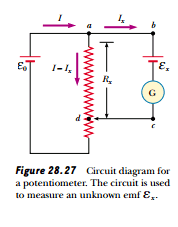
?temp_hash=58f9f9179e62bd430e2c624d6094b137.png


Homework Equations

The Attempt at a Solution


Assume resistance of Galvanometer is ##r## .
Total resistance in middle branch is ##R## , Variable resistance is ##R_x##

Applying KVL in right loop clockwise ,

##-E_x - I_xr + (I-I_x)R_x =0##

Applying KVL in the left loop clockwise ,

##E_0 - (I-I_x)R = 0##

Solving the above two equations ,

$$I_x = E_0 \frac{R_x}{rR} - \frac{E_x}{r}$$

Now when ##R_x## decreases , the first term decreases and consequently ##I_x## decreases .Finally at a particular value of ##R_x## , ##I_x## becomes zero .The current in the Galvanometer is zero and the circuit is said to be balanced .

Is this correct ?

Thanks
 

Attachments

  • potentiometer.png
    potentiometer.png
    4.4 KB · Views: 518
Physics news on Phys.org
conscience said:
E0−(I−Ix)R=0E0−(I−Ix)R=0E_0 - (I-I_x)R = 0
That's not correct.
Current through R is not I-Ix throughout.
What happens at point d?
 
  • Like
Likes   Reactions: conscience
cnh1995 said:
That's not correct.
Current through R is not I-Ix throughout.
What happens at point d?

Sorry .

The total resistance R in the middle branch can be broken up in two parts such that ##R_x + R' = R## .

Applying KVL in right loop clockwise ,

##-E_x - I_xr + (I-I_x)R_x =0##

Applying KVL in the left loop clockwise ,

##E_0 - (I-I_x)R_x - I(R-R_x) = 0##

Is it OK now ?
 
conscience said:
E0−(I−Ix)Rx−I(R−Rx)=0E0−(I−Ix)Rx−I(R−Rx)=0E_0 - (I-I_x)R_x - I(R-R_x) = 0
Yes.
 
$$I_x = \frac{E_0R_x -E_x R}{RR_x -R_x^2+Rr}$$

Denominator will always be positive since ##R >R_x## .

As ##R_x## decreases ,first term in numerator decreases .As a consequence ##I_x## decreases . Finally for a particular value of ##R_x## , ##I_x## becomes 0 .
 
conscience said:
$$I_x = \frac{E_0R_x -E_x R}{RR_x -R_x^2+Rr}$$

Denominator will always be positive since ##R >R_x## .

As ##R_x## decreases ,first term in numerator decreases .As a consequence ##I_x## decreases . Finally for a particular value of ##R_x## , ##I_x## becomes 0 .
Looks good to me.
 
  • Like
Likes   Reactions: conscience
Thank you .

Just to keep things simple , I think there was no need to include resistance ##r## .The resistance of Galvanometer could have been neglected .

The final expression will be $$I_x = \frac{E_0R_x -E_x R}{RR_x -R_x^2}$$

Is there anything you would like to add to the analysis I have done ?
 
No . I think resistance ##r## has to be included . If resistances of both battery ##E_x## and Galvanometer are neglected then potential difference across points 'ad' would be equal to emf ##E_x## at all times . Including ##r## would mean that only when ##I_x = 0## the potential difference across 'ad' would equal emf ##E_x## .
 
conscience said:
I think resistance rrr has to be included
As far as the potentiometer experiment is concerned, you need not use r as the null point does not depend on r.
But then, Rx=R becomes an invalid condition (two ideal unequal voltage sources in parallel).
So, I believe you should include r to make the circuit practical and free from contradictions such as infinite current and unequal voltage sources in parallel.
 
  • Like
Likes   Reactions: conscience
  • #10
Thank you
 
  • #11
conscience said:
Applying KVL in right loop clockwise ,

##-E_x - I_xr + (I-I_x)R_x =0##

From this equation I can also infer that just when the product of current from battery ##E_0## times resistance ##R_x## becomes equal to EMF ##E_x## , current ##I_x## becomes zero and null point is achieved .

In other words , ##I_x =0## , as and when ##E_x=IR_x## condition is achieved .

Can we put it this way ?
 
  • #12
conscience said:
In other words , Ix=0Ix=0I_x =0 , as and when Ex=IRxEx=IRxE_x=IR_x condition is achieved .
Yes.
 
  • Like
Likes   Reactions: conscience
  • #13
I hope you are not reasoning it backwards in the sense , when ##I_x =0## , then ##E_x=IR_x## .

It's the other way round .
As and when the product of current from battery ##E_0## times resistance ##R_x## becomes equal to EMF ##E_x## , current ##I_x## becomes zero and null point is achieved .

It may look like I am over thinking this , but actually I need to explain potentiometer to someone . So I am just trying to simplify the analysis as much as I can .Since you are an expert in circuit , I just want to make sure my thinking is correct :smile:
 
  • #14
conscience said:
It may look like I am over thinking this , but actually I need to explain potentiometer to someone . So I am just trying to simplify the analysis as much as I can .Since you are an expert in circuit , I just want to make sure my thinking is correct
It is correct. In fact, I said something much similar in this recent thread.
https://www.physicsforums.com/threads/find-the-value-of-resistance-in-the-circuit.921298/
See #22 and #29.
 
  • Like
Likes   Reactions: conscience
  • #15
Thanks .

One last clarification .

In the figure given in OP , as we move the jockey along potentiometer wire , current ##I## in the primary circuit changes .

But in the textbook I have to refer states that , there is also a rheostat in the primary circuit maintaining a constant current flow in the potentiometer wire all the time (while jockey moves on the wire)

Is this the way ?
 
Last edited:
  • #16
@gneill , do you believe a constant current flowing in the potentiometer wires is a necessity ? Is a rheostat really required in the primary circuit ?
 
  • #17
conscience said:
there is also a rheostat in the primary circuit maintaining a constant current flow in the potentiometer wire all the time (while jockey moves on the wire)
I don't see how a rheostat can maintain a constant current in the circuit. Constant current is not a requirement here. I believe it is used to adjust the potential gradient along the potentiometer wire.
 
  • Like
Likes   Reactions: conscience
  • #18
I think the rheostat comes in picture when we are required to take more than one reading .First time any suitable value of rheostat would work .While taking second reading , it's value could change resulting in different value of primary current .Potential gradient would change . If we are comparing EMF's , balance lenths would also change , but the ratio of EMF's would very nearly be same as the previous result . Then we could find the mean value of the results .
 
  • #19
conscience said:
I think the rheostat comes in picture when we are required to take more than one reading .First time any suitable value of rheostat would work .While taking second reading , it's value could change resulting in different value of primary current .Potential gradient would change . If we are comparing EMF's , balance lenths would also change , but the ratio of EMF's would very nearly be same as the previous result . Then we could find the mean value of the results .
Yes, that's how it is performed in laboratory.
But the rheostat's function is still the same.
cnh1995 said:
I believe it is used to adjust the potential gradient along the potentiometer wire.
 
  • #20
cnh1995 said:
I believe it is used to adjust the potential gradient along the potentiometer wire.

But potential gradient is adjusted by altering current in primary circuit .
 
  • #21
conscience said:
But potential gradient is adjusted by altering current in primary circuit .
...which is done by altering the rheostat position, isn't it?
 
  • #22
Right .

Thanks !
 

Similar threads

  • · Replies 3 ·
Replies
3
Views
2K
  • · Replies 4 ·
Replies
4
Views
2K
  • · Replies 14 ·
Replies
14
Views
12K
  • · Replies 2 ·
Replies
2
Views
3K
Replies
7
Views
1K
  • · Replies 2 ·
Replies
2
Views
13K
  • · Replies 8 ·
Replies
8
Views
2K
  • · Replies 13 ·
Replies
13
Views
2K
  • · Replies 13 ·
Replies
13
Views
2K
  • · Replies 1 ·
Replies
1
Views
997