Power Analysis in Circuits: Understanding the Flow of Current

  • Thread starter Thread starter charlies1902
  • Start date Start date
  • Tags Tags
    Circuits Current
Click For Summary

Homework Help Overview

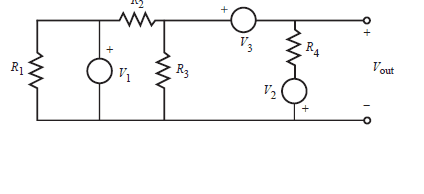
The discussion revolves around analyzing a circuit to determine the output voltage (V_out) and the power produced by voltage sources. Participants are exploring methods within the context of circuit analysis, specifically using mesh analysis, Kirchhoff's Laws, and the Superposition Theorem.

Discussion Character

  • Mixed

Approaches and Questions Raised

  • Participants discuss various methods for solving for V_out, including mesh analysis and Kirchhoff's Laws. Some suggest using the Superposition Theorem as a simpler alternative. Questions arise regarding the correctness of the calculated values and the interpretation of V_out's sign based on its circuit representation.

Discussion Status

There is ongoing exploration of different approaches to the problem, with some participants verifying calculations and others providing hints or alternative methods. The discussion includes considerations of how to analyze power in the context of voltage sources, with no explicit consensus reached on a single method.

Contextual Notes

Participants are working under the constraints of homework rules, which may limit the depth of assistance provided. There is a focus on understanding the implications of current flow in relation to power generation and absorption in the circuit.

charlies1902
Messages
162
Reaction score
0
I attached the circuit. I'm trying to solve for V_out, but I'm stuck.
I can solve for it using mesh analysis, but there must be an easier way. I just don't see it yet. Can anyone give me a hint?
 

Attachments

  • Untitled.png
    Untitled.png
    2.6 KB · Views: 460
Last edited:
Physics news on Phys.org
charlies1902 said:
I attached the circuit. I'm trying to solve for V_out, but I'm stuck.
I can solve for it using mesh analysis, but there must be an easier way. I just don't see it yet. Can anyone give me a hint?
attachment.php?attachmentid=55191&d=1359520682.png

Use Kirchhoff's Laws.

I don't know that it's any easier than mesh analysis.
 
To me simplest seems using the Superposition Theorem.
 
SammyS said:
attachment.php?attachmentid=55191&d=1359520682.png

Use Kirchhoff's Laws.

I don't know that it's any easier than mesh analysis.

I used mesh analysis. Can someone verify if my answer at the bottom is correct?

Here's what I did using mesh analysis:
1. For the 3 closed loops, assume each loop has a clockwise current
2. I1 is the left loop's current, I2 is the middle, and I3 is the right

Given:
R1=1000Ω R2=2000Ω R3=3000Ω R4=4000Ω
V1=V3=10V, V2=5V

For loop 1 (left):
-1000*I_1-10=0
-1000*I_1=10

For loop 2 (mid):
10-2000I2-3000I2+3000I3=0
-5000I+3000I3=-10

For loop 3:
-3000I3+3000I2-10-4000I3+5=0
3000I2-7000I3=-5


Putting this in matrix form and solving gives:
I1=-0.01A, I2=2.1mA, I3=1.923*10^-4A


Vout-R4*I3+V2=0
Vout=4000*1.923*10^-4 - 5
= -4.2308V

With the way Vout is drawn, it should be negative right?
 
charlies1902 said:
...

With the way Vout is drawn, it should be negative right?
Yes, that's correct.

Notice that you didn't need to consider Loop 1 at all.
 
rollingstein said:
To me simplest seems using the Superposition Theorem.

This was how I did it. Same answer.

wleJKO4.png
 
If you recognize that R1 is "hidden" from the rest of the circuit by V1 (and so can be eliminated from the circuit entirely), and that V3 forms a supernode of Vout, you can write a single node equation and solve for Vout.

attachment.php?attachmentid=55198&stc=1&d=1359558784.gif
 

Attachments

  • Fig1.gif
    Fig1.gif
    5.9 KB · Views: 495
Thank you everyone!

The second part of the question asks what the power produced by each voltage source is.
This is easy with the equation P=IV.

The exact wording is "What's the power produced by each source."

Generally speaking, if a current enters the positive terminal of the voltage source that means the power is positive, right?

If a current enters the negative terminal of the voltage source that means the power is negative?

For V_1, the net current enters the negative terminal of V_1.
 
If current exits the + terminal of a voltage source it is producing power (injecting energy into the circuit). If current enters the + terminal it is absorbing power (taking power out of the circuit). Whether you call the power positive or negative depends upon your point of view: are you adding up power being dissipated or power being generated?
 

Similar threads

  • · Replies 10 ·
Replies
10
Views
1K
  • · Replies 5 ·
Replies
5
Views
2K
  • · Replies 39 ·
2
Replies
39
Views
5K
Replies
5
Views
1K
  • · Replies 5 ·
Replies
5
Views
2K
  • · Replies 8 ·
Replies
8
Views
3K
  • · Replies 9 ·
Replies
9
Views
2K
Replies
4
Views
2K
  • · Replies 8 ·
Replies
8
Views
2K
Replies
3
Views
2K